

arrow_backBack to Blog
Finance
M3M Elie Saab Investment & ROI: Complete 2026 Guide
Anyone following Gurgaon's luxury housing market over the past year has probably heard the name M3M Elie Saab come up more than once. It's not just another launch sitting on the Dwarka Expressway map — it's India's first branded residence built alongside a global couture house, and that's exactly why serious buyers keep pausing on one question: does the M3M Elie Saab investment story actually hold up once you run the numbers? This guide goes through that story properly — capital appreciation, rental yield, CAGR, a worked ROI calculation, tax angles, exit routes, and the risks nobody puts on a brochure — so you're not stitching the picture together from ten different tabs.
Years of walking buyers through this corridor have taught me one thing that repeats itself constantly: people fall for branded residences emotionally, and the math only gets done afterward, if at all. Let's reverse that order here. Every number below is either backed by a formula, flagged as an assumption, or tied to a named source — and wherever a figure is illustrative rather than confirmed fact, that's said plainly.
What Is M3M Elie Saab? Project Overview
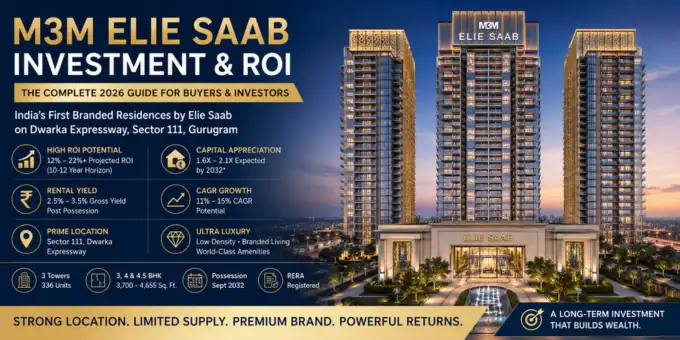
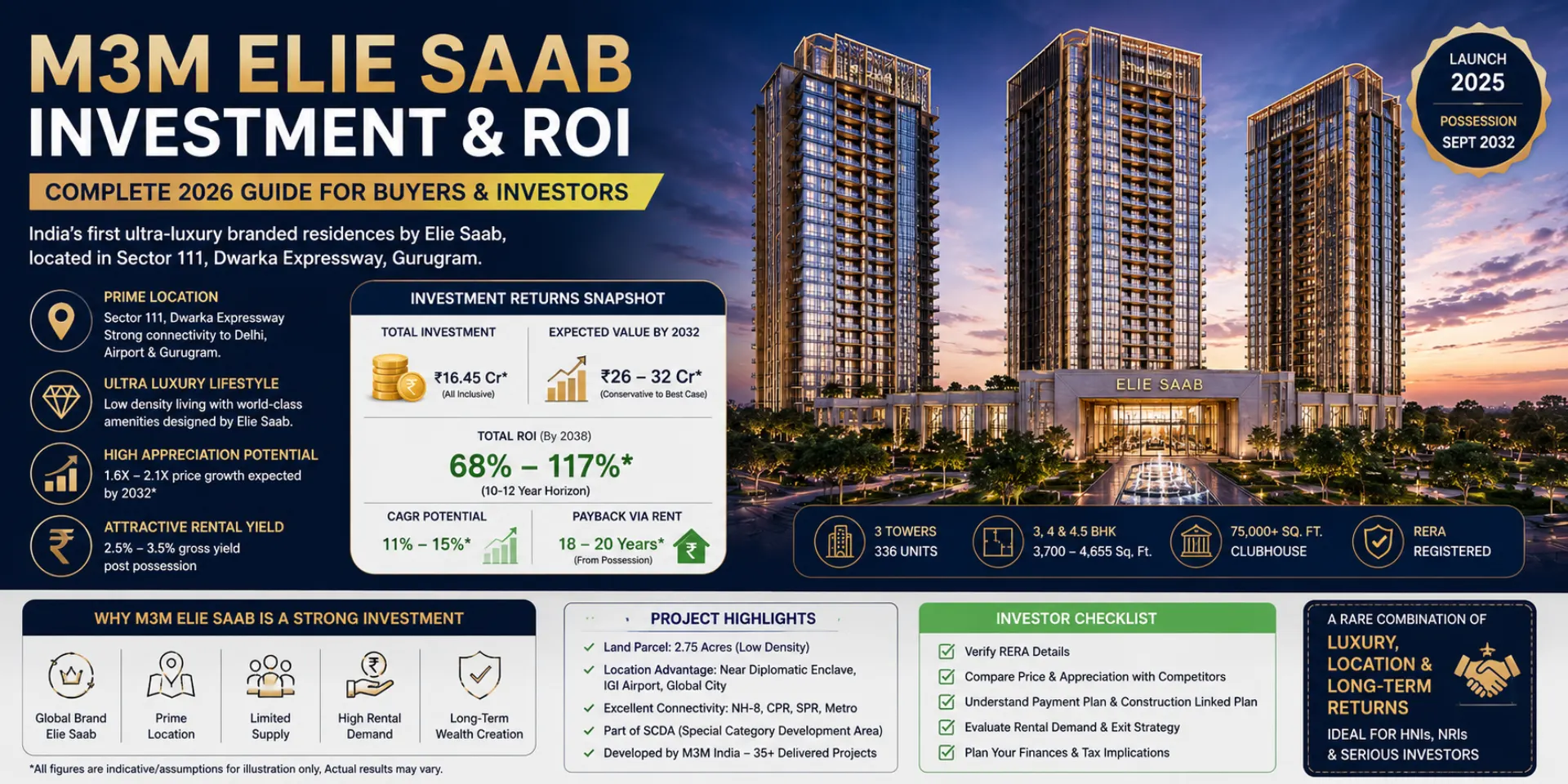
M3M Elie Saab is an ultra-luxury residential project by M3M India, developed in partnership with Elie Saab, the Lebanese couture house that's been around since 1982. It sits on 2.75 acres in Sector 111, Gurugram, right on the Dwarka Expressway, inside the SCDA (Special Category Development Area) zone, and it's spread across three towers with 336 units in total. Configurations run from 3 BHK and 4 BHK up to larger 4.5 BHK homes, with carpet areas reportedly between roughly 3,700 and 4,655 sq. ft., depending on which layout you're looking at.
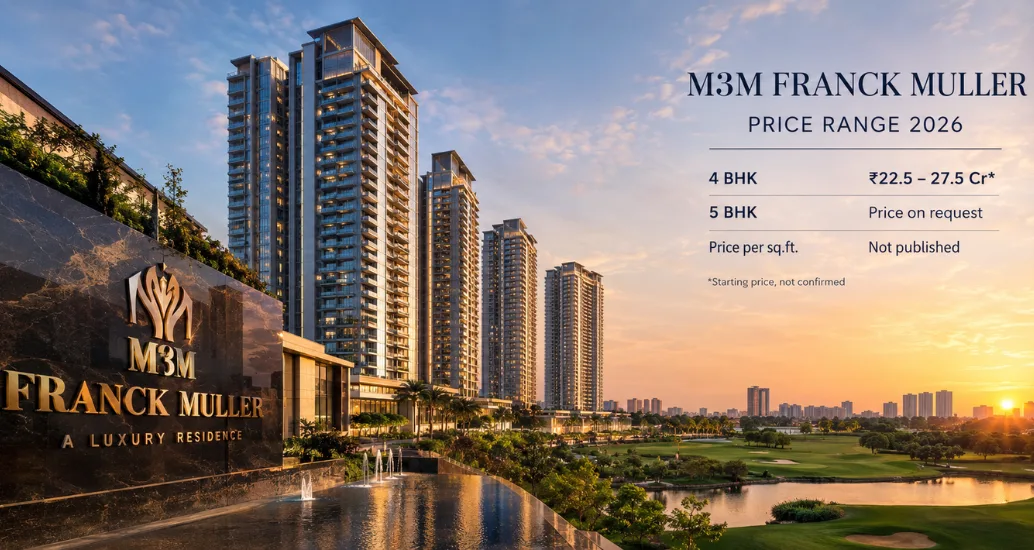
Current listings put the M3M Elie Saab price starting around ₹14–15.7 Cr, with per-square-foot rates hovering near ₹35,000, and most channel partners quote a construction-linked payment plan built roughly on a 30:40:30 split. The project launched sometime between October and December 2025 and carries Haryana RERA registration — though the exact registration number isn't identical across every listing portal, so it's worth cross-checking directly on the official Haryana RERA site before you book anything. Possession is set for September 2032, and that long runway needs to sit at the back of your mind for every return calculation that follows in this guide.
As for amenities, the brochure and master plan describe a roughly 75,000 sq. ft. clubhouse, a swimming pool, spa, gym, yoga and wellness areas, jogging and cycling tracks, kids' play zones, and landscaped gardens — a fairly standard list for this price bracket, though here it comes wrapped in Elie Saab's design language across the lobbies, facades, and common areas.
Who Is the Builder Behind M3M Elie Saab?
M3M India is one of the more established names in Gurgaon, with more than 35 delivered projects behind it, including M3M Golf Estate, M3M Polo Suites, and the recently completed Trump Towers Gurugram. On a project with an eight-year construction timeline, a developer's track record on delivery often tells you more than anything printed in a brochure ever will.
Why Invest in M3M Elie Saab?
The investment case for M3M Elie Saab rests on three things overlapping at once: a genuinely branded product in a category India barely has yet, a low-density footprint of just 336 units across 2.75 acres, and a location that sits almost exactly where Delhi meets Gurgaon. Whether that adds up to a good investment for you specifically depends on your time horizon, how much liquidity you can afford to lock away, and your comfort with holding through a multi-year build. This is a project built for people thinking in decades, not quarters — and the numbers further down make that pretty clear.
Scarcity by Design
336 units across 2.75 acres is genuinely low density. A typical Gurgaon high-rise crams a thousand-plus units into a similar or even smaller footprint, so exclusivity isn't a marketing add-on here — it's central to the whole pitch. Fewer units usually means fewer competing sellers when resale season arrives, which tends to work in an owner's favour once the branded-residence category matures locally.
M3M Elie Saab Investment & ROI Analysis
What Is ROI in Real Estate, and How Does It Apply Here?
Return on Investment measures total gain relative to what you put in, and the formula stays simple:
ROI (%) = (Net Profit ÷ Total Investment) × 100
Net Profit is capital appreciation plus any rental income earned along the way, minus costs like stamp duty, maintenance, brokerage, and loan interest. For M3M Elie Saab, ROI plays out in two distinct stretches: a pre-possession phase (2026 to 2032) where returns come purely from appreciation because there's no rent yet, and a post-possession phase (from 2032 onward) where rental yield joins appreciation to form the full return. That split matters more than it sounds — you're effectively pricing in six and a half years with zero income before the asset earns anything, so the appreciation over that stretch has to work hard enough to make the wait worthwhile.
A Practical ROI Calculation: Worked Example
Numbers make all of this concrete, so here's one scenario. The inputs below are assumed for illustration only — this isn't a forecast, a projection, or a promise, and real outcomes will look different.
Assumptions:
- Purchase price: ₹15 Cr (4 BHK, ~4,285 sq. ft. at ~₹35,000/sq. ft.)
- Stamp duty + registration (Haryana, joint ownership): ~8% = ₹1.2 Cr
- Total upfront investment: ₹16.2 Cr
- Holding period: 10 years (2026 booking to 2036), with roughly the first 6.5 years pre-possession
- Assumed appreciation: 9% CAGR (average-case, explained further in the CAGR section)
- Post-possession rental income (years 7–10, i.e., 4 years): net yield of ~2.8% of purchase price annually
- Annual maintenance during the pre-rental years: ~₹4.5 lakh, borne by the owner
Step 1 — Capital appreciation: Future value = ₹15 Cr × (1.09)^10 ≈ ₹35.5 Cr
Appreciation gain = ₹35.5 Cr − ₹15 Cr = ₹20.5 Cr
Step 2 — Rental income (4 years post-possession): Net annual rent ≈ 2.8% × ₹15 Cr = ₹42 lakh
Over 4 years ≈ ₹1.68 Cr
Step 3 — Costs: Maintenance across the full 10 years (partly offset by rent once tenanted) ≈ ₹45 lakh Stamp duty already counted in total investment
Step 4 — Net Profit and ROI: Net Profit ≈ ₹20.5 Cr + ₹1.68 Cr − ₹0.45 Cr ≈ ₹21.7 Cr
ROI = (21.7 ÷ 16.2) × 100 ≈ 134% absolute return over 10 years Worked out as a blended CAGR on total capital deployed, that's roughly 8.5–9% per year.
This is one illustrative scenario built on assumed inputs — change the appreciation rate, the rental start date, or the holding period, and the whole outcome shifts. Use it as a framework to slot your own numbers into, not as a guarantee of what you'll actually get.
Best-Case, Average-Case, and Conservative ROI Scenarios
Since appreciation is the single biggest swing factor, a range is more honest than a single number. Same ₹15 Cr entry price, same 10-year hold:
| Scenario | Assumed CAGR | Property Value After 10 Years | Approx. Absolute Gain |
| Conservative | 6% | ~₹26.9 Cr | ~₹11.9 Cr |
| Average / Base Case | 9% | ~₹35.5 Cr | ~₹20.5 Cr |
| Best Case | 12% | ~₹46.6 Cr | ~₹31.6 Cr |
The conservative case bakes in infrastructure delays and a slower luxury cycle. The average case is a moderated read of the 10–12% historical growth reported for the broader Sector 111 micro-market. The best case assumes Global City and Diplomatic Enclave II land close to schedule and branded residences gain further traction across India. None of these are promises — they're planning tools, and a prudent buyer sizes their commitment around the conservative case, not the best one.
Capital Appreciation Potential
What Is Capital Appreciation and Why It Matters Here
Capital appreciation is simply the rise in a property's market value, separate from any rent it earns. For an under-construction luxury project like this one, it's the only return driver in the early years, since rental income only kicks in after possession. Independent property research platforms tracking Sector 111 have pointed to historical annual price growth in the 10–12% range for the broader micro-market, driven largely by the Dwarka Expressway going fully operational. That figure describes the locality's recent trend, not a guaranteed forecast for this specific project — and appreciation rarely moves in a straight line anyway. It tends to cluster around infrastructure milestones and flatten out in between.
Capital Appreciation Timeline: Launch to Possession and Beyond
- Launch phase (2025–2026): Prices sit at their lowest relative to the finished product, since early buyers are effectively compensating the developer for construction and delivery risk. This is usually where the best entry pricing shows up.
- Mid-construction phase (2027–2030): Most of the price movement in comparable Gurgaon launches has historically happened here, as construction becomes visible and surrounding infrastructure matures — the Dwarka Expressway's full activation and metro extension work both fall in this window.
- Pre-possession phase (2031–2032): Prices in similar projects tend to firm up as delivery gets closer and remaining risk shrinks, though overall market sentiment at the time still plays a role.
- Post-possession phase (2032 onward): Once handed over, the asset moves from a paper-appreciation play to a dual-return asset — rental income plus continued, usually steadier, appreciation.
M3M Elie Saab Future Price and Future Value Outlook
The future price will largely hinge on three things playing out close to plan: the Elie Saab brand holding its premium positioning in India, construction staying reasonably on schedule through 2032, and Sector 111's supporting infrastructure — the proposed metro extension linking Huda City Centre to Cyber City, the Global City economic hub, and the Diplomatic Enclave II — actually arriving on the timelines currently being discussed. If those land on time, the growth story strengthens considerably. If they slip, expect appreciation to be slower and steadier rather than dramatic.
M3M Elie Saab Resale Value: What Early Buyers Should Expect
Resale value for branded residences tends to hold up once a project is delivered and the brand earns a local reputation, mostly thanks to consistent facility management and a smaller, curated pool of buyers. As a reference point, DLF The Camellias on Golf Course Road — a very different, older, non-branded luxury project — reportedly launched around ₹25,000 per sq. ft. in 2010 and now resells between ₹40,000 and ₹80,000 per sq. ft., according to industry consultant reports. Converted into a compound annual growth rate, that range works out to roughly 3–8% CAGR over 15 years — not the "3-4x flat multiple" some marketing content likes to throw around. The multiple sounds dramatic, but the underlying yearly growth rate is a lot closer to what conservative-to-average investors should realistically expect. India doesn't yet have an equivalent long resale history for fashion-branded residences like Elie Saab specifically, so any resale projection here should be treated as an informed estimate, not a proven pattern.
Understanding CAGR in Long-Term Luxury Real Estate
CAGR smooths year-to-year volatility into one average annual growth figure. The formula:
CAGR = [(Ending Value ÷ Beginning Value)^(1 ÷ Number of Years)] − 1
It matters more than a simple appreciation percentage because property doesn't grow in equal yearly slices — it moves in bursts tied to infrastructure delivery and market cycles, then plateaus for a while. A property that doubled in 6 years grew at roughly 12.2% CAGR, while one that took 12 years to double grew at roughly 5.9% CAGR — same multiple, very different pace. So the next time you see a headline like "prices doubled in Sector 111," ask over how many years, and convert it to CAGR before comparing it against something like an equity or debt fund.
Pre-Possession vs Post-Possession Investment Returns
These two phases are worth separating explicitly, because they really do behave like different asset classes.
Pre-possession (2026–2032): Returns come entirely from appreciation on paper, visible mostly through resale listings and secondary-market activity in Sector 111 rather than actual transactions on your unit. There's no rental income, no depreciation benefit, and limited liquidity — selling before possession usually means transferring the buyer's agreement, which can involve developer transfer charges and a much smaller pool of interested buyers.
Post-possession (2032 onward): The asset turns fully liquid and income-generating. Rental yield kicks in, mortgaging becomes easier, and resale comparables get far more reliable since actual transacted prices — not just under-construction listings — start setting the benchmark. Most of the "wealth creation" story for branded residences plays out here, not in the pre-possession phase, which is exactly why patience matters so much on a project with this timeline.
Rental Yield & Rental Income Potential
What Is Rental Yield and How Does It Work?
Rental yield is the annual rental income a property generates, expressed as a percentage of its value.
Gross Rental Yield vs Net Rental Yield
Gross Rental Yield (%) = (Annual Rental Income ÷ Property Purchase Price) × 100
Net Rental Yield (%) = [(Annual Rental Income − Annual Expenses) ÷ Property Purchase Price] × 100
Annual expenses typically cover maintenance charges, property tax, insurance, and periodic repairs — brokerage and vacancy losses can be folded in too, for a more realistic picture.
Worked example on a ₹15 Cr unit:
Assume monthly rent of ₹4 lakh (₹48 lakh a year), broadly in line with what branded and premium addresses on Dwarka Expressway have reportedly commanded from corporate and expat tenants.
- Gross Rental Yield = (₹48,00,000 ÷ ₹15,00,00,000) × 100 = 3.2%
- Annual expenses (maintenance ~₹4.5L + property tax ~₹1L + insurance/repairs ~₹1L) = ₹6.5L
- Net Rental Yield = [(₹48,00,000 − ₹6,50,000) ÷ ₹15,00,00,000] × 100 = 2.77%
That roughly 0.4-percentage-point gap between gross and net is exactly why "up to 4% yield" figures quoted by portals should be read as gross numbers unless stated otherwise. Net yield is what actually lands in your account.
M3M Elie Saab Rental Yield: What to Expect
Property research platforms have positioned branded residences in this micro-market for rental yields up to around 4% gross, on the strength of expected demand from expats, diplomats, and senior corporate tenants who tend to prefer branded, low-density addresses over generic high-rises. Broader Gurgaon data backs this up too — industry trackers place Dwarka Expressway's emerging-premium segment at roughly 3.2–4.0% gross yield, against 2.0–2.8% for the older ultra-prime Golf Course Road belt and 2.8–3.5% for Golf Course Extension Road. That's a reasonable yield band for ultra-luxury Gurgaon real estate, though meaningful rental income only starts once the towers are ready in 2032 — this is a long-horizon income play, not a near-term cash flow source.
M3M Elie Saab Rental Demand: Who Will Actually Rent Here?
Given the location — 7–10 minutes from IGI Airport's Terminal 3, close to Cyber City and Udyog Vihar, and near the upcoming Diplomatic Enclave II — the expected tenant profile leans toward corporate leadership, diplomatic staff, and professionals who travel frequently. That's generally a more stable, higher-paying tenant category than the typical mid-segment rental pool, though it's also a smaller pool, which means marketing and tenant search for a branded ultra-luxury unit can take longer than it would for a standard apartment.
Rental Income Projection: Occupancy Scenarios
Yield calculations usually assume full-year occupancy, which rarely happens in practice, especially in a niche ultra-luxury segment with a limited tenant base. Applying different occupancy assumptions to the ₹48 lakh annual rent figure above:
| Occupancy Level | Effective Annual Rent | Gross Yield on ₹15 Cr |
|---|---|---|
| 90% (strong demand, minimal vacancy) | ₹43.2 lakh | 2.88% |
| 75% (moderate demand, typical vacancy gaps) | ₹36 lakh | 2.4% |
| 60% (slow leasing, longer search periods) | ₹28.8 lakh | 1.92% |
Which is why the "up to 4% yield" figure quoted by portals should be read as a best-case, fully-occupied scenario. A realistic underwriting approach budgets for at least one to two months of vacancy a year between tenants, even for a strong branded address.
Factors That Affect Rental Yield
A handful of variables push actual yield up or down from the headline figure: vacancy periods between tenants, which run longer for niche ultra-luxury units simply because the buyer pool is smaller; maintenance charges, which in branded projects tend to run higher than standard societies because of premium facility management; furnishing status, since a fully furnished, move-in-ready unit commands a rent premium over a bare shell but needs more upfront capital; tenant profile, where corporate leases through relocation agencies tend to bring longer lock-ins and more reliable payment than individual tenants; and overall market demand, which tracks how many multinational companies and diplomatic postings are actively expanding across the NCR at any given time.
Passive Income and Cash Flow: Setting Realistic Expectations
If passive income is the main reason you're considering M3M Elie Saab, it helps to be clear-eyed about the timeline: roughly seven years of zero rental cash flow before possession, followed by an estimated net yield in the 2.5–3% range once tenanted, assuming reasonable occupancy. That can still fit well within a long-term wealth creation plan, but it shouldn't be mistaken for an immediate income-generating asset. If near-term cash flow is the actual priority, a ready-to-move property in an established Gurgaon micro-market will usually serve that goal better.
M3M Elie Saab Price List, Floor Plan & Payment Plan
Pricing here reflects the brand premium about as much as it reflects the location. At approximately ₹35,000 per sq. ft. and unit sizes starting near 3,700 sq. ft., total ticket sizes cross ₹14 Cr even at the entry configuration. The floor plan is built around zero-wastage layouts, high ceilings — reportedly up to 12 feet in some configurations — private elevator lobbies, and large windows for natural light. Fairly standard for this price bracket, though well-executed here based on available brochure details.
For the payment plan, most sources point to a construction-linked structure, commonly cited as roughly 30:40:30 across booking, construction milestones, and possession. It's always worth requesting the latest official price list and payment schedule directly from the developer or an authorised channel partner, since promotional pricing and early-bird offers shift between launch phases.
Explore our detailed M3M Elie Saab Price guide to check the latest price list, cost sheet, payment plan, PLC charges, GST, and complete pricing details before making your investment decision.
How M3M Elie Saab Compares: Rental Yield & ROI vs Other Luxury Projects
Buyers evaluating M3M Elie Saab typically shortlist it against a handful of other branded or ultra-luxury Gurgaon addresses. The figures below come from industry and consultant reporting rather than verified transaction data, so treat them as directional and confirm current numbers with a local broker before deciding anything.
| Project | Location | Approx. Entry Price (psf) | Positioning | Reported Rental Range |
| M3M Elie Saab | Sector 111, Dwarka Expressway | ~₹35,000 | Fashion-branded, low-density (336 units) | Gross yield estimated up to ~4% |
| M3M St. Andrews | Sector 113, Dwarka Expressway | Comparable premium band | Golf-integrated, mixed-use "megapolis" | Similar Dwarka Expressway yield band |
| Trump Towers Gurugram | Sector 65, Golf Course Ext. Road | Ultra-luxury premium | Global hospitality-branded, delivered | Reportedly ₹2.5–3 lakh/month for select units |
| DLF The Camellias | Sector 42, Golf Course Road | Reported ₹40,000–1,00,000+ (resale) | Non-branded, developer-luxury, delivered | Ultra-prime segment yield ~2.0–2.8% |
| Smartworld One DXP | Dwarka Expressway | Premium-luxury band | Developer-luxury, newer entrant | Emerging premium yield band ~3.2–4.0% |
| Sobha Altus | Sector 106, Gurgaon | Premium-luxury band | Developer-luxury, backward-integrated builder | Broadly comparable to premium Gurgaon segment |
The pattern worth flagging: branded residences — Elie Saab, Trump Towers, and increasingly newer entrants on the Noida Expressway — tend to carry a reported 25–30% resale premium over standard developer-luxury projects, per industry consultant analysis, largely on account of the smaller, curated buyer pool and consistent global-standard facility management. Whether that premium holds up for Elie Saab specifically depends on how the fashion-branded category performs through its first full delivery cycle, since it doesn't yet have India-specific resale history the way Trump-branded or DLF projects do.
Location-Based Investment Comparison: Sector 111 vs Other Gurgaon Micro-Markets
Location drives yield and appreciation potential more than almost anything else on this list. Here's how the relevant corridors stack up, based on aggregated industry yield tracking:
| Micro-Market | Positioning | Typical Gross Rental Yield | Appreciation Character |
| Golf Course Road (Sector 42/54) | Ultra-prime, established, low new supply | ~2.0–2.8% | Slower, steadier; highest absolute prices; best resale liquidity at the top end |
| Golf Course Extension Road (Sectors 58–67) | Premium, strong leasing depth | ~2.8–3.5% | Moderate, consistent appreciation |
| Southern Peripheral Road (SPR) | Mid-to-premium, still developing | Broadly comparable to premium band | Growth tied to ongoing infrastructure completion |
| Dwarka Expressway (Sector 111/113, incl. M3M Elie Saab) | Emerging premium, newest supply wave | ~3.2–4.0% | Highest reported micro-market growth (10–12% annually), infrastructure-dependent |
| Sector 113 (M3M St. Andrews) | Emerging premium, mixed-use format | Similar Dwarka Expressway band | Similar to Sector 111, different lifestyle format |
The takeaway here is fairly simple: Dwarka Expressway currently offers the strongest combination of yield and reported appreciation among these corridors, precisely because it's the newest and least developed of the group. The flip side is that its infrastructure story still has to fully play out, unlike Golf Course Road, which has already matured.
Location Advantage & Infrastructure Growth
Sector 111 Growth Story
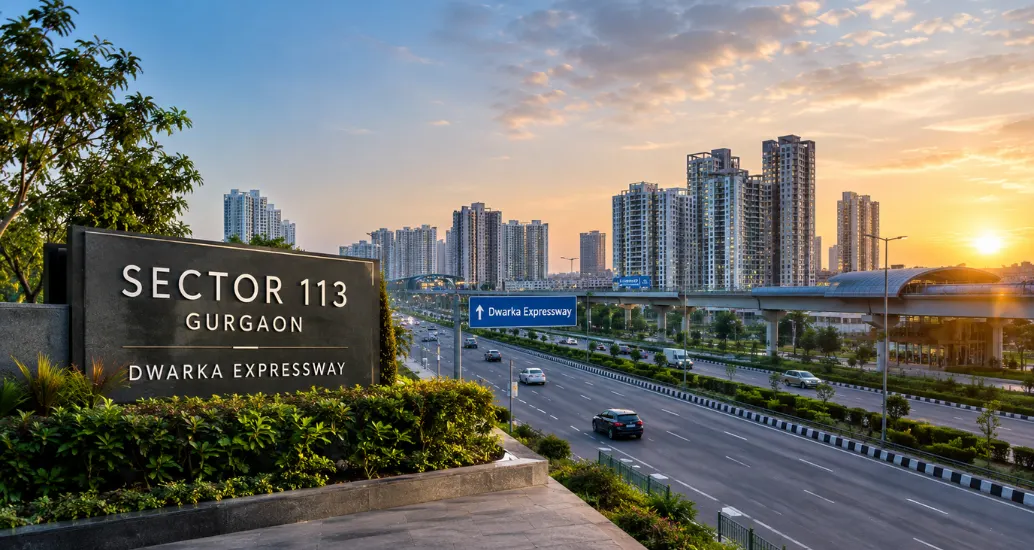
Sector 111 has quietly turned into one of Gurgaon's more talked-about luxury addresses, sometimes described informally as the zero-kilometre point between Delhi and Gurgaon. A handful of residential projects already sit here, and the area benefits from proximity to established social infrastructure — Manipal Hospital in Palam Vihar, Global Foyer Mall, and The NorthCap University are all a comfortable drive away. Investor scorecards from portals like 99acres generally rate Sector 111 as a mid-to-strong investment zone rather than a purely speculative one.
Dwarka Expressway Impact on Property Value
The 150-metre-wide Dwarka Expressway has fundamentally reshaped how this part of Gurgaon connects to Delhi. A commute that used to be congested and unpredictable is now a much faster corridor linking South Delhi directly to Sector 111 and beyond. Arguably, this single piece of infrastructure is the biggest reason property values along this belt have moved the way they have — and it remains the anchor argument behind the entire M3M Elie Saab investment and ROI story.
SCDA Development Impact
M3M Elie Saab falls within the SCDA zone, which usually brings more structured planning norms, better open-space ratios, and a more curated skyline compared to standard sector development. Sitting inside this zone alongside other planned luxury developments suggests Sector 111 is being built out as a coordinated high-end enclave rather than a piecemeal one — a factor that tends to support long-term value retention.
Connectivity: IGI Airport, Delhi-Gurgaon Border, and Beyond
Beyond the airport link, the location gives reasonably quick access to Cyber City and Udyog Vihar for business travel, and sits close to the Yashobhoomi convention centre, which is expected to bring steady corporate and diplomatic footfall to the surrounding area. For NRI buyers and frequent international travellers, this level of connectivity often ends up mattering more than anything printed on the amenities page.
How Each Infrastructure Project Could Influence Future Appreciation
Not every upcoming project carries equal weight here. The metro extension linking Huda City Centre to Cyber City would meaningfully improve daily commute options and tends to have the broadest impact on end-user demand. The Global City economic hub, if it lands close to its stated scope, could pull in commercial and residential demand at the same time — historically, that combination has a stronger multiplier effect on nearby residential prices than residential-only developments manage on their own. The Diplomatic Enclave II is more of a niche driver; it mainly supports the rental demand thesis through diplomatic tenants rather than broad-based capital appreciation. Investors should track construction progress on these three specifically, since delays here are the single biggest variable in whether the "average case" or "conservative case" scenario above ends up playing out.
Luxury Real Estate Demand in Gurgaon
Gurgaon's broader luxury housing market has been on a genuine upswing, with limited-inventory, branded, and design-led projects commanding a clear premium over generic high-rises. Demand at this level tends to be less price-sensitive and more focused on exclusivity, privacy, and brand association. Luxury demand is also more cyclical than mid-segment housing — it reacts faster to shifts in liquidity, interest rates, and stock market sentiment among high-net-worth buyers — so tracking the broader economic mood matters nearly as much as tracking the project itself.
Market Demand for Branded Residences: Future Outlook
Branded residences are still a small but fast-growing category across the NCR. Beyond M3M Elie Saab, similarly branded projects have started appearing along the Noida Expressway too, which itself signals that developers see sustained appetite for this format among India's growing HNI and NRI buyer base. If that trend holds, early entrants like M3M Elie Saab benefit from being part of a smaller, first-mover pool before supply catches up — though more branded competition down the line could also cap how much premium pricing power any single project keeps long-term.
Branded Residences and Their Investment Value
What Is a Branded Residence?
A branded residence is a residential development co-created or licensed with a recognised global brand — often a hotel chain, fashion house, or luxury lifestyle name — that lends its design standards, service protocols, and brand equity to the project. Buyers here aren't just purchasing square footage; they're buying into consistency, curation, and an association that matters to a specific class of buyer and tenant.
Why Branded Residences Often Appreciate Faster — And Will the Premium Sustain?
Globally, branded residences have frequently commanded a resale premium over comparable unbranded stock — industry consultant estimates put this at roughly 25–30% in the Indian context — largely because of consistent facility management standards and a smaller, curated buyer pool competing for limited inventory. Whether that premium sustains for M3M Elie Saab specifically comes down to execution: if the property is managed to the standard the Elie Saab name implies, the premium tends to hold or even grow; if maintenance quality slips after handover, as has happened with some branded projects internationally once the initial marketing push fades, the premium can compress faster than the base market corrects. This is a genuine variable, not a formality — worth asking the developer directly how facility management will be structured after possession.
NRI Investment Perspective
For NRIs, branded residences like M3M Elie Saab often carry extra appeal simply because the brand name gives an easy reference point and a level of confidence even without frequent site visits. The airport connectivity matters practically too — a home 7–10 minutes from Terminal 3 is genuinely convenient for someone flying in only a few times a year. Before investing, NRI buyers should factor in FEMA regulations governing property purchase, repatriation rules for rental income and resale proceeds, and applicable TDS norms — ideally with guidance from a chartered accountant who specialises in NRI real estate transactions, since these rules get updated periodically and are easy to misread from abroad.
Investment Suitability by Buyer Type
| Buyer Type | Suitability | Why |
| High-Net-Worth Individuals (HNIs) | Strong fit | Capital isn't a constraint; long holding period aligns with existing wealth-management strategy |
| NRI Buyers | Strong fit | Brand recognition simplifies remote decision-making; airport proximity is genuinely useful |
| End Users (self-use) | Good fit, if 2032 timeline works for their housing plans | Design quality and low density suit long-term family living, but not immediate move-in needs |
| Long-Term Investors (8–10 year horizon) | Strong fit | Aligns with the pre/post-possession return structure discussed above |
| Rental Income Investors (near-term) | Weak fit | No rental income until 2032; better served by ready-to-move premium stock |
| Wealth Preservation Buyers | Moderate-to-strong fit | Low-density, branded assets have historically preserved value well in mature markets, though this project lacks a long local track record |
Ideal Investment Horizon: 5 Years, 10 Years, and Post-Possession Holding
A 5-year horizon (roughly 2026–2031) only captures the pre-possession appreciation phase, with no rental income and comparatively lower liquidity — suited only to investors comfortable exiting via resale of the under-construction agreement, often to a smaller pool of buyers and possibly at a negotiated discount. A 10-year horizon (through 2036, as modelled in the ROI example above) captures roughly four years of stabilised rental income on top of the appreciation curve, and is the horizon this project's timeline is best suited to. Beyond that, a post-possession holding strategy — buying now, holding through completion, then holding a further 5–10 years as a rental-generating asset — is where the branded-residence thesis has historically paid off best in mature international markets, since both facility reputation and resale comparables tend to strengthen the longer a well-managed branded project stays on the ground.
Exit Strategy: When and How to Sell
Resale before possession: This usually means transferring the buyer's agreement to a new purchaser, which typically involves developer transfer charges and a much smaller buyer pool than a fully delivered property offers. Pricing power is weaker here, and it's generally the least favourable exit route unless there's a specific financial need pushing it.
Resale after possession: Once delivered, the property becomes a conventional resale transaction with proper title transfer, and comparables get far more reliable since actual transacted prices exist. This is typically the stronger exit point, especially once the project has a few years of stabilised occupancy and a visible facility-management track record behind it.
Long-term holding: Given the appreciation curve modelled earlier — where most of the CAGR benefit compounds over 8–10+ years rather than the first few — holding well beyond possession, instead of selling right at handover, is generally the strategy most aligned with how branded residences have historically built value elsewhere.
Property Liquidity in the Ultra-Luxury Segment
Liquidity is the honest limitation of this asset class. High-ticket properties have a smaller buyer pool by definition — most buyers simply can't write a ₹15 Cr cheque, which narrows the market considerably compared to a mid-segment apartment. In practice, ultra-luxury resale in Gurgaon can take anywhere from several months to over a year to find the right buyer at the right price, especially for a newer branded category without an established secondary market yet. This isn't unique to M3M Elie Saab — it's structural to the entire ₹10 Cr-plus segment across Gurgaon — but it's a real trade-off buyers should size their overall portfolio liquidity around, rather than assuming this asset can be turned into cash quickly if needed.
Long-Term Investment Potential and Portfolio Fit
Building Wealth Through Long-Horizon Real Estate and Portfolio Diversification
Wealth creation through real estate compounds over long holding periods, and this project's own timeline more or less forces that discipline onto the buyer. Viewed as one piece within a broader real estate portfolio — sitting alongside more liquid, income-generating properties — it can serve a specific role: a long-duration, appreciation-focused holding rather than a primary source of near-term cash flow. For investors already holding equities, debt instruments, or commercial real estate, adding a low-correlation, branded residential asset can improve overall portfolio diversification, as long as it doesn't crowd out liquidity elsewhere.
Real Estate as an Inflation Hedge and Long-Term Wealth Preservation Asset
Property has historically functioned as a reasonable inflation hedge, since replacement construction costs and land values tend to rise alongside broader price levels over long periods. Branded, low-density luxury assets like this one add a layer of additional appreciation potential on top of that base inflation-linked growth, provided the brand and location narratives play out as expected. This is a historical tendency, not a mathematical certainty, and shouldn't be the sole reason to invest — but as a piece of long-term wealth preservation, and even a legacy asset passed across generations, low-density branded real estate has a reasonably strong international track record.
Financial Planning Considerations
Before committing, it's worth running the full financial picture rather than just the headline price. On down payment, most construction-linked plans require 30% at booking — roughly ₹4.2–4.7 Cr on a ₹14–15.7 Cr unit — which is a substantial capital lock-in before a bank loan even enters the picture. On loan eligibility, banks typically fund 75–80% of a property's value for a salaried or well-documented HNI borrower, but at ticket sizes this large, lenders scrutinise income stability and existing liabilities closely, so pre-approval before booking is worth the effort. On EMI impact, a large loan on a ₹10–12 Cr disbursed amount at current housing loan rates can translate into a monthly outflow running into several lakhs, so it's worth stress-testing that EMI against your income even under a higher-rate scenario, not just today's rate. Holding costs — maintenance, property tax, insurance — continue through the entire pre-possession period with zero offsetting income, and opportunity cost deserves equal weight: the same ₹15–16 Cr deployed in equities or debt instruments over the same 6.5-year pre-possession window would itself generate a return, which is the real benchmark your property appreciation needs to beat, not just "zero."
Tax Implications for M3M Elie Saab Buyers
Tax rules shift periodically, so treat what follows as a general framework and verify current rates with a chartered accountant before transacting. On GST, under-construction non-affordable housing typically attracts 5% GST without input tax credit, payable on the construction-linked instalments; this doesn't apply once the project receives its completion certificate. On stamp duty and registration, Haryana currently charges roughly 7% for male buyers, 5% for female buyers, and 6% for joint ownership, plus about 1% registration charges — choosing joint or female ownership can meaningfully cut this one-time cost on a ticket size this large. On capital gains tax, current rules broadly separate short-term gains (property held under 24 months, taxed at the applicable income slab rate) from long-term gains (held 24 months or more), with recent policy changes affecting whether indexation benefits apply — this is an area where rules have shifted in the last couple of years, so specific current rates need confirming with a tax professional rather than assuming from general knowledge. On rental income taxation, rent received is taxable under "income from house property," with a standard deduction typically available before arriving at taxable income. For NRI sellers specifically, TDS under Section 195 gets deducted by the buyer at the time of sale on capital gains, generally at a materially higher rate than for resident sellers, which makes a lower-deduction certificate from the tax department worth pursuing in advance if a future sale is on the cards. None of this replaces professional advice — get it before you sign, not after.
Investment Risks and How to Mitigate Them
Long construction timeline (possession September 2032): Verify the developer's delivery track record on comparable large projects, check construction-linked payment milestones against actual progress through periodic site visits, and build a financial plan that doesn't depend on this specific rental income arriving on schedule.
Premium entry pricing (~₹35,000 psf): Compare per-square-foot pricing against at least two or three other Dwarka Expressway luxury launches before booking, and negotiate early-mover pricing or payment-plan concessions where possible.
Thin resale history for branded residences in India: Treat this as a long-hold asset rather than a short-term flip, and track how Trump Towers Gurugram's post-delivery resale market performs, since it's the closest local precedent for a global-branded residence.
Infrastructure dependency (Global City, Diplomatic Enclave II, metro extension): Track official project status updates rather than developer marketing material, and discount your appreciation assumptions toward the conservative-case scenario until these projects show visible construction progress.
Market cyclicality in ultra-luxury housing: Avoid over-leveraging — a lower loan-to-value ratio reduces the risk of a forced sale during a down cycle, which is exactly when ultra-luxury assets are hardest to liquidate at fair value.
Liquidity constraints: Make sure this purchase doesn't end up as an outsized share of your overall liquid net worth, so you're never forced into a distressed sale.
Investment Tips and Checklist Before Buying M3M Elie Saab
Before committing, a few basic steps rarely get skipped by experienced buyers. Verify the RERA registration number directly on the Haryana RERA website rather than trusting a single listing portal, since the figures vary across sources. Ask for the exact payment plan in writing, and get clarity on how each tranche ties to specific construction milestones rather than calendar dates. Compare per-square-foot pricing against at least two or three other Dwarka Expressway luxury launches — including nearby options like M3M St. Andrews in Sector 113 — so you know where Elie Saab sits on the price spectrum. Run the full financial-planning and tax picture covered above before signing anything, not after. And factor in the full holding cost through possession — maintenance, loan interest if financed, and the opportunity cost of capital tied up until 2032 — not just the headline purchase price.
M3M Elie Saab vs Other Dwarka Expressway Luxury Projects
Buyers often compare M3M Elie Saab against M3M St. Andrews in Sector 113, a few minutes away on the same Dwarka Expressway stretch. The two rest on fairly different premises: Sector 111 (Elie Saab) is positioned as a private, low-density enclave built around brand exclusivity, while Sector 113 (St. Andrews) leans into a more dynamic, mixed-use format with an integrated golf course and retail component. Both share the near-zero-kilometre-from-Delhi positioning, but the right pick really depends on whether privacy and brand cachet matter more to you than an active, amenity-dense lifestyle setting.
Final Investment Conclusion: Is M3M Elie Saab Worth Buying?
Pulling every thread together: the ROI potential here is genuinely above-average for the Gurgaon market on a 10-year view, supported by a reported 10–12% historical appreciation trend in Sector 111 and a modelled base-case CAGR of roughly 8–9% once rental income joins the picture post-2032. The rental outlook is respectable rather than spectacular — a gross yield in the 3–4% range, closer to 2.5–3% net, arriving only after possession. Appreciation potential is above-average but infrastructure-dependent, hinging on the Global City, Diplomatic Enclave II, and metro extension actually being delivered close to schedule. The risks are real and specific too: a long construction runway, a meaningful brand premium already baked into the entry price, thin local resale history for this category, and the structural illiquidity that comes with any ₹10 Cr-plus asset.
The ideal buyer here is patient, well-capitalised, and thinking in eight-to-ten-year cycles rather than three-to-five — an HNI, NRI, or long-term wealth-preservation investor comfortable holding through a multi-year build before the asset starts earning. If that description fits you, and you've independently verified the RERA status, current price list, and payment terms, M3M Elie Saab deserves serious consideration as a long-horizon addition to a real estate portfolio. If you need liquidity or income within the next few years, though, this specific project is very likely not the right fit — no matter how compelling the brand story sounds.
 Sumit Mishra / Property Counselor
You Must Read:
 Other
Other