


arrow_backBack to Blog
Residential
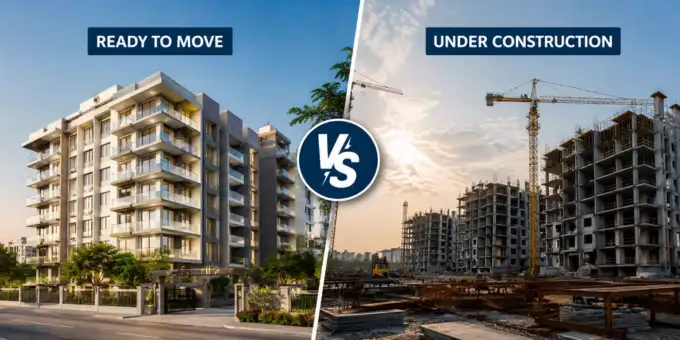
Ready to Move vs Under Construction Property | Full Comparison
Choosing between a ready to move property and an under construction property usually comes down to one question: do you value certainty, or are you willing to wait for something better priced? Both paths lead to a home, but the journey looks completely different.
This guide compares ready to move property and under construction property across price, timeline, risk, and buyer suitability, so you can match the choice to your own situation rather than someone else's.
What is a Ready to Move Property?
A ready to move property is a home that's fully built, has received its completion certificate, and is available for immediate occupancy. What you see during your site visit is exactly what you get at handover.
There's no waiting period, no construction risk, and no dependency on a builder finishing on schedule. You inspect the actual flat, not a sample unit or a floor plan, and you move in as soon as the paperwork is done.
This certainty is the single biggest reason buyers lean toward ready to move homes, especially when relocation timelines or family circumstances don't allow for flexibility.
What is an Under Construction Property?
An under construction property is a home that's still being built, sold at a stage before completion, sometimes as early as the foundation stage and sometimes closer to finishing touches. You're buying based on a floor plan, a sample flat, and a promised delivery date.
The appeal here isn't the finished product; it's the price and the payment structure. Under construction homes are typically priced lower than a completed unit of similar size and location, and payments are usually spread across construction milestones rather than paid upfront.
The trade-off is straightforward: you accept a waiting period and some uncertainty about final delivery in exchange for a lower entry cost and more manageable payment timing.
Ready to Move vs Under Construction Property: Key Differences
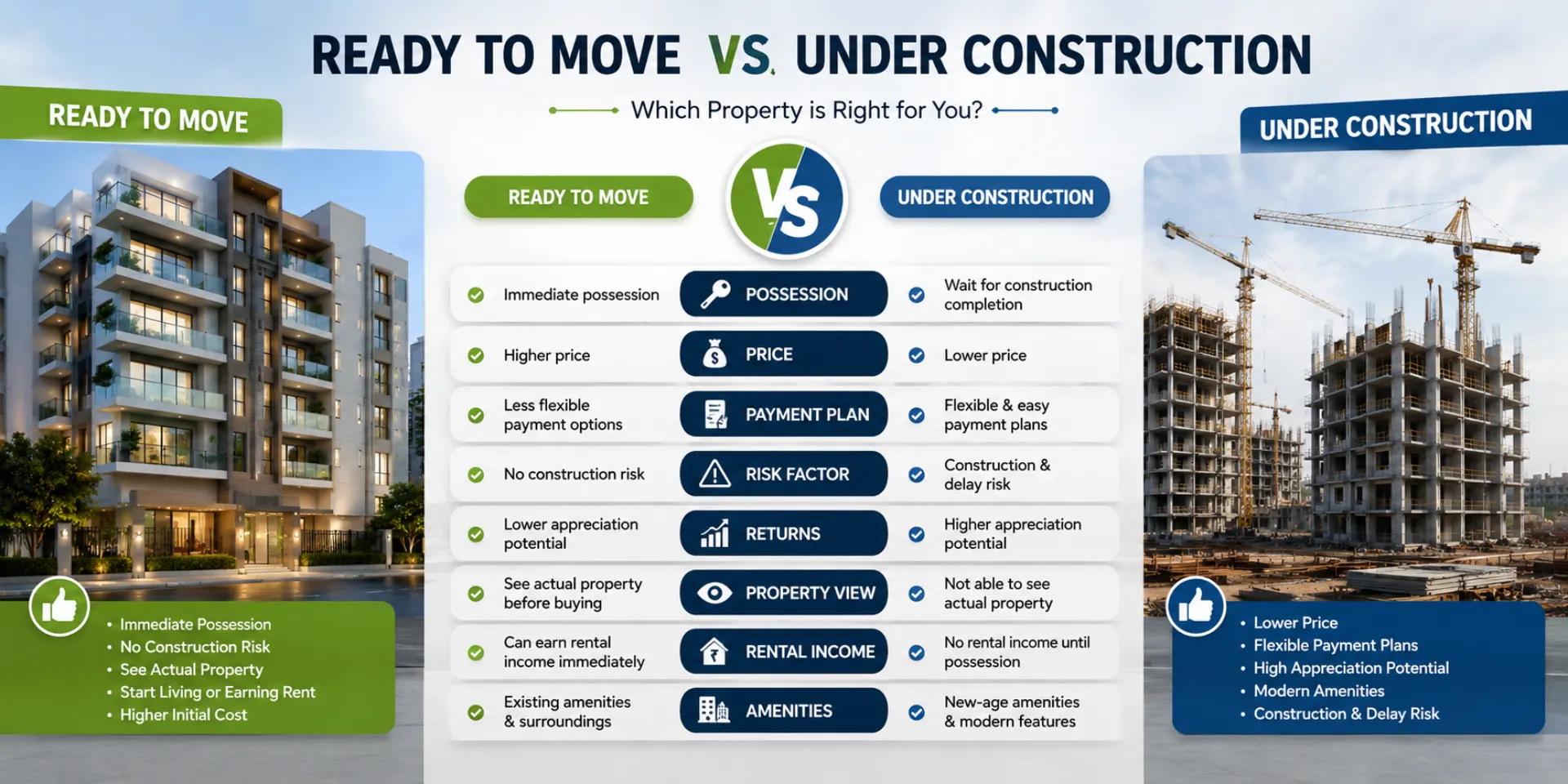
The core difference isn't just about waiting time. It touches pricing, risk, customisation, and even how the property looks when you first walk in.
| Factor | Ready to Move Property | Under Construction Property |
| Possession | Immediate | After construction completes |
| Pricing | Generally higher | Generally lower |
| Payment structure | Mostly lump sum or short-term | Spread across construction stages |
| Physical inspection | Actual unit, fully visible | Sample flat or floor plan only |
| Construction risk | None | Present, varies by builder |
| Customisation scope | Little to none | Sometimes possible in early stages |
| Waiting period | None | Months to years |
Neither option is universally better. What matters is which set of trade-offs suits your timeline, budget, and risk tolerance.
Price Comparison
Under construction properties are almost always priced lower than a ready to move unit of comparable size and specification. Builders price this way because early buyers are effectively funding construction and taking on timeline risk.
Ready to move properties carry a price premium because that risk has already been removed. You're paying for certainty as much as you're paying for the physical structure.
This price gap tends to narrow as an under construction project nears completion. A project that's 90% complete often prices closer to a ready to move unit than one that's just broken ground.
For a buyer working with a fixed budget, this gap can be the deciding factor. A slightly lower price on an under construction home can open up a larger unit or a better configuration that a ready to move budget wouldn't stretch to.
Possession Timeline Comparison
Ready to move property offers a possession timeline of essentially zero — you can occupy the home as soon as documentation is complete. There's no dependency on external factors once the sale is finalised.
Under construction property possession depends entirely on the builder's construction schedule. Promised delivery dates can hold, or they can slip due to labour availability, material supply, weather, or approval delays.
This is the single most practical difference between the two options. If your need for a home is immediate — a job relocation, a growing family, an expiring rental lease — an under construction property introduces a timeline risk that a ready to move home simply doesn't carry.
Construction Status Comparison
With a ready to move property, construction status isn't a variable at all — the building is complete, tested, and occupied or ready for occupation. There's nothing left to monitor.
With an under construction property, construction status is something a buyer needs to actively track. Progress can be checked through site visits, progress photographs, or update reports the builder shares periodically.
Buyers who choose under construction homes should treat construction monitoring as an ongoing responsibility, not a one-time check during booking. A project that looked on-track at the time of purchase can still face delays later.
Property Handover Comparison
Handover for a ready to move property is usually quick. Once you've completed your paperwork and payment, you receive keys, and the transition into the home is largely administrative.
Handover for an under construction property is a longer process. It typically includes a final inspection, addressing any snags or finishing issues, and formal completion documentation before keys are handed over.
Buyers of under construction homes should budget time for this handover phase rather than assuming keys arrive the moment construction visually looks complete. There's usually a gap between "looks finished" and "ready to hand over."
Ready to Move Property Advantages
- No waiting period. You move in as soon as the transaction closes, without depending on anyone else's construction schedule.
- What you see is what you get. You inspect the actual unit — its layout, finishing quality, natural light, and surroundings — rather than relying on a sample flat or a rendered image.
- No construction risk. There's no possibility of project delays, quality shortfalls during construction, or a builder failing to deliver as promised.
- Established surroundings. A completed property usually sits in a neighbourhood that already has functioning infrastructure and amenities, rather than one still being built out.
- Simpler decision-making. Since the product is finished, there's far less to evaluate on trust — you're judging a finished asset, not a promise.
Under Construction Property Advantages
- Lower entry price. Under construction homes typically cost less than an equivalent ready to move unit, making them more accessible on a limited budget.
- Staggered payments. Payments are usually linked to construction milestones, which spreads the financial commitment over time rather than requiring a lump sum upfront.
- Wider unit availability. Early-stage projects often have more configurations and floor choices available, since inventory hasn't been picked over yet.
- Possible customisation. Depending on the construction stage, some builders allow limited changes to layout, fittings, or finishes that aren't possible once a property is complete.
- Newer specifications. Under construction homes are often built to more current design standards, layouts, and material choices than older ready to move stock in the same area.
Ready to Move Property Disadvantages
- Higher price. The certainty of immediate possession comes at a cost — ready to move properties command a premium over comparable under construction options.
- Limited customisation. Since the property is already built, there's little to no room to modify layout or structural elements to personal preference.
- Payment timing. Buyers typically need to arrange a larger portion of funds upfront or within a shorter window, compared to the staggered payments of an under construction purchase.
- Older specifications. Some ready to move inventory, particularly older completed stock, may reflect design and layout standards that feel dated compared to newer launches.
Under Construction Property Disadvantages
- Timeline uncertainty. Delivery dates can shift, and buyers have limited control over construction pace once the purchase is made.
- No physical inspection of the actual unit. Buyers commit based on plans and sample flats, which don't always translate exactly to the finished product.
- Construction risk. Quality, finishing standards, and even project completion itself depend on the builder's execution, which varies significantly.
- Waiting period. Buyers with an immediate housing need may find the wait genuinely inconvenient, regardless of the price advantage.
- Ongoing monitoring required. Unlike a ready to move purchase, an under construction buyer needs to stay engaged with progress until handover, which takes time and attention.
Pros and Cons Comparison Table
| Ready to Move Property | Under Construction Property | |
| Pros | Immediate possession, no construction risk, actual unit inspection, simpler decision | Lower price, staggered payments, more configuration choices, newer specifications |
| Cons | Higher price, limited customisation, larger upfront payment, sometimes older stock | Timeline uncertainty, no physical inspection of final unit, ongoing monitoring needed, construction risk |
Which Property is Better for First-Time Buyers?
First-time buyers often benefit more from a ready to move property, mainly because it removes an entire category of decision-making: judging a builder's execution ability without prior experience to draw on.
For someone buying a home for the first time, being able to walk through the actual unit, evaluate real light and space, and move in without waiting reduces both financial and emotional uncertainty.
That said, first-time buyers with a tighter budget and no immediate possession need may still find an under construction property practical, provided they're comfortable tracking construction progress over an extended period.
Which Property is Better for Long-Term Buyers?
Buyers planning to hold a property for many years often have more flexibility to consider an under construction option, since a delivery delay of several months matters less within a long-term horizon.
Long-term buyers can also use the staggered payment structure of under construction properties to plan their finances more comfortably over time, rather than committing a large sum immediately.
For long-term buyers without urgency around possession, the lower entry price of an under construction property can represent meaningfully better value over the life of ownership.
Buyer Decision Matrix
| Your Situation | Better Fit |
| Need possession within a few months | Ready to Move Property |
| Working with a limited budget | Under Construction Property |
| Prefer staggered payments | Under Construction Property |
| Want to inspect the exact unit before buying | Ready to Move Property |
| Comfortable monitoring construction progress | Under Construction Property |
| Prioritise zero construction risk | Ready to Move Property |
| Looking for newer layouts and specifications | Under Construction Property |
| Relocating due to work or family need | Ready to Move Property |
Common Buying Mistakes
Choosing under construction purely for price, without checking delivery track record. A lower price means little if possession keeps getting pushed back year after year.
Assuming a sample flat perfectly represents the final unit. Finishing quality, fittings, and even layout details can differ between a sample flat and the actual delivered home.
Ignoring the true cost of waiting. Buyers sometimes underestimate the cost of continuing to rent or stay in a temporary arrangement while an under construction property is completed.
Skipping a physical inspection of a ready to move unit before finalising. Even completed properties should be walked through carefully — finishing quality and maintenance history still matter.
Not tracking construction progress consistently. Buyers who check in only at the time of booking and again near the promised delivery date often miss early warning signs of delay.
Comparing prices without comparing construction stage. An under construction unit at 20% completion and one at 90% completion aren't priced the same way, and shouldn't be compared as if they were.
Expert Buying Tips
Match the property type to your actual timeline, not your ideal one. If you need a home in the next few months, an under construction property with an uncertain delivery date isn't solving your problem, no matter how attractive the price looks.
Treat the waiting period as a real cost, not just an inconvenience. Factor in rent, temporary accommodation, or delayed lifestyle changes when comparing the lower price of an under construction home against a ready to move option.
For under construction purchases, ask specifically about the current construction stage rather than relying on a general timeline. "Nearing completion" and "just started" carry very different risk levels, even under the same project name.
For ready to move purchases, inspect the unit at different times of day if possible. Natural light, noise levels, and general upkeep can look different in the morning versus the evening.
Don't let payment structure alone drive the decision. A staggered payment plan feels easier month to month, but the total cost and the waiting period still need to work for your situation.
Keep your decision anchored to your own circumstances — family timeline, job stability, and comfort with uncertainty — rather than general market opinion about which option is "smarter."
Final Verdict
The ready to move vs under construction property decision isn't about which option is objectively superior — it's about which set of trade-offs matches your situation. Ready to move property offers certainty, immediate possession, and zero construction risk, at a higher price. Under construction property offers a lower price and flexible payments, in exchange for a waiting period and some dependency on the builder's execution.
Buyers with an immediate housing need are usually better served by a ready to move property. Buyers with budget constraints and flexibility on timing often find better value in an under construction property. Neither answer is right for everyone — only for the buyer whose circumstances it actually fits.
Frequently Asked Questions
What is the Difference Between Ready to Move and Under Construction Property?
The main differences are possession timing, pricing, payment structure, and construction risk — ready to move offers immediate, certain possession, while under construction offers lower pricing with a waiting period.
Which is Better, Ready to Move or Under Construction Property?
Neither is universally better; it depends on whether immediate possession or lower price and flexible payments matter more to the buyer.
Which Property is Better for First-Time Buyers?
Ready to move properties are often easier for first-time buyers, since they remove the uncertainty of judging construction execution without prior experience.
Which Property is Better for Long-Term Buyers?
Under construction properties can work well for long-term buyers who aren't in a hurry for possession and want to benefit from lower pricing and staggered payments.
 Sumit Mishra / Property Counselor
You Must Read:
 Other
Other
 Residential