

arrow_backBack to Blog
Other
M3M Franck Muller: Swiss Watchmaking Meets Real Estate
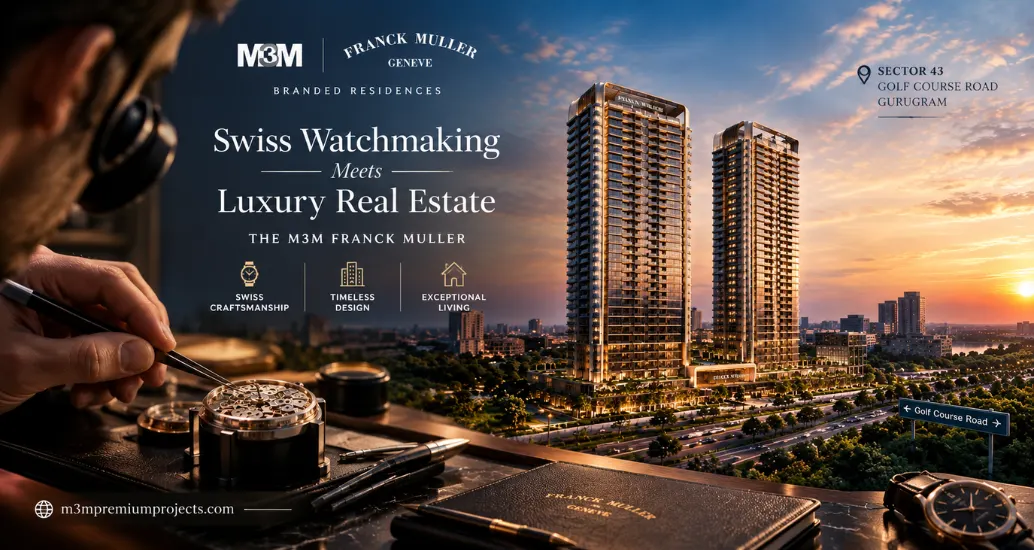
A watch brand and an apartment building do not obviously belong in the same sentence. One is a small mechanical object you wear on your wrist. The other is a multi-storey structure people live in for decades. Yet in Gurugram's Sector 43, along Golf Course Road, a project called M3M Franck Muller is asking buyers to think about both at once. M3M India, one of the larger private developers in the National Capital Region, has partnered with Franck Muller, the Swiss watchmaking house, to put a residential project under that name.
This is not a new idea globally. Branded residences — homes carrying the name of a hotel chain, a car maker, or a fashion label — have existed for years in cities like Dubai, Miami and London. What is less discussed is what actually happens when a name from one industry is placed on a building in another. Does it change the design? The construction? The buyer's experience? Or is it mostly a marketing device? This article tries to answer that honestly, using what has been publicly confirmed and separating it clearly from what is still market talk.
What Is M3M Franck Muller?
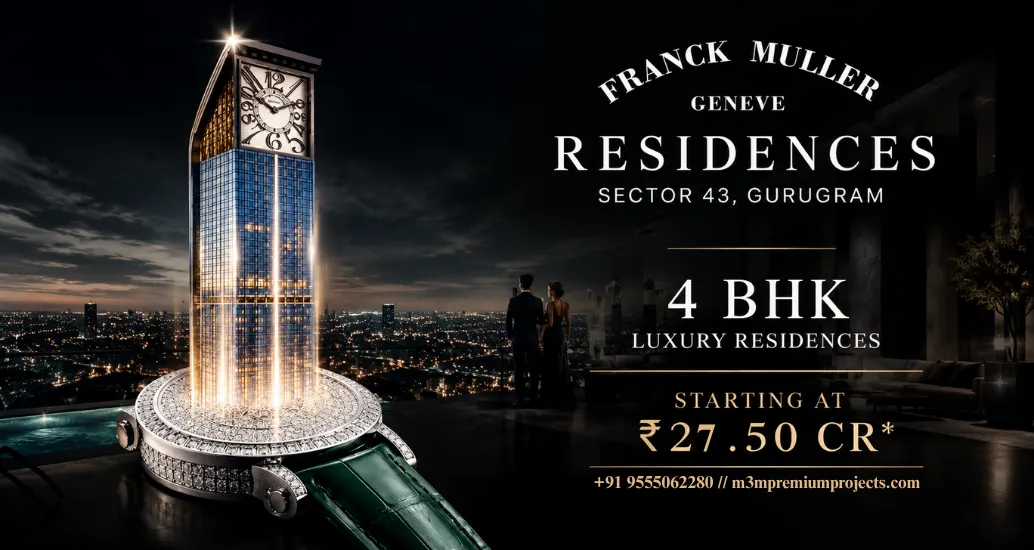
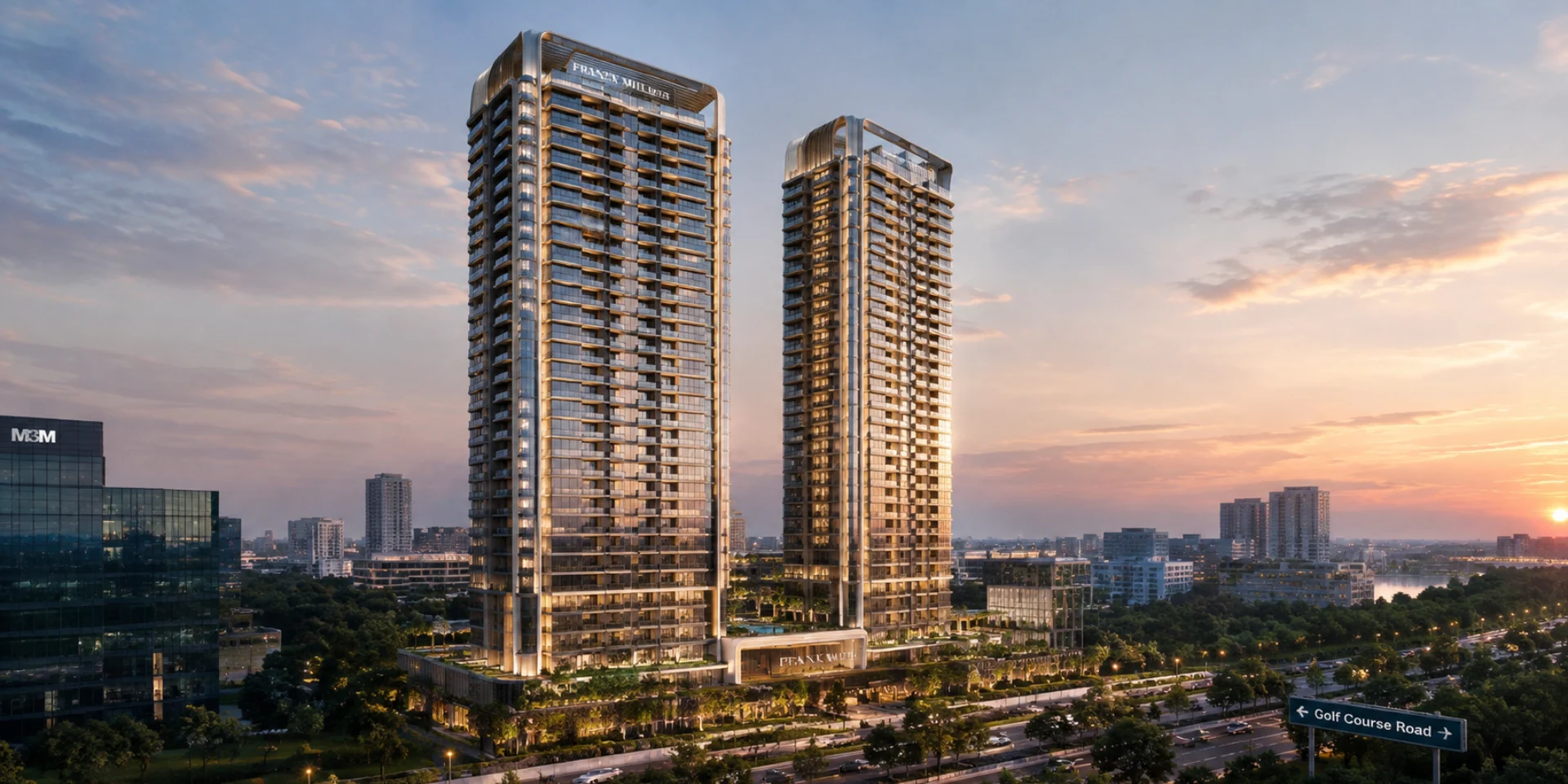
M3M Franck Muller is a residential project being developed by M3M India in Sector 43, Gurugram, close to Golf Course Road. According to public project listings, it is positioned as an ultra-luxury branded residence, built in partnership with Franck Muller, the Swiss watch manufacturer.
Here is what appears consistently across public listings and can be treated as verified project information:
- The developer is M3M India.
- The brand partner is Franck Muller, a Swiss luxury watchmaking company.
- The project is located in Sector 43, near Golf Course Road, Gurugram.
- The residences are being marketed as 4 and 5 BHK units.
- The project is described as low-density, with a small number of towers rather than a large apartment complex.
Beyond that, listings start to disagree or provide numbers that are difficult to verify independently — exact land area, total unit count, tower height, pricing, and possession timelines vary from one property portal to another. Where sources conflict or a claim cannot be traced to an official document, this article treats it as market observation rather than fact, and says so plainly. If you are seriously considering this project, ask for the RERA registration, the sanctioned layout, and the brand collaboration agreement rather than relying on any single website, including this one.
Why Would a Watchmaking Brand Enter Luxury Real Estate?
Branded residences are, at their simplest, a licensing arrangement. A developer builds and sells the property. A brand from another category lends its name, and often some design guidelines, in exchange for a fee and the exposure that comes with association. Hotel brands like Armani, Ritz-Carlton and Four Seasons have done this for two decades. Car brands like Porsche and Bentley have done it more recently. Fashion houses have tried it too.
For the brand, the appeal is simple: real estate reaches a wealthy audience in a physical, permanent way that advertising cannot match. A watch magazine ad disappears after the reader turns the page. A tower with your name on it stays visible for thirty years.
For the developer, the appeal is positioning. A generic luxury apartment competes on square footage and amenities against dozens of similar projects. A branded one competes on identity — it tells a buyer this home belongs to a different category before they have even walked into a sample flat.
None of this means the branding automatically makes the building better constructed, better located, or a better investment. It changes how the project is perceived and marketed. Whether the underlying product matches that perception is something a buyer still has to check independently, and that is really the theme running through the rest of this piece.
What Does Swiss Watchmaking Have to Do With a Home?
This is the part most project pages gloss over with a single line about "Swiss craftsmanship" and move on. It deserves more attention.
Swiss watchmaking, as an industry, is built around a specific set of values: mechanical precision measured in fractions of a second, small components fitted together by hand, materials chosen for durability rather than just appearance, and a culture where the maker's name is a guarantee of consistency across every piece produced. A Franck Muller watch is not valued because it tells time — plenty of ten-dollar watches do that accurately. It is valued because of the discipline behind how it is made.
The interesting question is whether any of that discipline can genuinely transfer to a residential building. A watch is assembled by a handful of specialists in a controlled workshop. A residential tower is built over years by hundreds of workers, contractors and vendors, exposed to weather, site conditions and supply chains. The two processes are not comparable in scale or method.
What can transfer, at least in principle, are certain design values: attention to proportion, careful selection of finishing materials, a preference for clean detailing over decorative excess, and consistency in how spaces are executed. Whether M3M Franck Muller actually delivers on these values is something that can only be judged by inspecting the finished units, the sample flat, and the material specifications — not by the name on the gate. Buyers should ask the developer directly what the brand collaboration actually covers: is it limited to naming and marketing, or does it extend to interior specification, finishing standards, or design sign-off? That distinction matters more than most sales conversations let on.
M3M Franck Muller and the Idea of a Branded Residence
A conventional luxury residence is judged mostly on things you can measure: location, unit size, amenities, build quality, and price per square foot. A branded residence adds a layer on top of that — an identity borrowed from another category, along with an implicit promise that the brand's standards apply somewhere in the project.
The honest way to think about this is as two separate questions stacked together. The first is the normal real estate question: is this a well-located, well-built, fairly priced home? The second is a branding question: does the Franck Muller association add something real — design input, quality assurance, a distinct buyer community — or is it primarily a naming right used for marketing?
Both questions matter, but they are not the same question, and a good brand name cannot answer the first one for you. A branded residence that is poorly located or overpriced for its segment is still a poorly located, overpriced home, whatever name is on the entrance. Conversely, a well-executed branded project may offer a genuinely different experience from an unbranded one in the same micro-market — but that has to be demonstrated project by project, not assumed because of the label.
What Makes M3M Franck Muller Different From a Regular Luxury Apartment?
Based on what has been publicly stated so far, a few things are being positioned as differentiators:
- The Franck Muller name and the design identity associated with it, rather than a purely developer-branded project.
- A relatively low-density layout, reportedly limited to a small number of towers rather than a sprawling complex.
- Larger-format 4 and 5 BHK configurations aimed at a narrower, higher-budget buyer segment.
- A Golf Course Road address, which is already one of Gurugram's established luxury corridors.
These are positioning choices, and each one is plausible as a differentiator — low density genuinely does change the living experience compared to a high-rise with hundreds of units per floor plate, for instance. But "low density" and "branded" are claims that need to be checked against the actual sanctioned plan and unit count once available, not taken as marketing copy. Until the project's exact specifications are officially confirmed and cross-checked, it is more accurate to describe these as intended positioning than as guaranteed features of the finished product.
Why Sector 43 and Golf Course Road Matter
Whatever the branding, location does most of the work in any real estate decision, and this is worth spelling out rather than assuming.
Golf Course Road has been one of Gurugram's established high-end residential corridors for close to two decades. It sits near DLF Cyber City and the broader Cyber Hub office and business district, which matters for buyers who want to be close to work or expect tenants who do. The stretch also has an existing base of luxury housing, established schools, hospitals and retail, which is different from betting on a newly developing sector where that infrastructure is still being built out.
Sector 43 specifically benefits from proximity to the Delhi-Gurgaon Expressway and reasonable access to the metro network, which supports day-to-day connectivity for residents and staff. None of this is unique to M3M Franck Muller — several other luxury projects sit in the same corridor and compete for the same buyer pool. A brand name changes how a project is marketed within that corridor; it does not change the corridor's underlying fundamentals, which buyers would be evaluating regardless of which project they choose.
Is the Franck Muller Brand Enough to Make a Property Valuable?
No. A brand name is one input into a real estate decision, not a substitute for the rest of the analysis.
Buyers evaluating any luxury residence, branded or not, should look at:
- The location and its long-term trajectory, not just its current reputation.
- The developer's track record on delivery timelines and construction quality in past projects.
- Project approvals — RERA registration, sanctioned building plans, and land title.
- Actual construction quality and specifications, ideally verified by inspecting a sample unit or a similar completed project by the same developer.
- Carpet area versus super area, since luxury projects often carry a wide loading factor that affects the real price per usable square foot.
- Maintenance charges and the ongoing cost of living in a branded, high-service building.
- The depth of the resale and rental market for large-format luxury units, which tends to be thinner than for mid-size apartments.
- The number of competing luxury and branded projects launching in the same corridor around the same time.
- Payment terms and the legal documentation governing the sale.
A strong brand can support a project's positioning and may help with buyer recall in a crowded luxury segment. It does not substitute for due diligence on any of the points above, and any professional advising you otherwise is skipping steps that matter.
M3M Franck Muller From an Investment Perspective
This is the section where the temptation to promise returns is strongest, and where restraint matters most. No one — including this article — can responsibly tell you that a specific under-construction project will appreciate by a certain amount, rent at a certain yield, or resell easily. Those outcomes depend on the entry price, market conditions at possession, competing supply, and factors that have not yet played out.
What can be said is that the project sits in a location with a long track record of luxury demand, and that branded positioning is a genuine trend in the luxury segment globally, not a gimmick invented for this one project. Those are reasonable points in its favor as a category.
Before treating it as an investment rather than a home, an investor should be asking:
- What is the actual all-in entry price, including all charges, not just the base rate quoted verbally?
- What are the holding costs until possession and after — maintenance, taxes, and any brand-related service charges?
- Who is the realistic buyer or tenant pool for a 4 or 5 BHK branded residence at this price point, and how large is it?
- How many other luxury and branded projects are launching or under construction in the same corridor, and what does that mean for future supply?
- What does the rental market currently look like for comparable large-format units nearby?
- How liquid is resale likely to be for a large, expensive unit, compared with a smaller apartment?
- What are the project's approvals and RERA status right now, not at some future date?
- What payment plan is being offered, and what obligations does it create if the project timeline shifts?
These are the same questions a careful buyer should ask of any luxury project. The brand name does not remove the need to ask them.
Who Is a Branded Residence Like M3M Franck Muller Really For?
Branded residences tend to attract a specific kind of buyer: business owners and senior professionals who want a home that signals a certain status, NRIs looking for a recognisable name they can explain easily to family or associates abroad, and buyers who already own one home and are purchasing a second or third as much for identity as for shelter.
They are not necessarily the right fit for a first-time luxury buyer who is mainly optimising for space, layout efficiency and price per square foot. For that buyer, an established non-branded luxury project in the same corridor, with a longer delivery track record, may offer more house for the money. There is no wrong answer here — it depends on what the buyer values, but it is worth being honest with yourself about which category you fall into before you get drawn in by the name on the gate.
M3M Franck Muller — The Bigger Idea
Step back from the specific project, and the interesting question is not really whether a watch company has a building named after it in Gurugram. It is whether the values that made Franck Muller a respected name in watchmaking — precision, attention to detail, and a distinct design identity — can genuinely shape how a residential building is designed, finished and lived in, or whether the association stays mostly on the signage and the sales brochure.
That question will not be answered by any article, including this one. It will be answered once the project is built, once buyers move in, and once the finishing and service standards can be judged against what was promised. Until then, the honest position is that M3M Franck Muller represents an interesting attempt to bring a global branded-residence trend to one of Gurugram's established luxury corridors — and that, like any project, it deserves to be judged on its actual execution rather than on the strength of the name alone.
If you are considering it, treat the brand as one part of the story. Spend at least as much time on the location fundamentals, the developer's delivery record, and the legal and financial documents as you would on any unbranded luxury purchase. That is the only way to know whether the Swiss watchmaking connection is a meaningful part of the home you are buying, or simply a well-chosen name.
 Sumit Mishra / Property Counselor
You Must Read:
Other