


arrow_backBack to Blog
Finance
How Highways Changed Gurgaon Property Prices in 2025
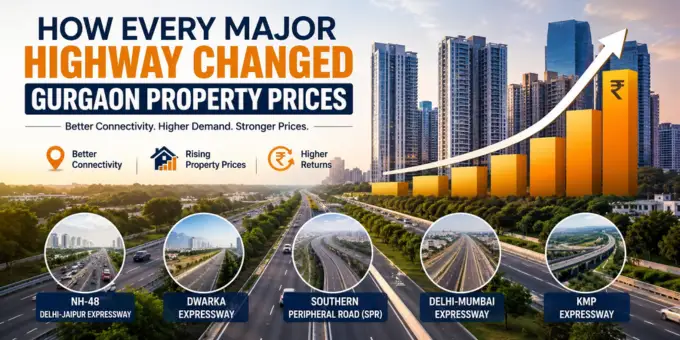
Understanding how every major highway changed Gurgaon property prices is the single most important insight any serious real estate investor or homebuyer can have in today's market. From NH-48 to the Dwarka Expressway, every major road project has redrawn the city's pricing boundaries — sector by sector, year by year. This guide breaks it all down with real price data for 2025.
Table of Contents
1. The Highway–Property Price Connection
2. NH-48: The Original Growth Engine
3. Golf Course Road Connectivity Corridors
4. Southern Peripheral Road (SPR)
5. Dwarka Expressway: The Biggest Transformation
6. Delhi-Mumbai Expressway
7. KMP Expressway
8. Sectors That Benefited the Most
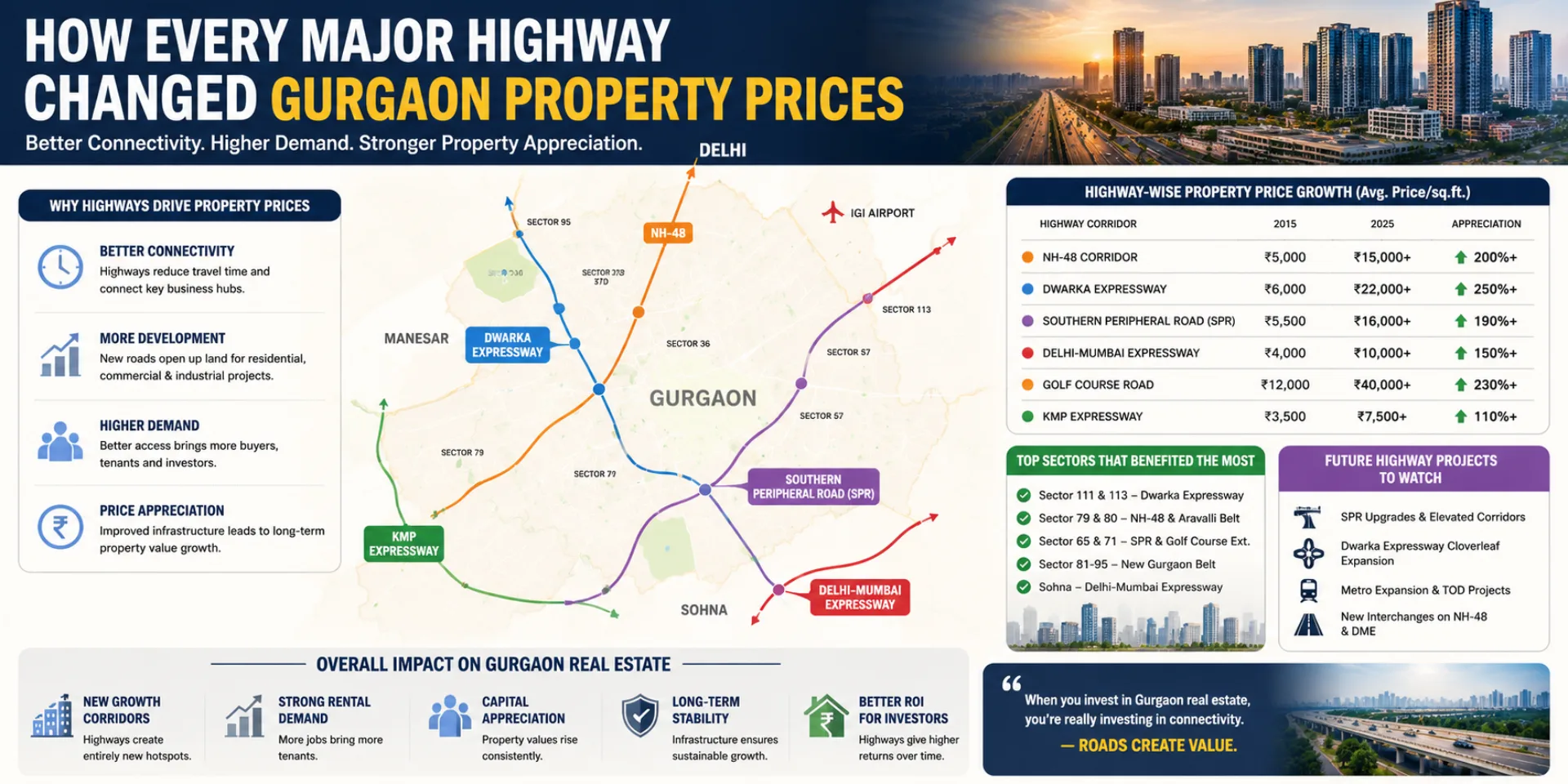
9. Highway Impact Comparison Table (2025 Data)
10. Common Investor Mistakes
11. Future Highway Projects to Watch
12. Frequently Asked Questions
Why Highways Are the Driver of Gurgaon Property Prices
If you look at a map of Gurgaon from twenty years ago, you will see a vast stretch of farmland, small villages, and scattered factories. Today, that same land is filled with towering skyscrapers, world-class luxury apartments, and massive corporate hubs. To truly understand how every major highway changed Gurgaon property prices, you must first understand what roads actually do for a real estate market.
Road networks are not just connectors between two points on a map — they act as life-support systems for urban growth. When a new highway opens, it does two critical things: it cuts down travel times and opens large parcels of vacant land for master-planned urban development. Without proper road connectivity, even the most beautifully designed housing society fails to attract serious buyers. People want to live where they can commute to work quickly, send their children to school easily, and find hospitals nearby. Highways make these daily routines possible by connecting once-isolated peripheral sectors directly to the city's central economic engines.
This dynamic creates a highly predictable pattern known as infrastructure-led development. The moment a new transit corridor is announced, land speculation begins — often months before the first excavator arrives on site. As the physical road takes shape, risk drops, end-users arrive, and rental and resale demand climb steeply. This is precisely why tracking infrastructure timelines is the most reliable method for predicting capital appreciation in Gurgaon's real estate market in 2025.
Key insight: In Gurgaon, a property's value is directly tied to how many minutes it takes to drive from the front gate to a major expressway. This single metric often explains 60–70% of the price difference between two comparable properties in different sectors.
NH-48 (Delhi–Jaipur Highway): The Foundation That Started It All
To fully appreciate how every major highway changed Gurgaon property prices, you must begin with NH-48 — the Delhi–Jaipur Highway. Before this route was widened and modernised in the late 1990s and early 2000s, Gurgaon was largely seen as a distant satellite town with little commercial appeal. The upgrading of NH-48 slashed commuting times between central Delhi and Gurgaon, making the city genuinely viable for multinational corporations seeking large, modern office spaces outside Delhi's congested core.
Corporate Boom and Price Impact
NH-48 became a magnet for Fortune 500 companies, directly fueling the development of iconic commercial zones like Cyber City and Udyog Vihar. As thousands of young professionals relocated to Gurgaon for work, residential demand shot up near NH-48. Properties that originally sold for below ₹2,000 per square foot in the early 2000s quickly crossed the ₹10,000–₹15,000 per square foot mark once the commercial ecosystem matured.
In 2025, mature sectors along NH-48 command ₹15,000–₹20,000 per sq. ft. for quality mid-luxury residences. NH-48 remains the single most important reason why Gurgaon property prices are what they are today. Every highway that came after it used NH-48 as its reference anchor and benchmark for growth.
Golf Course Road: Where Connectivity Created a Luxury Address
While Golf Course Road is technically a micro-market, it is a textbook example of how every major highway changed Gurgaon property prices at the luxury end of the spectrum. Its direct, seamless connection to NH-48 — combined with the construction of signal-free underpass networks and the Rapid Metro corridor — transformed Golf Course Road into one of India's most expensive residential stretches.
Price Appreciation Over Two Decades
Golf Course Road became the address of choice for corporate CEOs, high-net-worth individuals (HNIs), and expatriates. Property rates climbed from mid-segment averages to ultra-premium pricing, with some top-tier projects commanding ₹30,000–₹40,000 per square foot as of 2025. The elimination of traffic bottlenecks through signal-free corridors was the single catalyst that turned this stretch from a nice neighborhood into a truly aspirational address. Today, the Golf Course Road story stands as proof of what sustained highway-led infrastructure can deliver over two decades.
Southern Peripheral Road (SPR): The Rising Mid-Premium Corridor
The Southern Peripheral Road connects Golf Course Extension Road directly to NH-48, cutting across multiple newer sectors. For several years, missing links and delayed land acquisition slowed growth on SPR significantly. However, recent infrastructure upgrades — including new flyovers, road widening, and improved internal sector roads — have renewed strong market interest going into 2025.
Why SPR Is Attracting Smart Investors in 2025
SPR sits at the intersection of old commercial zones and new industrial developments near Sectors 65 and 71. This corridor has attracted major premium-mid and luxury housing projects, offering larger apartment sizes at a meaningfully lower cost than the fully mature Golf Course Road market.
Long-term investors view SPR as having significant remaining upside — approximately 80–110% property price appreciation potential over the next 5 years. The pattern here closely mirrors how every major highway changed Gurgaon property prices in earlier cycles: delayed infrastructure, followed by a concentrated period of rapid price discovery once the roads fully open.
Dwarka Expressway: The Most Dramatic Example of How a Highway Changed Gurgaon Property Prices
No single highway demonstrates more powerfully how every major highway changed Gurgaon property prices than the Dwarka Expressway — also known as the Northern Peripheral Road. Its story is a master class in patience, risk, and compounding reward for real estate investors.
The Long Wait and the Big Payoff
For over a decade, construction on the Dwarka Expressway faced severe legal conflicts, stalled land acquisition, and incomplete stretches. During this prolonged period, property values in sectors along its length remained flat or depressed — stuck between ₹5,000–₹6,000 per square foot. Early investors endured years of uncertainty, with projects surrounded by unfinished road stretches and no clear completion timeline in sight.
Then the expressway opened — and the entire market inverted. The Dwarka Expressway now provides a direct, signal-free path to Indira Gandhi International Airport and connects seamlessly with West Delhi, bypassing the congested NH-48 toll plazas. By 2025, property prices along the Dwarka Expressway corridor have surged to ₹15,000–₹22,000+ per square foot — a 200–300% increase from stagnation-era prices.
This is perhaps the clearest modern example of how every major highway changed Gurgaon property prices when investor patience and completed infrastructure finally converge. The Dwarka Expressway alone has created more real estate wealth for long-term holders than any other single corridor in the city's history.
"The Dwarka Expressway is the single greatest proof point that infrastructure delays do not kill returns — they compress them. Investors who held through the uncertainty collected appreciation that would have taken a decade in a normal market." — Senior Real Estate Research Analyst, Delhi NCR Market
Current Demand Profile in 2025
The expressway has catalyzed a massive shift toward premium housing demand in Sectors 106, 111, 112, and 113. Top-tier developers have launched high-end gated communities with luxury amenities to serve buyers priced out of central Delhi and mature Gurgaon markets. Corporate professionals, airport-adjacent business travelers, and NRI buyers have all made Dwarka Expressway their preferred destination for property investment in 2025.
Delhi–Mumbai Expressway: The Next Big Chapter in Gurgaon Property Price Growth
The Delhi-Mumbai Expressway (DME) is the most ambitious infrastructure project to influence Gurgaon property prices since the original NH-48 transformation. The expressway begins from the Sohna area on the outskirts of Gurgaon and links the local market directly to a massive national trade corridor spanning six states.
South Gurgaon's Transformation
The connection point of the Delhi-Mumbai Expressway has turned South Gurgaon — the Sohna Road belt — into an immediate real estate hotspot. Major commercial enterprises, warehousing hubs, and retail developments are gravitating toward this zone, generating fresh employment and driving residential demand at a rate that closely mirrors how every major highway changed Gurgaon property prices in earlier cycles.
Real estate analysts project 60–90% property price appreciation along this corridor over the next 5–7 years, making it one of the most closely watched emerging markets in the NCR for 2025 and beyond. Families seeking larger homes, green spaces, and cleaner air are actively purchasing in this zone, confident that the DME connection ensures they remain well-connected to the core city.
KMP Expressway: The Industrial Backbone Reshaping Peripheral Property Values
The Kundli-Manesar-Palwal (KMP) Expressway functions as a massive outer ring road for the National Capital Region. Originally designed to divert heavy trucks away from Delhi and central Gurgaon, the KMP Expressway has had a powerful secondary effect — it transformed peripheral sectors near Manesar into a major industrial, manufacturing, and logistics corridor.
While the KMP primarily drives commercial and industrial property values, the large-scale employment it has generated creates steady, reliable demand for affordable and mid-segment residential housing in nearby sectors. For investors in the ₹30–₹60 lakh ticket-size range, KMP-adjacent sectors continue to offer strong rental yield prospects going into 2025.
Sectors That Benefited Most from Highway Development in 2025
Understanding how every major highway changed Gurgaon property prices at the micro-level means looking at specific sectors and their highway proximity.
Sectors 111 & 113 (Dwarka Expressway): Called the "Smart City Delhi Gateway," these sectors saw prices surge dramatically post-expressway opening. They remain prime spots for luxury housing investment in 2025.
Sectors 79 & 80 (NH-48 + Aravalli border): Transformed from quiet weekend-getaway zones into booming residential hubs for Manesar and Cyber City corporate professionals.
Sectors 65 & 71 (SPR + Golf Course Extension): Attracted major commercial developments, premium retail malls, and high-end towers. Steady capital appreciation continues through 2025.
New Gurgaon — Sectors 81 to 95: Acts as the bridge between NH-48 and the Dwarka Expressway. A major real estate revival is underway as highway integration makes commuting to both Delhi and central Gurgaon effortless.
Sohna–South Gurgaon (Delhi-Mumbai Expressway Zone): The most exciting emerging corridor of 2025, with prices still in the early appreciation phase and significant upside remaining.
Highway Impact Comparison — 2025 Data
| Highway Corridor | Market Profile | Price Range (2025) | 5-Year Appreciation | Investment Stage |
| NH-48 | Mature commercial & mid-luxury | ₹12,000–₹20,000/sq. ft. | 50–70% | Stable / Hold |
| Golf Course Road | Ultra-luxury residential | ₹25,000–₹40,000/sq. ft. | 40–60% | Mature / Premium |
| Dwarka Expressway | Premium luxury gated communities | ₹15,000–₹22,000+/sq. ft. | 150–200%+ | Growth Phase |
| Southern Peripheral Road | Mid-to-premium residential | ₹9,000–₹16,000/sq. ft. | 80–110% | Active Growth |
| Delhi-Mumbai Expressway | Emerging residential & industrial | ₹5,000–₹10,000/sq. ft. | 60–90% (projected) | Early Stage / Buy |
| KMP Expressway | Industrial, logistics & affordable | ₹4,000–₹7,500/sq. ft. | 40–60% | Stable Industrial |
Common Mistakes Investors Make When Buying Near Gurgaon Highways
While understanding how every major highway changed Gurgaon property prices gives you a powerful edge, it can also create costly blind spots if not applied carefully.
Overpaying during hype cycles: When a highway is announced, media coverage artificially inflates local prices. Savvy investors wait for speculative waves to cool before committing capital.
Ignoring micro-location access: Being "near a highway" is meaningless if your sector lacks proper service lanes or U-turn access points. Always verify internal road connectivity before buying.
Ignoring developer track record: A highway brings people to an area but cannot fix a poorly constructed building. Always check RERA registration, delivery timelines, and past project completion records.
Short-term capital in long-term assets: Highway corridor investments require patient capital. Selling before completion means missing the actual appreciation wave — a painful lesson learned by many Dwarka Expressway investors who exited too early.
Future Highway Projects That Will Influence Gurgaon Property Prices
The story of how every major highway changed Gurgaon property prices is far from over. Several upcoming transit projects are set to redraw the city's property value map again in 2025 and beyond.
New flyovers and elevated corridors on NH-48 and SPR are planned to eliminate remaining bottlenecks and improve signal-free traffic flow across key junctions.
Dwarka Expressway cloverleaf expansion will add dedicated slip lanes connecting the CPR and SPR for fully seamless cross-city travel, further boosting surrounding sector values.
Transit-Oriented Development (TOD) combined with Metro integration will create high-density residential and commercial projects at the intersection of highway exits and upcoming metro lines — generating hyper-valuable mini-hubs along peripheral Gurgaon routes that are still affordable today.
Conclusion: The Roads Are the Real Asset
It is impossible to separate the story of Gurgaon's real estate market from the history of its concrete lifelines. From the corporate transformation driven by NH-48 to the explosive luxury boom along the Dwarka Expressway, understanding how every major highway changed Gurgaon property prices is the most reliable lens through which any investor or homebuyer can evaluate this market in 2025.
As the city expands further outward, new master-planned corridors and transit-oriented development projects will continue altering land values. The Delhi-Mumbai Expressway and upcoming SPR upgrades are already seeding the next major appreciation wave.
The lesson is clear: if you want to protect your capital and maximize long-term wealth in Gurgaon, stop looking at the buildings alone. Look at the roads connecting them. By aligning your investment with upcoming highway projects, tracking micro-location accessibility carefully, and focusing on developer quality, you can position yourself to ride the next great wave of property appreciation in Gurgaon.
 Sumit Mishra / Property Counselor
You Must Read:
 Other
Other

 Residential