

arrow_backBack to Blog


New Launch
M3M St. Andrews Investment Guide 2026 – ROI, Risks & Price Analysis
I have sat across the table from enough Gurgaon property buyers over the years to know how this conversation usually starts. Someone mentions Sector 113, drops the word "golf-facing," and within five minutes the topic shifts to how fast the Dwarka Expressway belt is supposedly appreciating. M3M St. Andrews gets brought up almost every week now, and the questions that follow are always the same: is the price justified, will the rental income cover the EMI, and what happens if the corridor doesn't grow the way the sales brochure claims?
This piece answers those questions properly. Not with brochure language, but with the kind of scrutiny you'd expect from someone advising a client who is about to commit five to ten crore rupees of their own money. Some of what follows will support the investment case. Some of it will poke holes in it. Both are necessary if you want a decision you won't second-guess three years from now.
We'll go through the project itself, the reasoning behind the price tag, what the numbers actually look like when you run them properly, who this property genuinely suits, the risks nobody puts in a sales presentation, and how it holds up against the other big names competing for the same buyer in this belt.
Project Snapshot
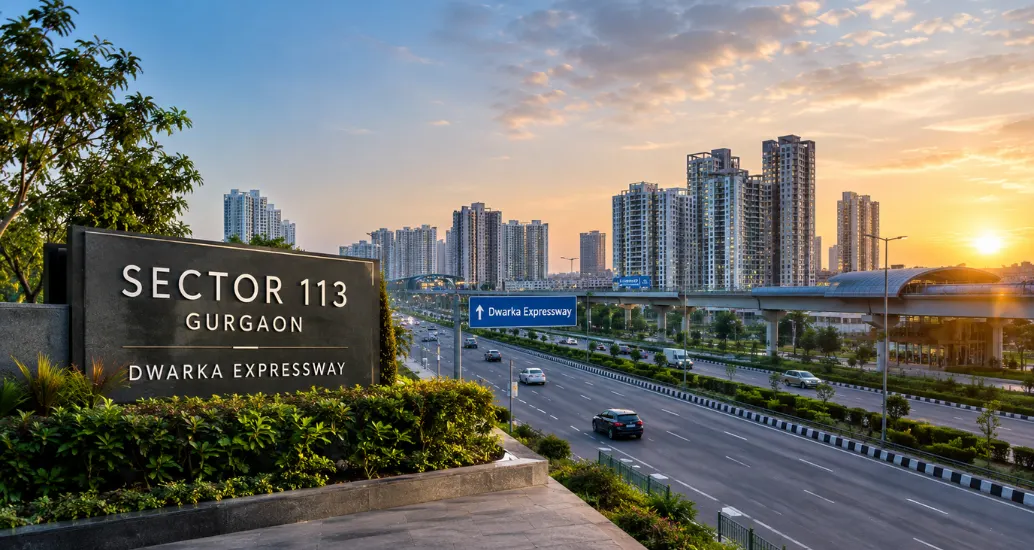
M3M St. Andrews sits inside the 250-acre Smart City Delhi Airport township — everyone in the trade just calls it SCDA — right in Sector 113, Gurugram, with direct frontage on the Dwarka Expressway. It's close enough to the Delhi border that some agents genuinely market it as walking distance, which stretches the truth a bit, but the point stands: this is about as close to Delhi as a Gurgaon address gets.
The development leans heavily on a golf-view identity. Two towers, roughly four apartments per floor, configurations running from 3.5 BHK to 4.5 BHK plus a handful of penthouses. Unit sizes reported across different listings range from around 2,730 sq. ft. up to 7,480 sq. ft. for the largest penthouse formats, though the exact numbers shift depending on which tower and phase you're looking at.
| Detail | Information |
| Developer | M3M India Pvt. Ltd. |
| Location | Sector 113, SCDA, Gurugram |
| Configuration | 3.5 BHK, 4.5 BHK apartments and penthouses |
| Unit Size Range | ~2,730 to 7,480 sq. ft. (varies by source) |
| Starting Price | Approx. ₹6 Cr onwards* |
| Payment Plan | Flexible construction-linked plans (commonly 25:75 or similar) |
| Land Parcel | Reported between 7.5 and 11 acres within the larger SCDA township |
| Amenities | Clubhouse, pool, gym, jogging track, landscaped gardens, golf greens view |
| Regulatory Status | RERA-registered under Haryana RERA |
The Investment Thesis, Stripped of Sales Talk
Here's the question worth sitting with before anything else: why would someone hand over six to ten crore rupees for this specific address instead of putting that money into another Gurgaon project, or frankly, into equities, gold, or a second business? Every good real estate decision starts with an honest answer to that, not a comparison of clubhouse sizes.
The case for St. Andrews rests on a fairly narrow but real combination of factors. You're buying into a land parcel that happens to sit on one of the few genuinely new arterial roads built in NCR in the last decade. You're buying a low-density format — four units per floor is not something most Gurgaon developers offer at this price point, and low density tends to hold its value better over a full market cycle because there simply isn't a flood of identical inventory competing with yours at resale. And you're buying into a township model, SCDA, that is large enough to eventually generate its own commercial and social ecosystem rather than depending entirely on what already exists in the surrounding sectors.
None of these three things is unique on its own. Plenty of projects sit near expressways. Plenty claim low density. What matters here is that all three show up together, on this stretch of land, at this price. That combination is genuinely harder to find right now than the marketing suggests, though it won't stay scarce forever — more on that later.
There's also a quieter reason buyers in this bracket make this kind of purchase, and it rarely gets discussed openly: physical real estate functions as a counterweight to a portfolio that's otherwise sitting in equities, mutual funds, or business equity. It doesn't move with the stock market. During inflationary stretches, land and construction costs tend to rise too, which gives a property like this some protection against the rupee losing purchasing power over a long holding period. That's not a guarantee — real estate has had flat, even declining, multi-year stretches in India before — but as a portfolio diversifier, it does a job that a mutual fund SIP simply cannot.
If you strip away the golf views and the clubhouse renders, what you're actually betting on is this: Sector 113 becomes a genuine extension of premium Gurgaon-Delhi living over the next decade, and the scarcity of low-density luxury stock in this specific corridor supports both resale value and rental desirability along the way. That's the thesis. Whether it plays out depends on infrastructure delivery staying on track and your own ability to hold the asset long enough to see it through.
What's Actually Driving Gurgaon's Luxury Boom
A luxury project doesn't create its own demand. The city around it does, and Gurgaon's story here is worth understanding properly rather than accepting the "Gurgaon is booming" line at face value.
Migration into Gurgaon from Delhi has been happening steadily for two decades, and it has consistently tilted toward the upper end of the housing market as incomes have grown faster than the supply of genuinely premium homes. I've watched this play out with clients personally — families who started in a 3 BHK in South Delhi twenty years ago are now looking at their second or third Gurgaon upgrade, and each move has trended larger and more expensive, not smaller.
Add to that the sheer density of corporate offices packed into Cyber City, Golf Course Road, and the wider Millennium City stretch. Several Fortune 500 companies run their India or regional operations out of Gurgaon, and every year a fresh batch of senior professionals reaches the seniority and income level where renting stops making sense and buying starts to. That group has historically fed directly into the luxury segment, and Sector 113 is positioned to catch a slice of it specifically because of how close it sits to the airport corridor.
Speaking of which — IGI Airport's ongoing expansion, along with the growth of the Aerocity zone, has quietly made airport proximity a genuine luxury differentiator in a way it wasn't fifteen years ago. Frequent flyers, aviation executives, and companies setting up regional offices near the airport all factor commute time into their housing decision now, and that works in Sector 113's favour.
Then there's the wealth data itself. Every credible study on India's high-net-worth population over the past several years has shown the same pattern: the numbers keep growing, and Delhi NCR consistently ranks among the top concentrations nationally. More wealthy households means more demand for status-driven, well-located luxury homes — not because status matters more than shelter, but because at this income level, the home doubles as both. None of this guarantees any single project outperforms the trend, but it does mean the broader tailwind is real, not manufactured for a sales pitch.
Sector 113 and SCDA: Reading the Location Correctly
Location analysis for a project like this needs more nuance than "it's near the airport." Let me break down what's actually working in Sector 113's favour, and what's still a work in progress.
The SCDA township model is the first thing worth understanding. Unlike a standalone tower dropped into an existing sector, SCDA was planned as an integrated 250-acre development with roads, drainage, and green cover designed upfront. In my experience, that upfront planning tends to produce more even, better-paced price growth than you see in older Gurgaon sectors where infrastructure got added piecemeal, years after the towers went up.
Second, the neighbours matter more than people realise. The Yashobhoomi convention centre, the Diplomatic Enclave II, and a growing base of commercial development nearby aren't just landmarks for a brochure map — they create a built-in pool of corporate tenants, diplomatic staff, and business travellers who need housing close by. That's a real demand driver for both rental and resale, not a decorative detail.
But here's the part sales teams tend to gloss over: SCDA is still very much a township under construction. A large master-planned development takes years, sometimes closer to a decade, to feel fully lived-in. If you buy here expecting the polished, tree-lined, fully-occupied feel you'd get in an established sector like DLF Phase 3 today, you'll be disappointed for at least the first few years. Construction dust, half-finished roads, and a thinner social scene around you are the trade-off you're accepting in exchange for buying early into a location with genuine long-term upside.
Dwarka Expressway — Why This Road Matters More Than the Project
If I had to pick one single factor responsible for the price this project commands, it wouldn't be the golf views or the clubhouse. It would be the road it sits on.
Dwarka Expressway is one of the first fully elevated urban expressways built in the country, and it has already changed how people think about the Delhi-Gurgaon commute. Direct access to NH-48 and NH-248BB cuts travel time toward Cyber City and Golf Course Extension Road noticeably. The drive to IGI Airport, which used to be a genuine headache from most of Gurgaon, becomes short and predictable from this stretch — and for NRI buyers or frequent flyers, that single point often outweighs everything else on the brochure.
There's also the metro conversation. Public transport planning along this corridor has been discussed for years, and any confirmed extension closer to Sector 113 would likely be one of the bigger price catalysts this belt could see. I'd caution against buying purely on the expectation of a metro line that hasn't broken ground yet, though — I've seen buyers in other corridors overpay years in advance for infrastructure that took twice as long as promised to materialise.
The honest way to frame this: the expressway is real, operational, and already delivering value. The metro and further commercial build-out are multi-year tailwinds worth factoring into a long-term thesis, not something that should show up in your resale price within the first year or two after possession.
Price and Payment Plan: What You're Really Signing Up For
Numbers on this project move around depending on who's quoting them. Broadly, entry-level 3.5 BHK units start somewhere near ₹6 crore, and larger configurations along with penthouses climb toward ₹10-11 crore. Payment structures vary too — some channel partners quote a 25:75 split, others mention staggered plans like 25:25:25:25 or 25:25:40:10. Don't assume the number your broker quoted last month still holds; phase-wise price escalation is standard practice in projects this size.
A few things I'd insist any client check before signing a cheque. Get the official cost sheet directly from M3M rather than trusting a portal listing — third-party sites often carry outdated or promotional figures designed to get you to call in. Ask exactly what sits outside the base price: preferential location charges for a golf-facing unit, IFMS, club membership, and parking can add a meaningful chunk on top of what looked like a clean number initially. And if you're weighing a construction-linked plan against a possession-linked or subvention option, actually run the cash flow difference across the full construction timeline rather than comparing the headline percentages side by side — the real cost difference often surprises people.
Pricing at M3M St. Andrews depends on tower, floor, view, and unit size, and golf-facing units carry a clear premium over standard-view apartments in this project. The payment plan you choose changes your effective cost meaningfully over the construction window, because a construction-linked schedule behaves very differently from a possession-linked one once you factor in interest on a home loan. PLC, GST, IFMS, and club charges layer on top of the base price and should be confirmed with the developer directly rather than assumed from a listing site. For a complete breakdown of current pricing, applicable charges, and the payment plan options on offer, our detailed m3m st. andrews price & payment plan guide covers this in far more depth, and it's worth reading before you commit to a budget.
The Full Cost of Owning This Property
Buyers almost always anchor on the headline sale price and forget that owning a ₹6-10 crore apartment comes with an entire lifecycle of costs attached to it, some of which show up years after possession.
It starts with registration and stamp duty, payable to the state government when the sale deed gets registered — rates shift periodically, so confirm the current figure with a lawyer or registrar rather than relying on last year's number. GST applies on the under-construction portion of your payments at whatever rate is in force at each milestone, and this is another area where your CA should be involved early rather than after the fact.
Once you move in, maintenance becomes a recurring reality, and ultra-luxury projects with large clubhouses tend to charge noticeably more per square foot than mid-segment towers simply because there's more common infrastructure to run. Property tax is a separate annual municipal charge, independent of anything the developer collects. Many large clubhouse-led projects, this one included, also levy a separate club membership fee on top of monthly maintenance, and IFMS — a one-time deposit meant to fund future major repairs — gets collected at possession, so it's worth understanding the exact refund or adjustment terms before you pay it.
Then there's the money people forget to plan for entirely: renovation and fit-out costs even on a finished unit, the interest you're paying during construction if you've taken a loan, and eventually, when you sell, brokerage on the resale value plus capital gains tax. Map this whole lifecycle out on paper before you book. It changes the real return calculation more than most buyers expect.
Capital Appreciation — Separating Fact From Sales Pitch
Every channel partner selling this corridor will quote you a 20-25% annual appreciation figure, and I won't pretend that number is fabricated — parts of the Dwarka Expressway belt genuinely have moved that fast in recent years as the expressway opened and construction picked up across SCDA. What I will say is that treating a recent multi-year growth spurt as a repeatable annual return is exactly the kind of assumption that gets investors into trouble.
Appreciation depends on more variables than any single sales pitch accounts for: how balanced demand and supply stay in this specific micro-market, where interest rates sit over your holding period, whether infrastructure actually gets delivered on the timeline promised, and how much competing luxury supply lands in the same corridor before you're ready to sell. Right now, large-format luxury supply in Sector 113 is genuinely limited relative to demand from HNIs and NRIs eyeing this corridor — that's a real tailwind. But M3M itself has other projects in various stages within the same SCDA township, and other developers are active here too, so the supply picture five years from now will look very different from today's.
Take any appreciation percentage you're quoted as a description of what already happened, not a forecast of what will happen next. Future performance depends on market conditions and infrastructure delivery, and no one — not me, not the sales team, not the brochure — can guarantee it.
What Could Actually Push Prices Higher
Beyond the general "the market is growing" narrative, it's worth naming the specific triggers that could genuinely move pricing in this corridor, and being equally honest about what could hold it back.
A confirmed metro extension closer to Sector 113 would probably do more for pricing here than any other single event — that pattern has repeated itself across nearly every Gurgaon corridor once metro access actually arrived, rather than just being discussed. Continued expansion of IGI Airport and the Aerocity ecosystem around it adds a slower but steady pull on nearby residential demand. As SCDA itself fills out with retail, commercial space, and more residents, the entire zone becomes genuinely more livable, and that lifts pricing across every project in the township, not just this one.
On the flip side, constrained supply only supports pricing power as long as it stays constrained. The moment several large luxury projects in this exact price band reach completion around the same window, that scarcity premium narrows, sometimes faster than buyers expect. Brand positioning helps too — a project that successfully markets itself as a genuinely exclusive address can sustain a premium over comparable stock, but that premium tends to shrink once three or four similarly positioned projects are all competing for the same shortlist of buyers.
Who's Going to Buy or Rent This, and Why
Every price forecast is really a demand forecast in disguise, so it's worth being specific about who's actually going to want this property, and why.
Senior executives working at the corporate campuses scattered across Gurgaon form the most obvious recurring buyer and tenant base — people who've reached a seniority level where a large, well-located home starts to matter more than a shorter commute from a smaller flat elsewhere. NRIs form a second, distinct pool, and airport proximity specifically pulls them toward this corridor over other parts of Gurgaon; a Gurgaon base that's a seven-minute drive from IGI is a genuinely different value proposition for someone who flies in twice a year than one that's forty minutes away.
The Diplomatic Enclave II nearby is expected to bring in embassy staff and consular officials looking for housing close to work, which adds another layer of steady, professional-grade demand that isn't tied to Gurgaon's usual corporate cycle. Companies relocating senior staff to Gurgaon also tend to prefer ready luxury rentals in well-connected pockets over a long commute from older, more established but farther-flung sectors. And a meaningful slice of demand simply comes from within Gurgaon itself — families already living in older luxury addresses like DLF Phase 1 through 5 or Golf Course Road, upgrading to newer stock along this corridor as their needs or income change.
Rental Income: Setting Realistic Expectations
If someone's pitching this to you primarily as a rental income play, push back a little, because that's not really what this asset does best.
Ultra-luxury apartments in this size bracket attract a narrow tenant pool — senior executives, diplomatic staff, business owners — rather than the broader rental market that mid-size apartments tap into. Comparable large-format units in this micro-market have reportedly rented in the ₹1.5 to ₹2 lakh a month range, though furnishing, floor, and view swing that number considerably. Run that against a ₹6-8 crore purchase price and you land in low single-digit gross yield territory, which is entirely normal for Indian ultra-luxury housing but a far cry from what a rental-income-focused investor might expect.
Where the rental case does genuinely help is proximity to Aerocity, the Diplomatic Enclave, and the commercial development building up around this corridor — all of which should support steady corporate leasing demand over time. If monthly cash flow is your main priority, you'll likely find better yield in mid-segment Gurgaon housing. This project makes more sense for someone prioritising long-term appreciation and lifestyle value over a rental cheque every month.
Running the Numbers Like an Investor, Not a Buyer
Most people evaluate a home purchase on gut feel and a headline appreciation percentage. Treating this as an actual investment means running a few specific numbers instead.
CAGR tells you your compounded price growth over your holding period, but only use it once you have real resale data points for this project or close comparables — a single advertised annual percentage from a brochure is not a CAGR, it's a marketing figure. IRR gives investors financing part of the purchase a more complete picture than simple appreciation, because it accounts for exactly when your money goes out (down payment, EMIs, maintenance) against when it eventually comes back through rent or resale.
Gross yield — annual rent divided by purchase price — is a quick comparison tool against other assets, while net yield, which subtracts maintenance, property tax, and other recurring costs, is the more honest number when you're weighing this against a fixed deposit or bond. Monthly cash flow matters practically: many ultra-luxury purchases run negative every month through the loan tenure, and that's acceptable only if you've genuinely planned for it rather than discovered it after the fact.
Holding cost covers total interest paid during construction plus any vacancy period before a tenant moves in. Opportunity cost — what the same capital could have earned elsewhere, in equities or another property — is probably the single most overlooked number in real estate decisions, and it's worth calculating honestly rather than skipping. Payback period, how many years of net rent it takes to recoup your investment ignoring appreciation, tends to be long for ultra-luxury property, which again reinforces that this is an appreciation story, not an income one. And finally, ask what percentage of your total net worth this single purchase represents, because that number tells you more about your real risk exposure than any of the others.
Matching the Property to the Right Kind of Buyer
NRI buyers tend to do well here if they want a Gurgaon base close to the airport and are comfortable with a long horizon; they should think twice if they need quick liquidity or aren't prepared to engage a specialist on FEMA and repatriation rules.
HNIs find this a reasonable fit when it sits within a defined real estate allocation inside a broader portfolio; it becomes a poor decision if this single purchase would make real estate a disproportionately large share of their net worth.
Business owners often like having a tangible asset sitting outside their business balance sheet, and the prestige of the address for hosting clients does carry real value — but only if business cash flow is stable enough to comfortably absorb a large committed payment schedule without strain.
CXOs and senior executives working along the Dwarka Expressway-Aerocity-Cyber City belt gain the most from cutting a long commute, but should be cautious if their job location could change within a few years, since a fast resale in this bracket is never guaranteed.
End users should buy here if low-density living and golf-facing views genuinely matter to daily life, independent of returns; they should be cautious if proximity to established schools and a fully mature neighbourhood today, rather than in a few years, is the real priority.
Pure investors not planning to live in the unit do reasonably well if they're comfortable with a long holding period and modest yield, underwriting the location story primarily. They're a poor fit if predictable monthly cash flow or a short holding period is the actual goal.
First-time luxury buyers should proceed only after genuinely researching ultra-luxury real estate cycles and preparing for the holding costs discussed earlier — this should not be your only major property holding, since concentration risk runs higher without other real estate exposure to balance it.
Family offices find this useful for capital preservation and legacy planning alongside a diversified market-linked portfolio, but it's the wrong tool if the mandate specifically calls for liquid, income-generating assets on a short timeframe.
A Rough Timeline of How This Corridor Might Evolve
By 2026, the project remains under construction, and early-phase buyers typically get comparatively lower entry pricing in exchange for a longer wait and more construction-stage uncertainty. By 2028, assuming no major delays, construction across most large Dwarka Expressway launches from this period should be considerably further along, with SCDA's internal roads and utilities catching up too.
2030 looks like a realistic window for possession across several units and phases, and this is typically when rental potential and resale liquidity start improving in a noticeable way compared to the under-construction years. By 2035, if infrastructure delivery has broadly stayed on track, Sector 113 and the wider SCDA township should feel like an established address rather than an emerging one — though by then, the early scarcity premium buyers are paying for today will likely have narrowed, simply because more supply will have entered and matured alongside it.
These are directional markers based on how comparable NCR corridors have typically evolved, not developer-committed dates. Cross-check any specific possession promise against the RERA-registered timeline for your exact tower and phase before treating it as fact.
What Could Go Wrong
A guide like this earns its credibility in this section, so let's not soften it.
Construction and delivery risk is real for any large twin-tower luxury development — verify the RERA-declared possession date directly rather than trusting marketing collateral. Concentration risk is the one I see clients underestimate most often: putting a large share of net worth into one ultra-luxury unit reduces both liquidity and diversification, and most financial planners would tell you to cap real estate exposure, luxury housing included, to a defined slice of your total investable assets.
Supply risk deserves repeating here in plain terms: multiple luxury projects are coming up within the same SCDA township and along the broader corridor, and a wave of new supply hitting resale around the same possession window as yours could soften short-term price growth. Liquidity is a separate concern — properties above ₹5-6 crore simply take longer to sell than mid-segment homes because fewer buyers can write that cheque, so plan for a longer holding period if your exit depends on a fast sale.
Interest rate movement matters more on a large-ticket loan than people assume; stress-test your EMI against a higher rate before committing to any construction-linked plan. Economic slowdowns hit luxury demand harder and faster than mid-segment housing, since large discretionary purchases are usually the first thing deferred when sentiment sours among senior professionals. Policy shifts — changes to GST, capital gains rules, stamp duty, FEMA regulations for NRIs, or RERA itself — can alter your effective returns over a multi-year holding, which is exactly why staying updated through a professional advisor, rather than assuming today's rules hold forever, matters for an asset you might own for a decade.
| Risk | What I'd Tell a Client to Do About It |
| Delayed possession | Verify the RERA timeline directly, and check the delay-compensation clause in your agreement |
| Overpaying | Get cost sheets from at least two or three channel partners plus the developer directly, and compare |
| Poor resale liquidity | Favour a golf-view or corner unit — these have historically resold faster in comparable projects |
| Concentration risk | Cap this purchase to a sensible share of your total portfolio, not your entire liquid net worth |
| Legal ambiguity | Get an independent lawyer to review title and RERA documents — don't rely on the sales team's paperwork summary |
| Rate movement | Stress-test your EMI at a meaningfully higher rate before signing a construction-linked plan |
| Corridor oversupply | Check new RERA registrations in Sector 113 and nearby sectors every few months |
M3M's Track Record, Examined Honestly
M3M India was founded in 2010 and has built a fairly substantial footprint in Delhi-NCR's luxury segment since — residential towers, commercial complexes, integrated townships, with M3M Golfestate among the better-known names in their portfolio. The group markets itself as one of the leading developers in North India by project scale, and that claim holds up reasonably well when you look at their overall delivery volume.
For a purchase this size, though, developer reputation deserves more scrutiny than a portfolio list provides. Before you finalise anything, check the delivery history of two or three of M3M's earlier residential projects specifically — how actual possession dates compared to what was originally promised, the construction quality at sites that are already handed over, and how any disputes that arose were actually resolved. A personal visit to an already-delivered M3M project will tell you more about real construction quality than any brochure or sales presentation ever will, and I'd genuinely recommend doing that before signing anything here.
Where Construction Actually Stands
M3M St. Andrews is currently under construction, and possession timelines reported across sources point toward the later part of this decade, varying by tower and phase. As with any large twin-tower development at this scale, the actual pace on the ground deserves periodic checking rather than blind faith in the original launch timeline.
M3M St. Andrews is currently under construction, and the pace of tower completion, clubhouse readiness, and internal road development within SCDA will directly affect your possession experience and resale timing. Buyers who track construction milestones closely tend to make better decisions about when to sell or hold, especially if they are relying on a construction-linked payment plan tied to specific completion stages. Site progress should be checked periodically rather than relying only on the original launch brochure, since delays or acceleration in construction can shift your entire investment timeline. For the latest on-ground progress, tower-wise construction stage, and photographs from recent site visits, our detailed m3m st. andrews construction update guide is worth reading before you finalise your payment schedule.
Structuring Your Financing Sensibly
How you finance a purchase this size can affect your overall return almost as much as how the property itself performs, and it's an area where I've seen buyers leave real money on the table simply by not shopping around.
Get quotes from at least three lenders before signing anything — rates and processing fees for loans above ₹3-4 crore vary more between banks and housing finance companies than people expect. A construction-linked plan generally means paying interest only on the amount disbursed as construction progresses, which usually reduces total interest outgo compared to a plan requiring a large upfront lump sum. Stress-test your EMI at a rate at least 1-1.5% higher than today's offer, because rates move in cycles and you want this purchase to remain comfortable even if borrowing costs rise during your loan tenure. If you're planning to prepay a chunk once another asset sells, check the lender's prepayment terms upfront, particularly if any portion of the loan carries a fixed rate. NRI buyers should route financing through a bank with a dedicated NRI lending desk rather than a standard retail loan officer, since eligibility, repatriation, and TDS treatment all work differently for that category.
Planning Your Exit Before You've Even Bought
Resale value here will depend on three things playing out reasonably well: how the surrounding SCDA township develops, how well construction quality holds up over the first several years, and how much comparable new supply lands on the market by the time you're ready to sell.
Selling before possession, usually through an assignment of the builder-buyer agreement, is possible but pulls from a narrower buyer pool and typically fetches a thinner premium, since whoever buys from you inherits the remaining construction-linked payments and risk. Exiting right at possession is often the first point of genuine price discovery, because buyers can finally inspect the finished unit rather than relying on renders. A ten-year exit generally benefits from having real rental history and a longer price track record to negotiate against, which tends to make the whole process smoother for both sides.
Some investors rent the unit out for a few years post-possession specifically to offset holding costs before selling once the corridor has matured further — that strategy works, but factor in tenant vacancy stretches and the wear the unit takes on before resale. Others structure this purchase explicitly as a legacy asset meant for the next generation, in which case near-term liquidity matters far less than long-term capital preservation and clean title. And some simply plan to sell whenever it fits a broader portfolio reshuffle — funding a business opportunity, say — in which case timing your personal financial goals matters more than trying to perfectly call the real estate cycle.
Golf-facing units and higher floors with clear views have historically resold faster and at better premiums than lower-floor or non-view units in comparable projects. If a five-to-seven-year exit is part of your plan, build in extra time for ultra-luxury properties to find a buyer rather than assuming a quick sale.
How It Stacks Up Against the Competition
| Parameter | M3M St. Andrews | DLF Privana (Sector 76-77) | Other Dwarka Expressway Luxury Launches |
| Price positioning | Premium band, in line with ultra-luxury SCDA pricing | Comparable ultra-luxury pricing in an established belt | Varies, often slightly lower for newer entrants |
| Density | Low, roughly four units per floor | Varies by tower, generally moderate | Varies widely by developer |
| Airport distance | Very short, minutes from IGI | Moderate | Moderate to short depending on the sector |
| Brand track record | Growing, strong recent execution pace | Long-established, deep delivery history | Mixed, from established names to newer entrants |
| Rental demand | Emerging, tied to corporate and diplomatic proximity | Established, mature rental market | Emerging, developing alongside the corridor |
| Appreciation history | Strong recent momentum, limited long-term data | Longer historical track record to reference | Varies, generally tied to the corridor |
| Typical buyer | HNI, NRI, CXO, end-user upgraders | HNI, established Gurgaon residents | Mixed, often first-time luxury buyers |
Neither project is a clean "better" choice. DLF carries a longer track record and more mature surrounding infrastructure in its established Gurgaon pockets, while M3M St. Andrews offers stronger immediate airport connectivity and a corridor that's still developing but growing fast. The right pick genuinely depends on whether you value brand comfort and existing maturity more, or location and connectivity more — that's a personal call, not something a comparison table can settle for you.
My Honest Verdict
M3M St. Andrews is a genuinely well-positioned ultra-luxury project, and the location story around the Dwarka Expressway and IGI Airport proximity holds up under scrutiny better than most sales pitches deserve credit for. The fundamentals — SCDA's township planning, the golf-facing low-density design, a developer with a reasonable execution track record — support a defensible long-term appreciation case for buyers who can afford to be patient.
What it isn't: a high-yield rental product, or a quick flip. This suits buyers with a five-to-seven-year-plus horizon, genuine comfort with under-construction risk, and a portfolio that can absorb a large single-asset allocation without becoming lopsided. If you're weighing an M3M St. Andrews investment, verify current pricing, RERA status, and construction progress directly with the developer before committing funds — the specifics shift with every new phase, and no article, including this one, should be your final source.
Quick Recap
The Dwarka Expressway location and IGI Airport proximity are the strongest parts of this investment case. Prices currently start around ₹6 crore and vary by tower, size, and phase, so always confirm the latest cost sheet directly rather than trusting a listing. Rental yields stay modest, as they do across ultra-luxury housing generally, which makes this primarily an appreciation and lifestyle play rather than an income one. Multiple upcoming luxury launches within the same SCDA township mean future supply deserves ongoing attention. RERA verification and independent legal due diligence aren't optional steps — they're the difference between an informed purchase and an expensive mistake. A five-to-seven-year-plus holding horizon suits this asset class far better than a short-term flip. And NRI buyers specifically need dedicated FEMA, TDS, and repatriation planning well before they wire the first rupee.
 Sumit Mishra / Property Counselor
You Must Read:
 Residential