

arrow_backBack to Blog
New Launch
M3M Jacob & Co Location & Connectivity | Sector 111 Gurgaon
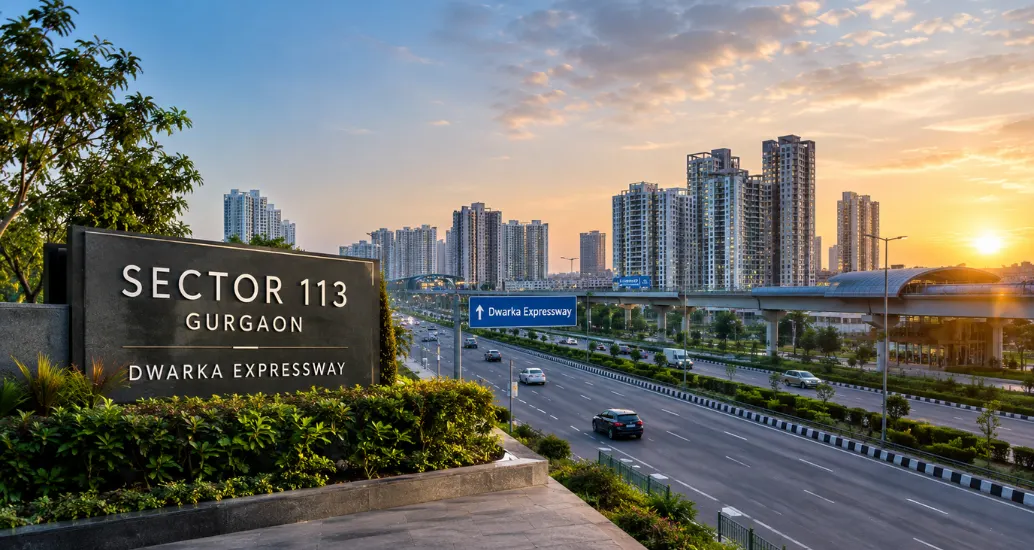
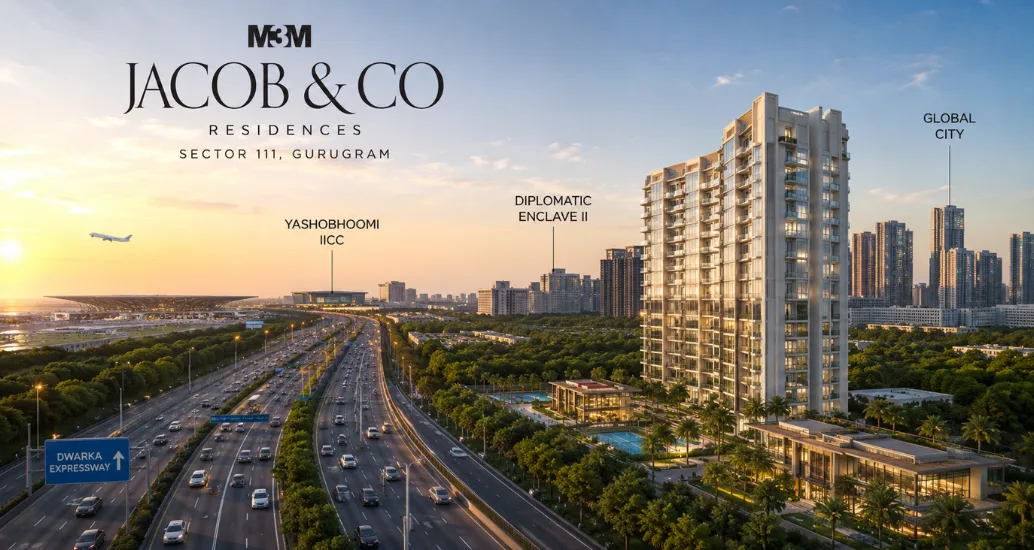
M3M Jacob & Co location sits in Sector 111, Gurgaon, right on the Dwarka Expressway, within the M3M Smart City (SCDA) township. It's about as close to the Delhi border as a Gurgaon address gets — practically zero kilometres — with IGI Airport roughly ten minutes away and Cyber City, Golf Course Road, and Udyog Vihar all within a fifteen-to-twenty-minute drive. Few Gurgaon projects can claim to function like a Delhi address while carrying a Gurgaon pin code.
As for M3M Jacob & Co connectivity, the short version is this: expressway frontage, an airport ten minutes out, a metro station under ten minutes away, and three institutional projects — a convention centre, a diplomatic enclave, and a planned business district — landing within the same few kilometres. That's the summary. Now let's break down why it holds up, and where the caveats sit.
The Exact Address and What It Means on a Map
Formally, this is M3M Jacob & Co Residences, Sector 111, Dwarka Expressway, Gurugram, Haryana, part of the larger M3M Smart City development. Sector 111 is one of the newest sectors on Gurgaon's map, licensed under Haryana's development framework and shaped heavily by GMDA and NHAI, since a national highway runs directly along its edge.
Pull up a satellite view and the position becomes obvious fast. Sector 111 borders Dwarka Sector 21 in Delhi to the north, sits within a short drive of IGI Airport's Terminal 3 approach, and opens south into the rest of Gurgaon along the expressway. Most developers stretch the truth on "Delhi proximity." Here, the map backs it up — the site genuinely touches the border.
For readers comparing this to the broader M3M Jacob & Co Gurgaon project, think of Sector 111 as the last sector before Gurgaon quietly becomes Delhi. That single geographic fact drives most of what follows in this guide.
M3M Jacob & Co Location Up Close: What's Actually Around You
A micro-location read looks at the two-to-three kilometre radius — the stuff that shapes your Tuesday evening, not just your quarterly flight schedule. This is also where the M3M Jacob & Co location story tends to hold up best under scrutiny, since it's the layer buyers can actually walk and drive through today rather than take on faith.
The project sits inside M3M Smart City, a 250-acre township that already hosts other premium addresses — M3M Crown, M3M Capital, M3M Elie Saab. Within that, M3M Jacob & Co occupies a dedicated low-density pocket buyers and brokers locally call the Billionaire's Block, roughly 170 acres reserved for globally branded residences only. That zoning choice matters more than it sounds. It keeps the immediate neighbourhood free of the construction dust and mismatched skylines that usually surround a sector this new.
Within that same radius, you'll find:
- Yashobhoomi (India International Convention Centre), positioned to become one of Asia's largest MICE venues once fully operational
- Diplomatic Enclave II, Delhi's second diplomatic zone, expected to eventually house dozens of foreign missions
- An International Sports Complex planned within Sector 111 itself
- Direct expressway frontage, cutting out the internal-road congestion most Gurgaon sectors deal with
I don't know another Gurgaon micro-market that sits this close to a diplomatic zone, a national convention centre, and an international airport simultaneously. That's precisely why global executives, NRIs, and HNI families have started circling this corridor over the past couple of years — though it's fair to say the surrounding social infrastructure is still catching up to the address itself, a point we'll return to later.
Macro-Location: Reading Sector 111 Against the Rest of NCR
Zoom out and Sector 111 sits at a genuine pivot point in the National Capital Region. NCR's growth has always followed a handful of corridors — NH-48 toward Jaipur, Golf Course Road toward Sohna, and lately, the Dwarka Expressway toward the airport and West Delhi. Sector 111 happens to sit exactly where that expressway meets the Delhi border.
Three things stack up here that rarely combine in one address. First, capital-adjacent prestige without Delhi's space crunch or ageing infrastructure. Second, New Gurgaon's planning discipline — wide carriageways, underground utilities, sector-level master plans that older corridors like MG Road never had. Third, an airport-first location, which is unusual for a purely residential project; most addresses this close to IGI Airport are hotels or commercial towers, not homes.
Put simply, Sector 111 works as the connective tissue between South Delhi's old-money prestige and Gurgaon's newer luxury belt. That's the macro case, and it holds regardless of which brand happens to be building here.
M3M Jacob & Co Connectivity: Roads You're Actually Driving On
Road access is where M3M Jacob & Co connectivity starts. The project fronts the Dwarka Expressway directly, with secondary access to NH-48, Southern Peripheral Road, and the still-developing Urban Extension Road-II. Together these give residents a route into Delhi and Gurgaon's commercial belt that mostly avoids traffic signals — a genuinely rare thing in this city.
The Dwarka Expressway
Also called the Northern Peripheral Road, this is a 29-km, access-controlled corridor connecting Dwarka in Delhi to Kherki Daula on NH-48. NHAI built it wide — sixteen lanes at its broadest stretches — with elevated sections and underpasses designed specifically to cut down at-grade signals. Practically, that means residents here spend most of a commute moving, not idling at a red light, which is more than most Gurgaon addresses can promise.
NH-48
Formerly NH-8, this remains the main artery toward Jaipur, Ahmedabad, and Mumbai, meeting the Dwarka Expressway at Kherki Daula. It gives residents a second route into central Gurgaon and onward to Manesar without leaning entirely on the expressway.
Southern Peripheral Road
SPR links Golf Course Extension Road to Sohna Road, running through some of Gurgaon's busiest residential pockets. It doesn't touch Sector 111 directly, but it's reachable through the expressway network and matters for anyone heading toward Golf Course Road or Sohna regularly.
UER-II
This peripheral expressway is still under construction, meant to relieve pressure on the Dwarka Expressway by giving traffic an alternate route toward Bijwasan and Delhi's western suburbs. Worth noting: it's planned, not finished. Buyers banking heavily on UER-II shaving minutes off their commute should treat that as a medium-term upside, not a day-one guarantee.
Taken together, these four roads put this address at the centre of Gurgaon's current and future highway network — a genuinely uncommon position for a single residential project.
M3M Jacob & Co Connectivity to the Airport: The Ten-Minute Reality
IGI Airport sits roughly ten to fifteen minutes away via the Dwarka Expressway, and this single number tends to close deals faster than any amenity list. For frequent flyers and NRI buyers especially, it's often the deciding factor over everything else in the brochure.
Here's why the number holds up on the ground: the route runs almost entirely on the expressway before merging into the airport approach road, so there's very little signal-stopping traffic to fight through. Compare that to Golf Course Road or Sohna Road, where an airport run during peak hours can stretch past forty-five minutes once you factor in the NH-48 toll plaza and the signal-heavy stretch near Cyber City. Sector 111 simply skips that bottleneck.
There's a commercial angle too. Aerocity, the airport's integrated hospitality and business district, sits just beyond the runway with several five-star hotels, corporate offices, and the diplomatic infrastructure taking shape nearby. Residents here effectively sit inside Aerocity's extended catchment while still living in a purpose-built residential township — a combination that's genuinely hard to find elsewhere in Delhi-NCR.
M3M Jacob & Co Connectivity by Metro and Rail
Dwarka Sector 21 is the nearest metro station, about five to seven minutes away, and it sits on the Airport Express Line — meaning residents can reach New Delhi Railway Station by rail in under twenty minutes once boarded, no car required.
That's a genuinely different proposition from most Gurgaon addresses, which lean on Delhi Metro's Yellow Line or the privately run Rapid Metro, both a fair distance from the Dwarka Expressway corridor. Talk of further metro extensions along this expressway has been circulating for a while, and if that materialises, it would bring a station meaningfully closer to Sector 111 itself. For now, treat it as a "watch this space" item rather than something to factor into today's commute math.
For longer rail journeys, Gurgaon Railway Station is fifteen to twenty minutes away for regional connections, while New Delhi Railway Station is thirty to forty minutes by road — faster if you catch the Airport Express instead of driving. Having both options nearby gives residents a flexibility that most peripheral Gurgaon sectors simply don't offer.
M3M Jacob & Co Connectivity to Delhi: The Border Advantage, Unpacked
This is the headline claim you'll see in every listing for this project, and for once, it largely checks out. The site sits at the Delhi-Gurgaon border, putting Dwarka, Vasant Vihar, and Dwarka Sector 21 within a genuinely short drive — not the 25-to-35-km haul you'd expect from Golf Course Road or Golf Course Extension Road.
Vasant Vihar, one of Delhi's older diplomatic and residential neighbourhoods, is about twenty minutes away. Dwarka's retail and residential zones are practically next door. For buyers who've kept family, schools, or social circles rooted in Delhi, that changes the calculus entirely — you get Haryana's more buyer-friendly property regulations and Gurgaon's newer civic infrastructure, without giving up easy access to the capital you already know.
M3M Jacob & Co Connectivity Into Gurgaon's Commercial Belt
The Delhi-border story gets most of the attention, but plenty of residents here will still commute locally, and that side of the connectivity picture deserves equal weight.
Cyber City and Udyog Vihar, Gurgaon's two biggest employment clusters, sit seven to ten kilometres away — a fifteen-to-twenty-minute drive via the expressway and NH-48. That's a genuinely workable daily commute, shorter than what residents further down Sohna Road or Golf Course Extension Road typically deal with.
Golf Course Road, still Gurgaon's most established retail and dining strip, is about fifteen minutes out, close enough for a dinner reservation without planning your evening around traffic. Gurugram's older CBD near MG Road takes closer to twenty-five to thirty minutes via NH-48 — not immediate, but reasonable given how far this corridor sits from the city's historic core. And for anyone tracking New Gurgaon's growth along Southern Peripheral Road and Sectors 76 through 95, that belt sits within a twenty-to-twenty-five-minute drive too.
The Three Developments Reshaping This Corridor
Global City, Diplomatic Enclave II, and Yashobhoomi are doing more to change Sector 111's trajectory than any single residential launch could. Worth understanding each on its own terms.
Global City is Haryana's flagship mixed-use push — a planned business and lifestyle district positioned to rival established financial hubs, sitting along the same expressway corridor. It's expected to bring serious Grade-A office space and retail within a short drive, though as with most large government-backed developments, actual delivery timelines tend to run longer than initial announcements suggest.
Diplomatic Enclave II is being built as Delhi's second diplomatic zone, meant to house foreign missions that no longer fit inside the original Chanakyapuri enclave. It sits roughly seven minutes from the project. Once operational, residents will effectively share their neighbourhood with embassies and the security infrastructure that typically comes with them — a genuine draw for expatriate buyers, and a mild consideration for anyone who prefers a purely residential feel.
Yashobhoomi, the India International Convention Centre, is already functioning as one of Asia's largest convention venues, roughly eight minutes away. A steady flow of business delegates and international visitors through a venue this close tends to support rental demand — something investors should weigh more heavily than end-users, since it's a commercial catalyst first and a lifestyle amenity second.
Schools Within Reach
| School | Approximate Distance | Approximate Drive Time |
| The Shri Ram School (Aravali/Moulsari) | 8-10 km | 15-18 minutes |
| Delhi Public School, various campuses | 6-9 km | 12-15 minutes |
| Amity International School | 7-9 km | 15 minutes |
| Pathways World School | 12-15 km | 20-25 minutes |
| DPS International Edge | 8-10 km | 15-18 minutes |
| GD Goenka Public School | 10-12 km | 18-20 minutes |
Families get an extra advantage here that most Gurgaon addresses don't offer — reasonable access to established South and West Delhi schools too, simply because the border sits so close.
Hospitals Within Reach
| Hospital | Approximate Distance | Approximate Drive Time |
| Medanta – The Medicity | 10-12 km | 18-20 minutes |
| Fortis Memorial Research Institute | 12-15 km | 20-25 minutes |
| Artemis Hospital | 12-14 km | 20-22 minutes |
| Max Hospital (various locations) | 10-13 km | 18-22 minutes |
| AIIMS, Delhi | 20-25 km | 30-40 minutes |
Multiple tertiary-care hospitals inside a twenty-minute radius is a genuine reassurance for families, and it's a comfort many peripheral sectors simply can't match yet.
Hotels, Shopping, and Everyday Convenience
Aerocity, right by the airport, carries a dense cluster of five-star names — JW Marriott, Andaz Delhi, Pullman, Novotel — within fifteen to twenty minutes. That's useful if you host international guests regularly; you're not booking rooms across the city, you're pointing them ten minutes down the road.
Retail is where I'd temper expectations slightly. Ambience Mall and Cyber Hub on Golf Course Road, roughly twenty minutes out, remain Gurgaon's strongest retail and dining destinations for now. Worldmark Gurgaon and Global Foyer near Golf Course Extension Road add further options at a similar distance, and on the Delhi side, Vasant Kunj's malls sit within comparable reach. Sector 111 itself doesn't yet have its own mature retail high street — that's coming with Global City, but it's not here today, and buyers should walk in with that expectation set correctly.
Employment Hubs Beyond Cyber City
Aerocity's commercial district houses airline offices, logistics firms, and multinational corporate teams near the airport itself. Global City, once operational, adds substantial office inventory right along the expressway. Further down NH-48, Manesar's industrial belt remains a thirty-five-minute drive, relevant if you or a family member works in manufacturing or automotive roles.
Few residential addresses in Gurgaon touch this many different employment sectors at once — aviation, diplomacy, IT, manufacturing, and soon finance through Global City. That spread matters more for long-term rental stability than most buyers initially realise.
Nearby Landmarks at a Glance
| Landmark | Category | Approximate Drive Time |
| IGI Airport, Terminal 3 | Transport | 10-15 minutes |
| Dwarka Sector 21 Metro | Transport | 5-7 minutes |
| Yashobhoomi (IICC) | Business / MICE | 8 minutes |
| Diplomatic Enclave II | Diplomatic | 7 minutes |
| International Sports Complex | Recreation | 10 minutes |
| Aerocity | Hospitality / Business | 15 minutes |
| Cyber City | Employment | 15-20 minutes |
| Ambience Mall, Golf Course Road | Retail | 20 minutes |
| Medanta – The Medicity | Healthcare | 18-20 minutes |
| The Shri Ram School | Education | 15-18 minutes |
A table like this won't replace an actual site visit, but it does give a realistic sense of what a resident's week looks like — errands, school runs, the occasional flight — without having to piece it together from five different brochures.
What's Still Being Built
Some of this corridor's biggest advantages are still under construction, and a consultant who doesn't say that plainly isn't being straight with you.
UER-II should ease pressure on the Dwarka Expressway once complete, giving residents an alternate route toward Delhi's western suburbs. Timelines for road projects in NCR have historically slipped, so treat this as a multi-year horizon rather than something arriving next season.
Metro extension talk along the Dwarka Expressway has been around for a while without a firm commitment date. If it happens, last-mile connectivity improves meaningfully. If it doesn't happen on the timeline currently floated, residents will keep relying on Dwarka Sector 21 as the nearest station — which, to be fair, already does a decent job on its own.
Global City and Diplomatic Enclave II are both under active development, and their eventual completion is what turns this from "expressway-facing sector" into "established diplomatic-business corridor." Buyers should factor in that some of the value case here is forward-looking, not fully realised yet.
Real Commutes, Not Just Distance Tables
Numbers on a table rarely capture how a location actually feels day to day. A few scenarios I've walked clients through over the years:
Someone flying internationally two or three times a month usually leaves home by 4:30 AM from a Golf Course Road address to clear traffic and security comfortably. From here, that buffer roughly halves, because the entire route runs on the expressway with almost no signals. Over a year, that's dozens of hours back in your life — probably the single most concrete benefit of this address.
A Cyber City professional gets a fifteen-to-twenty-minute daily commute, comparable to what a Golf Course Extension Road resident might experience heading to the same office, minus that resident's much longer airport and Delhi runs on weekends. A Delhi-rooted family — the kind still tied to South Delhi through parents, schools, or old friendships — reaches Vasant Vihar or Dwarka in under twenty minutes, bypassing Gurgaon's older, more congested stretches entirely. And for expatriate executives or diplomatic postings, having Diplomatic Enclave II and Yashobhoomi minutes away increasingly means the workplace is landing in the neighbourhood, not the other way around.
Different buyers reach the same conclusion through different lenses. The location works because it strips friction from whichever specific journey matters most to that household.
How This Fits Gurgaon's Longer Growth Pattern
I've watched this city's growth move in waves for two decades — DLF Phase 1 and MG Road in the nineties, Golf Course Road through the 2000s, Golf Course Extension Road and Sohna Road through the 2010s, and now the Dwarka Expressway corridor. Each wave followed roughly the same script: institutional infrastructure lands first, developers follow, and prices re-rate once that infrastructure stops being a promise and starts being visible on the ground.
What's different about Sector 111 is how much institutional-grade infrastructure is landing at once, rather than in the usual staggered fashion. A convention centre, a second diplomatic enclave, an expressway, and a planned business district — all within a few kilometres, all moving roughly in parallel. Earlier growth waves typically had one or two such anchors. This one has several, arriving close together. That's worth paying attention to if you're trying to read where the city goes next, though it also means the timing of your entry matters more than usual — buying too early into a still-forming corridor carries its own risk, which we'll get to under investment potential.
Investment Potential: The Honest Version
For an investor, location tends to be the strongest single predictor of long-term value, and this corridor ticks several boxes at once — airport proximity, a genuine Delhi-border address, a diversifying job base, and institutional infrastructure still mid-construction. NCR corridors that combined expressway frontage with government-backed infrastructure have historically seen strong re-rating once that infrastructure matured — Golf Course Extension Road is the clearest recent example.
Yashobhoomi and Diplomatic Enclave II in particular should support steadier rental demand from business travellers, diplomatic staff, and corporate executives — typically a more resilient tenant base than pure end-user demand. That said, resilience isn't certainty. A meaningful part of this thesis depends on Global City and the diplomatic enclave actually reaching operational maturity on something close to their stated timelines. Buyers weighing this purely as an investment should verify current RERA registration, pricing, and possession schedules directly with the developer, and treat the infrastructure story as an upside case rather than a locked-in outcome.
One thing I always tell investors: don't confuse a strong location thesis with a guaranteed timeline. I've seen corridors in Gurgaon sit "five years from maturity" for closer to eight, simply because government infrastructure projects rarely move as fast as the initial press release suggests. That's not a reason to avoid this address — it's a reason to size your entry and holding period around a realistic timeline rather than the optimistic one. Rental yields in newer expressway corridors also tend to lag capital appreciation in the early years, since tenant demand builds only after nearby offices and institutions actually open their doors. Anyone buying primarily for rental income should factor in a gap of a few years before the tenant base fully develops, rather than expecting immediate occupancy-driven returns.
Who This Location Actually Suits
End-users tend to value the daily convenience most — the short airport run, quick Delhi access for family and social life, a school and hospital network that's already functional even if retail is still catching up. NRI buyers usually weigh the airport proximity above everything else; a ten-minute drive from touchdown to home genuinely reduces the friction of periodic visits in a way brochures rarely oversell. Investors should focus less on today's amenities and more on the trajectory — diplomatic, aviation, and business infrastructure converging on one corridor at an early stage of its appreciation curve, assuming that infrastructure delivers on schedule.
Distance and Drive-Time Reference
| Destination | Approximate Distance | Approximate Drive Time |
| IGI Airport (Terminal 3) | 10-12 km | 10-15 minutes |
| Dwarka Sector 21 Metro Station | 4-5 km | 5-7 minutes |
| Diplomatic Enclave II | 5-6 km | 7 minutes |
| Yashobhoomi (IICC) | 6-7 km | 8 minutes |
| International Sports Complex | 5-6 km | 10 minutes |
| Cyber City / Udyog Vihar | 7-10 km | 15-20 minutes |
| Golf Course Road | 12-14 km | 15 minutes |
| Gurugram CBD (MG Road) | 20-22 km | 25-30 minutes |
| New Delhi Railway Station | 22-25 km | 30-40 minutes |
| Vasant Vihar, Delhi | 15-17 km | 18-20 minutes |
| Manesar Industrial Zone | 30-32 km | 35 minutes |
Treat these as approximate; traffic on the expressway varies by hour, and it's always worth checking live conditions before a time-sensitive trip.
How It Stacks Up Against Other Corridors
| Corridor | Airport Distance | Delhi Border Distance | Where It Wins |
| Sector 111 / Dwarka Expressway | ~10-15 min | ~0 km | Airport access, Delhi proximity, diplomatic zone |
| Golf Course Road | ~35-45 min | ~30+ km | Mature retail, dining, established social life |
| Golf Course Extension Road / SPR | ~40-50 min | ~35+ km | Golf-centric living, newer construction quality |
| Sohna Road | ~45-55 min | ~40+ km | Value pricing, longer growth runway |
No other established Gurgaon corridor currently pairs the same M3M Jacob & Co location advantages of airport speed and genuine Delhi-border access. Older corridors make up for it with retail and social infrastructure that's simply had more time to mature — which is the real trade-off buyers are weighing, not a straightforward win on every count.
The Honest Pros and Cons
What works in this location's favour:
- A genuine near-zero distance to the Delhi border, rare in Gurgaon's luxury segment
- One of the fastest airport runs of any residential address in NCR
- Direct expressway frontage with minimal signal-stopping traffic
- Proximity to three major institutional projects — Yashobhoomi, Diplomatic Enclave II, Global City
- A low-density, master-planned enclave within M3M Smart City
Where buyers should temper expectations:
- Local retail and entertainment infrastructure is genuinely thin right now compared to Golf Course Road
- Metro extension and UER-II remain under construction, with no firm delivery date
- As a young sector, everyday social infrastructure — parks, community spaces outside the project itself — is still forming
- A meaningful part of the long-term value case depends on nearby government projects delivering on schedule, which isn't guaranteed
An Honest Expert Take
Government-anchored infrastructure — an airport link, a diplomatic zone, a convention centre — tends to arrive before private real estate catches up in value, not after. Golf Course Road proved that pattern in the 2000s. Golf Course Extension Road proved it again in the 2010s. Sector 111, backed by Yashobhoomi, Diplomatic Enclave II, and Global City, looks like it's tracing the same arc, just earlier in the cycle.
If you want an established neighbourhood feel with mature retail today, a corridor like Golf Course Road probably still suits you better. If you're comfortable buying somewhat ahead of the infrastructure curve in exchange for airport convenience and genuine Delhi-border prestige, this address — and the broader M3M Jacob & Co Gurgaon development it sits within — makes a stronger case than most alternatives currently on the market. Just go in with eyes open about the timeline.
 Sumit Mishra / Property Counselor
You Must Read:
 Residential