

arrow_backBack to Blog

Finance
What Is RERA and Why It Matters for Home Buyers
Let me tell you something nobody tells you when you are about to buy a home.
You spend years saving money. You visit dozens of projects. You trust a builder's brochure. You sign a big
agreement. You pay lakhs of rupees. And then — you wait. And wait. And wait some more.
Three years pass. Then five. Your flat is still a concrete skeleton. The builder stops picking up calls. You
have no idea where your money went.
This is not a made-up story. This happened to thousands of real families across India — in Noida, Pune,
Gurgaon, Bengaluru — before 2017.
Then the government passed a law that changed everything for property buyers in this country.
That law is RERA.
If you are planning to buy a home — or even thinking about it — understanding what is RERA and why it
matters is the single most important thing you can do before spending a single rupee.
This guide is written in plain, simple language. No confusing legal terms. No complicated jargon. Just
clear, honest information that helps you protect yourself.
Let's get into it
What Is RERA?
RERA stands for Real Estate (Regulation and Development) Act, 2016.
It is a central law passed by the Indian Parliament. It came into effect on 1st May 2017.
In the simplest possible words — It is the set of rules that builders must follow when they sell you a home.
Think of it this way. When you go to a restaurant, you expect the food you ordered. Not something else.
Not half the portion. And definitely not a 3-year wait.
This law does exactly that for real estate. It makes sure the home you pay for is actually what you get —
on time, at the right size, with proper paperwork, and without any nasty surprises.
Every state in India has its own RERA authority that handles registrations and complaints. In Haryana, this
authority is called HRERA — Haryana Real Estate Regulatory Authority. If you are buying property in
Gurgaon, Faridabad, or anywhere in Haryana, HRERA is the body that protects you.
Why Was RERA Introduced?
Before 2017, nobody was watching over the real estate sector.
Builders could advertise dream projects, collect crores from buyers, and then do whatever they wanted.
Launch prices were low. Promises were big. Accountability was zero.
There was no standard definition of carpet area. Every builder measured it differently. A 1,200 sq. ft. flat in
one project was barely 800 sq. ft. of actual living space.
There was no rule about what happens if a builder delays by 3 or 5 years. Buyers had no legal teeth.
Courts were slow. Consumer forums were clogged.
The government saw what was happening — and this law was the answer.
The law was designed with one clear purpose: make real estate fair for the buyer.
What Buyers Went Through Before RERA
To truly understand what is RERA and why it matters, you need to see what life looked like without it.
Possession was just a word. Builders gave possession dates in agreements and then missed them by years. There was no financial penalty for this.
Your money was not safe. Builders collected money from 10 different projects and pooled it together. If one project ran dry, they used funds from another. Buyers had no idea this was happening with their hard-earned savings.
Super built-up area was a trap. The area the builder quoted always included walls, lifts, corridors, staircases — things you never actually use. The real usable area was always smaller. Sometimes much smaller.
Agreements were one-sided. Builders drafted contracts that protected only themselves. Penalty clauses for the builder were either missing or written so softly that enforcing them was nearly impossible.
Complaint? What complaint? If a buyer tried to fight back legally, they were looking at years inside a slow civil court. Most people simply gave up.
The law put an end to all of this.
What Is RERA and Why It Matters for Home Buyers
Here is the direct answer.
RERA matters because it shifts the power back to you — the person spending the money.
Before this law, builders held all the control. After this law, buyers have real legal rights that are actually enforceable.
Here is what changed specifically for you as a buyer:
You can see everything before you pay. Every registered project has a public file — land approvals, building plans, timeline, financial details. It is all online. Free to check. Anyone can see it.
Your money goes into a protected account. This is one of the most powerful protections in the law. We will cover this in detail below, but the short version is — a large portion of your money cannot be touched by the builder for anything other than your specific project.
The possession date is a legal commitment. If the builder misses it, he has to pay you interest every single month of the delay. This is not optional. It is law.
You have a fast-track complaint system. If something goes wrong, you do not have to wait years in a civil court. You file a complaint with RERA online, and it must be resolved within 60 days in most cases.
The builder is personally responsible. Under RERA, both the company and its promoters can be heldaccountable. There is no hiding behind a corporate entity.
Main Benefits of RERA for Buyers
Complete Transparency
Every registered project is listed on the state portal with full details. Floor plans, approvals, number of units, possession timeline, builder's background — all of it is publicly visible.
You are not dependent on a salesperson telling you what you want to hear. You can verify everything yourself, independently, for free.
Possession on Time — or You Get Paid
The law makes the possession date legally binding. If the builder fails to hand over your flat on the promised date, he must pay you interest on your total investment for every month he is late.
The interest rate is typically linked to the SBI's marginal cost lending rate — which works out to roughly 9–10% per annum. On a 60-lakh investment, that adds up quickly. This gives builders a strong financial reason to actually complete on time.
Builder Cannot Misuse Your Money
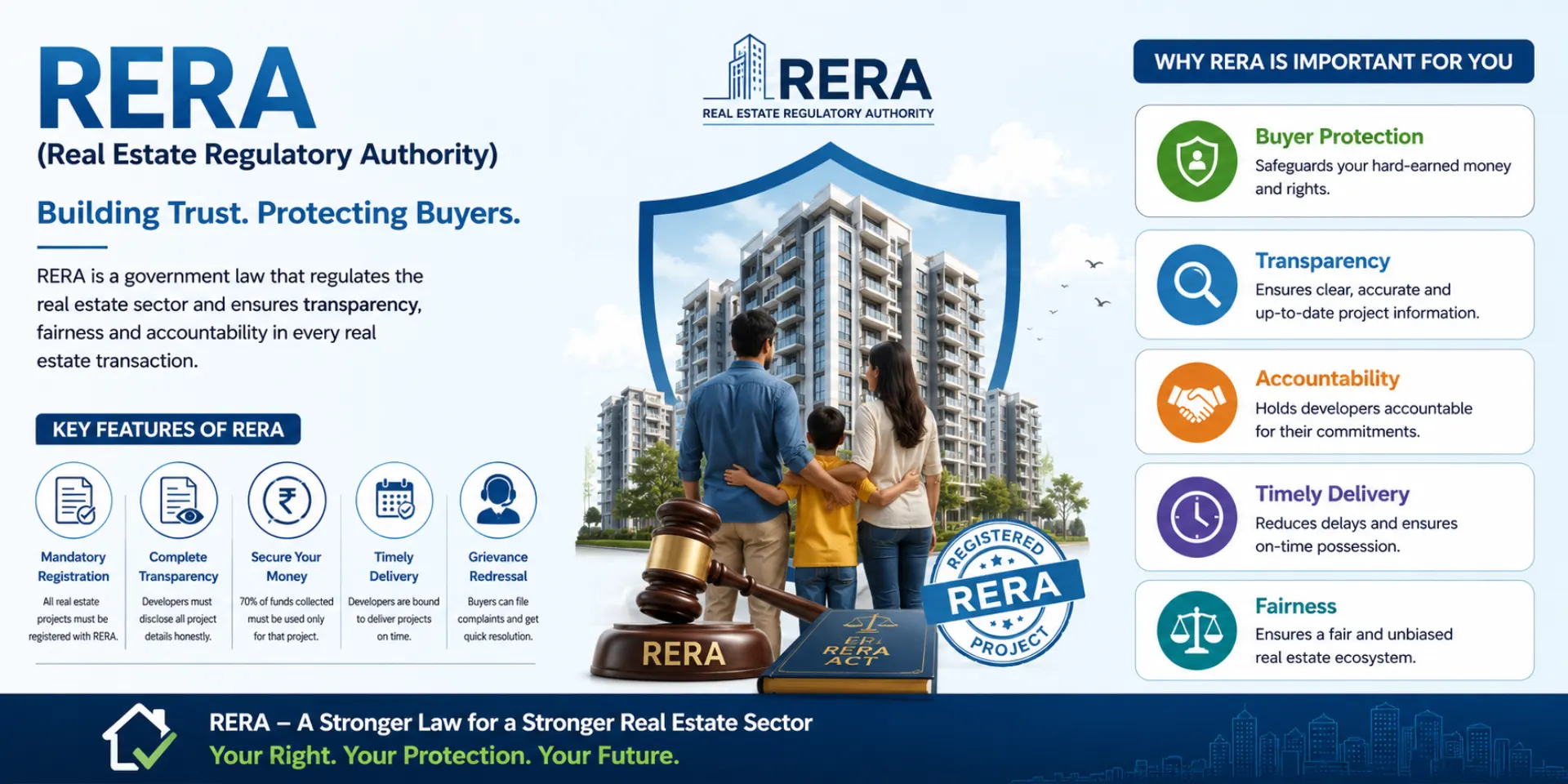
70% of all the money collected from buyers in a project must go into a dedicated escrow account. This money can only be used for that specific project. The builder cannot divert it to another site, another project, or his personal use.
Before RERA, this kind of fund diversion was extremely common. Entire projects stalled because the builder had quietly moved the money elsewhere. The escrow rule is a direct solution to that problem.
One Clear Definition of Carpet Area
The Act fixed the definition of carpet area once and for all.
Carpet area = the net usable floor area inside your flat. Nothing else. No common areas, no walls, no balconies counted separately in a misleading way.
This means if you are buying a 1,000 sq. ft. flat under RERA, you are getting 1,000 sq. ft. of actual living space. The era of inflated super built-up area calculations is over — at least for registered projects.
Legal Protection That Works
If a builder violates the agreement, you have the right to:
- Get a full refund of your money with interest
- Claim compensation for mental agony and financial loss
- File a complaint that must be resolved in 60 days
- Approach the the Appellate Tribunal if you are not satisfied
These are not vague promises. They are legally enforceable rights.
Structural Defect Warranty
Even after you get possession, the builder remains responsible for any structural defect in the flat for 5 years. If walls crack, plumbing fails, or the roof leaks within this period, the builder must fix it at his own cost.
This warranty did not exist in any standardized form before RERA.
How RERA Works in Real Estate — The Simple Version
RERA operates through a three-step system.
- Step 1 — Registration Before Launch. Before a builder can advertise, take bookings, or collect any money, he must register the project with the state authority. He submits all documents — land title, approvals, plans, timeline, CA-certified financials. The authority reviews everything and issues a unique registration number.
- Step 2 — Escrow and Quarterly Updates. Once the project is live, the builder must maintain the escrow account for buyer funds and update the the regulatory portal every quarter with actual construction progress. This creates a live, public record of what is happening on site.
- Step 3 — Complaint and Resolution. If any buyer faces a problem — delay, plan change, quality issue, refund refusal — they can file an online complaint. The adjudicating officer must resolve it within 60 days. That's the whole system. Transparent, accountable, and buyer-friendly.
The Escrow Account — Why It Is Such a Big Deal
Most buyers hear the word "escrow" and glaze over. But this is actually one of the most powerful protections RERA offers. Let me explain it simply.
When you buy an under-construction flat, you pay in installments over time. Before RERA, that money went directly into the builder's general account. He could — and often did — use it however he liked.
RERA changed this completely.
Now, at least 70% of all buyer payments must go into a separate, dedicated escrow account for that specific project. The remaining 30% can be used for land costs and other expenses.
The money in the escrow account can only be withdrawn by the builder to pay for actual construction expenses on your project — and only after a certified engineer, architect, and CA confirm that the corresponding work has been done.
This is not a formality. Regulatory authorities actively audit these accounts. Builders who divert funds face serious penalties.
For someone investing 50 to 80 lakhs in a home, knowing that the bulk of your money is ring-fenced and earmarked for your flat — that is genuine peace of mind.
RERA Rules Builders Must Follow
Builders have a long list of obligations. Here are the most important ones in plain language:
Before selling a single flat:
- Project must be registered with RERA
- All government approvals must be in place
- The registration number must appear in every advertisement, brochure, and email
While the project is under construction:
- Quarterly updates on construction progress must be uploaded to the regulatory portal
- 70% of buyer funds must stay in the escrow account
- Building plan cannot be changed without written consent from at least two-thirds of buyers
At the time of possession:
- Must handover on the date committed in the registered agreement
- Must provide Occupancy Certificate and all relevant documents
- Must register the sale deed
After possession:
- Structural defects must be rectified free of cost for 5 years
- No extra charges can be demanded beyond what was in the agreement
Violating any of these rules can result in fines up to 10% of the project value, cancellation of RERA
registration, or in serious fraud cases — imprisonment.
How to Get a Project RERA Registered
Here is how the registration process works from the builder's side — useful for buyers to understand what
a legitimate project goes through.
The builder applies to the state authority (HRERA for Haryana, MahaRERA for Maharashtra, etc.) with a
full set of documents.
- PAN and identity proof of the promoter or company
- Land title documents proving ownership
- Sanctioned building plans and layout approvals
- Environmental clearance and fire NOC
- Details of the architect, structural engineer, and project CA
- Audited financial statements
- Clear possession timeline with specific date
The The authority has 30 days to process the application. If approved, the project gets a unique registration number. If rejected, the builder is informed of the reason.
Without this registration number, the builder cannot legally sell, advertise, or collect money for the project.
How to Check if a Property Is RERA Registered
This is the most important thing you will do before buying any property. It takes 5 minutes and it is free.
For Haryana and Gurgaon:
Go to hrera.org.in
For Maharashtra:
Go to maharera.mahaonline.gov.in
For Delhi:
Go to rera.delhi.gov.in
For any other state, search: "[State name] RERA official website" on Google.
Step-by-Step Verification Guide
- Step 1: Open the official RERA website for your state.
- Step 2: Look for "Registered Projects" or "Search Projects" on the homepage.
- Step 3: Enter the project name, builder name, or registration number provided by the builder.
- Step 4: Hit search. The project details will appear if it is genuinely registered.
- Step 5: Cross-check the possession date, total units, and builder details with what you have been told.
- Step 6: Also check the complaints section to see if there are any pending issues against the builder or this project.
If the project does not appear — or the details do not match what the builder told you — treat this as a serious red flag and do not proceed.
What If the Builder Has No RERA Number?
Any project with more than 8 flats or more than 500 sq. meters of total land is legally required to be RERA registered before it can sell. No exceptions.
If a builder tells you "RERA doesn't apply to us" — verify that claim independently through the state RERA office. Do not take the builder's word for it.
If you have already paid money and the builder has no RERA registration:
- Demand a written explanation
- File a complaint with the state authority immediately
- You are legally entitled to a full refund with interest in such cases
- This situation is unfortunately not rare. Stay alert.
Builder Tricks Buyers Should Watch Out For
Even with this law in place, some builders find creative ways to mislead buyers. Here is what to watch out for:
"We will register it soon." Some builders collect bookings with a small token amount before the project is registered. This is illegal. Never pay anything — not even a booking amount — before the registration number exists.Verbal promises that never make it to paper. A builder might promise a club house, a swimming pool, a school nearby, or a specific view. If it is not written in the registered agreement, RERA cannot help you enforce it.
Super built-up area confusion. Even today, some builders quote prices based on super built-up area. Under RERA, you should pay based on carpet area. If the builder is quoting otherwise, ask for a clear carpet area calculation.
Showing sample flats with luxury finishes not in the specs. Walk through the agreement carefully. The sample flat is not a legal promise. What is written in the spec sheet and agreement is Pressure tactics. "Only 3 flats left." "Price going up next week." These are classic sales tactics.
Legitimate projects can wait 7 days for you to verify RERA details. If a builder cannot give you that time he probably has something to hide.
RERA-Registered vs Non-RERA Project: The Real Difference
| What You Are Checking | RERA Registered Project | Non-RERA Project |
| Legal status | Fully compliant and fully legal | Potentially illegal |
| Possession guarantee | Legally binding date | No guarantee at all |
| Buyer money protection | 70% in escrow account | No protection |
| Complaint resolution | 60 days via RERA | Years in civil court |
| Plan change without consent | Not allowed | Builder's discretion |
| Carpet area definition | Clear and standardized | Builder-defined |
| Public project information | Available on the regulatory portal | Not available |
| Safe to invest? | Yes, with verification | High risk |
The choice, when you see it laid out like this, is obvious.
How to File a Filing a Complaint
If you have a genuine problem with a builder — delay, poor quality, refund refusal, plan change — here is
exactly how to file a complaint:
Step 1: Visit your state portal. Go to the "Complaint" or "Grievance" section.
Step 2: Register as a complainant using your Aadhaar and PAN details.
Step 3: Fill in the complaint form. Include the builder's project registration number, nature of the problem,
and a clear timeline of events.
Step 4: Upload all supporting documents — payment receipts, agreement copy, email correspondence,
booking letter
Step 5: Pay the complaint filing fee. This is usually between Rs. 1,000 and Rs. 5,000 depending on the
Step 6: Submit and note your complaint reference number.
You should receive an acknowledgment within 15 days. The matter is typically heard and resolved within
60 days.
You can complain about:
- Delayed possession
- Unauthorized changes to the building plan
- Builder refusing to register the sale deed
- Structural defects within 5 years of possession
- Refusal to refund money
- Overcharging beyond what is in the agreement
- Builder not maintaining the escrow account properly
HRERA Gurgaon — What You Need to Know
If Gurgaon is where you are investing, what is RERA and why it matters becomes especially relevant —
and HRERA is the regulatory body you must know about.
HRERA (Haryana Real Estate Regulatory Authority) operates two benches:
HRERA Gurugram handles complaints and registrations for: Gurugram, Faridabad, Palwal, Nuh, Rewari,
and Mahendragarh districts.
HRERA Panchkula handles: Panchkula, Ambala, Sonipat, Rohtak, Hisar, Karnal, and surrounding areas.
Official website: hrera.org.in
On this portal you can search any registered project in Haryana, check builder registration status, file
complaints, track complaint status, and read quarterly progress updates of any project.
HRERA has been one of the more active state regulatory bodies in India. It has handled hundreds of major
cases — including against some of the biggest names in Gurgaon real estate — and issued significant
compensation orders in favor of buyers.
If a developer is operating in Haryana, they need to be registered here. If they are not — that alone is
enough reason to walk away.
Gurgaon Real Estate and RERA: The Ground Reality
Gurgaon is one of India's most dynamic property markets. It has also been one of the most troubled —
with large-scale project delays spanning a decade in many cases.
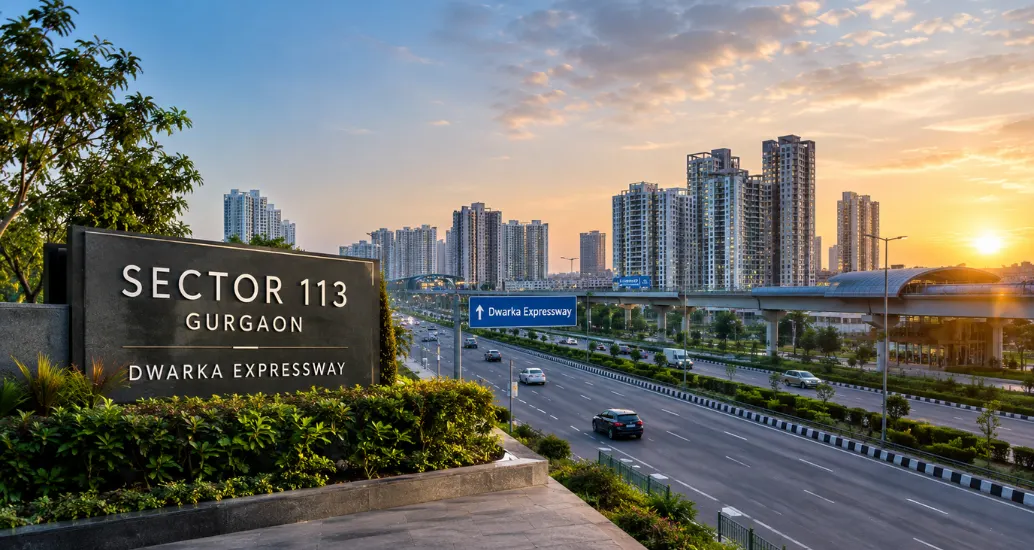
Before RERA, buyers in Dwarka Expressway, Golf Course Extension Road, Sohna Road, and Southern
Peripheral Road were among the worst-hit. Projects that were supposed to deliver in 2014–2015 were still
unfinished in 2021–2022.
Post-RERA, the picture has improved meaningfully. New projects launched after 2017 carry legal
timelines. HThe authority has forced several builders to either complete their projects or compensate
buyers. The market has moved toward more credible, organized developers — partly because smaller
fly-by-night builders cannot survive the compliance burden of RERA.
For buyers in Gurgaon today:
- Always verify the project on hrera.org.in before committing
- Check how many complaints are filed against the builder in question
- Look at the builder's track record on past project deliveries
- Read the possession date on the regulatory filing — not just what the sales executive tells you
Gurgaon continues to offer strong property investment opportunities. RERA makes it significantly safer
than it was five years ago.
How RERA Makes Property Investment Safer
Beyond individual buyer protection, understanding what is RERA and why it matters helps explain how it
has changed the fundamental risk profile of real estate investment in India.
Verified land title. Builders must submit ownership documents to RERA before registration. This reduces
the chance of buying property on disputed or encumbered land.
No more ghost projects. Before RERA, some builders would launch projects on paper without the basic
approvals. Now, approvals are a pre-condition for registration.
Public accountability. Because project details are public, journalists, consumer groups, and potential
buyers can spot problems early. Builders know they are being watched.
Delivery guarantee with financial teeth. The interest penalty for delay is not symbolic — it is real money.
This alone has pushed many developers to genuinely prioritize completion.
NRI confidence. Overseas Indians investing in property back home have historically been among the
easiest targets for fraud. This law has given NRI buyers a legally backed platform to invest with greater
confidence.
Together, these factors make a RERA-registered property one of the more structurally sound investments
you can make in India today.
Checklist: What Buyers Must Verify Before Buying
Before you sign anything or pay any amount — go through this list:
Legal verification:
- Registration number verified on state portal
- Possession date checked on RERA filing (not just sales team's word)
- Complaint history of builder checked on RERA website
- Land title and ownership documents reviewed
- All government approvals confirmed (building plan, environment, fire)
Financial verification:
- Builder's past project delivery record researched
- Any news of defaults or delays with previous projects checked
- All payment terms and charges spelled out in the agreement
Agreement review:
- Carpet area clearly mentioned (not super built-up)
- Possession date with delay penalty clause included
- All promised amenities listed in writing
- Maintenance charges and other fees disclosed upfront
On-ground check:
- Visit the actual construction site, not just the sample flat
- Speak to buyers who have invested in previous projects by the same builder
- Hire a property lawyer to review the sale agreement
Common Mistakes Home Buyers Still Make
This law has made real estate much safer — but buyers still make avoidable mistakes.
Relying on verbal commitments. Sales staff will make promises that sound great but mean nothing
legally. If it is not in the registered agreement, it does not exist.
Not reading the agreement. This is a legal document that governs your crore-plus investment. Many
buyers sign it without reading a single line. Do not do this.
Ignoring the builder's complaint history. state portals show publicly filed complaints. A builder with 50+
active complaints is telling you something important about how he operates.
Falling for artificial urgency. "Offer valid only today" and "only 2 flats left" are pressure tactics as old as
the industry itself. Take the time you need to verify everything properly.
Underestimating total cost. The flat price is just one part. Add stamp duty (5–7%), registration charges,
GST (5% for under-construction), society charges, parking cost, and maintenance deposit. These add up
significantly.
Skipping legal consultation. A property lawyer charges maybe Rs. 10,000–15,000 to review your
agreement. Given the size of the investment, this is among the best money you will spend.
Expert Tips for Safe Property Investment in India
These are things that experienced real estate advisors tell buyers. Once you understand what is RERA
and why it matters, these tips naturally fall into place.
Verify the registration number before paying even the booking token. Not after. Before.
Visit the site in its current construction stage. See actual progress. Take photos. Ask the site supervisor
questions.
Talk to existing investors in the project. Most are willing to share their experience honestly, especially if
things are going well or badly.
Search the builder's name on Google News. Look for reports of delays, fraud, or legal trouble. What you
find in 10 minutes online could save you years of pain.
Do not stretch beyond your financial capacity for an under-construction property. Under-construction
homes carry time risk. Life changes. EMIs can become burdensome if the project delays by 2–3 years.
Get everything in writing. Parking space — in writing. Club membership — in writing. Possession date —
in writing. Penalty for delay — in writing.
The Future of Real Estate After RERA
The real estate sector has already been transformed. But it is still evolving.
Here is what the future looks like:
The number of serious, organized developers is increasing. Builders who cannot meet regulatory
compliance standards are exiting the market. The ones who remain are generally more credible.
State RERA portals are improving year by year. Real-time project updates, automated alerts to buyers,
and digital complaint tracking are becoming standard in progressive states.
Enforcement is getting stricter. HRERA and several other state bodies have become significantly more
assertive in recent years — issuing recovery certificates and attaching builder assets to enforce
compensation orders.
Buyer awareness is rising. The average home buyer today is far more likely to check project registration
than a buyer in 2018. This awareness itself is a form of protection.
The Indian real estate market is on a strong growth trajectory. This regulation is the foundation that makes
this growth trustworthy — not just for individual buyers, but for the long-term health of the sector.
Conclusion
So let's bring it back to where we started.
You are about to make one of the biggest financial decisions of your life. You deserve to make it with full
information, genuine protection, and real legal rights.
Understanding what is RERA and why it matters is not a technicality. It is the foundation of safe property
buying in India today.
This law does not guarantee that every builder will be perfect. No legislation can do that. But it gives you
the tools — the legal framework, the complaint mechanism, the financial protections — to hold builders
accountable when things go wrong.
For buyers in Gurgaon and Haryana, HRERA at hrera.org.in is your direct point of contact for everything
from project verification to complaint filing.
Always check the registration. Always read the agreement. Always verify before you pay. And always
invest in projects where the builder has a clean track record on the regulatory portal.
Your home is not just an investment. It is where your family will live. Protect it like it matters — because it
Frequently Asked Questions
What is RERA in simple words?
When people ask what is RERA and why it matters, the simplest answer is this: it is a law that protects
home buyers in India. It makes builders register their projects before selling, keeps your money safe in a
separate account, holds them to a legal delivery timeline, and gives you a fast-track complaint process if
something goes wrong. In plain terms, it is the rulebook that makes builders answer to you.
Is RERA mandatory for all real estate projects?
Registration under this law is mandatory for all projects where the land is more than 500 sq. meters or
where there are more than 8 apartments. Most significant residential and commercial projects fall under
this. Very small developments may be exempt, but this is the exception rather than the rule.
How can I check if a project is RERA approved?
Visit your state portal — for Haryana and Gurgaon, that is hrera.org.in. Go to "Search Projects," enter the
project or builder name, and all registered details will appear. You can also check the complaint history for
that project or builder on the same website.
Can I file a complaint against a builder through RERA?
Yes. You can file an online complaint on the state portal. You will need the builder's registration number,
your booking and payment documents, and a clear description of the issue. RERA authorities are required
to resolve complaints within 60 days in most cases.
What happens if my builder delays possession?
Under RERA, a builder who misses the possession date must pay you interest on your full invested
amount for every month of delay. The rate is typically linked to the SBI lending rate — around 9–10% per
year. You also have the right to exit the project entirely and get a full refund with this interest.
Is RERA useful for buyers in Gurgaon specifically?
Very much so. The HRERA Gurugram bench has been one of the more active regulatory bodies in India. It
has processed hundreds of complaints against Gurgaon-based developers and issued real compensation
orders. Checking hrera.org.in before buying any Gurgaon property is one of the most important steps you
can take.
What is HRERA Gurgaon?
HRERA stands for Haryana Real Estate Regulatory Authority. It is the state-level body that implements
RERA across Haryana. The Gurugram bench specifically handles registrations and complaints for
Gurugram, Faridabad, and nearby districts. Their official website is hrera.org.in.
Can a builder sell property without RERA registration?
No. Selling a qualifying project without RERA registration is illegal. If a builder is doing this, buyers can file
a complaint and are legally entitled to a full refund with interest. Always demand the registration number
before any discussion of payment.
 Sumit Mishra / Property Counselor
You Must Read:
 Residential