

arrow_backBack to Blog
Other
Freehold vs Leasehold Property in India: Key Differences Explained
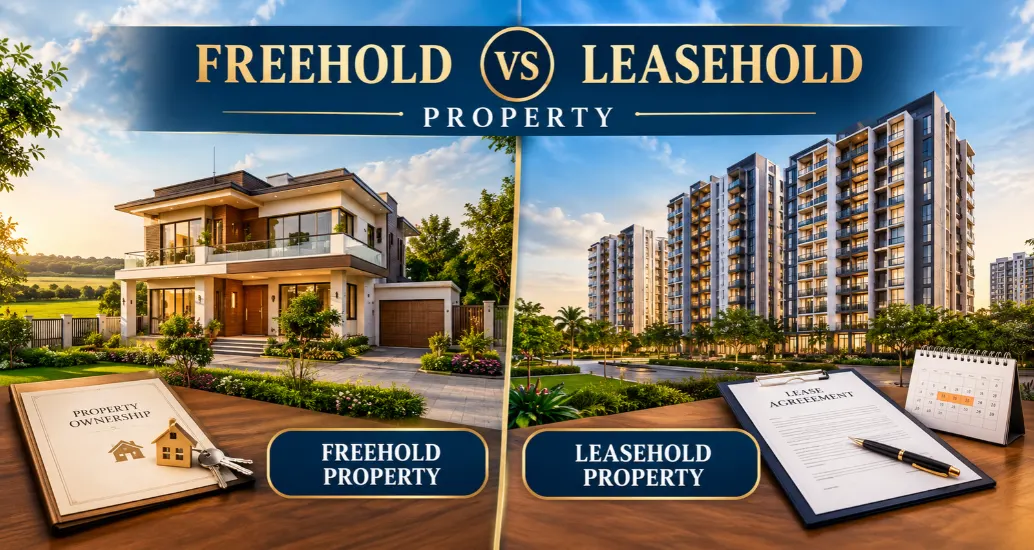
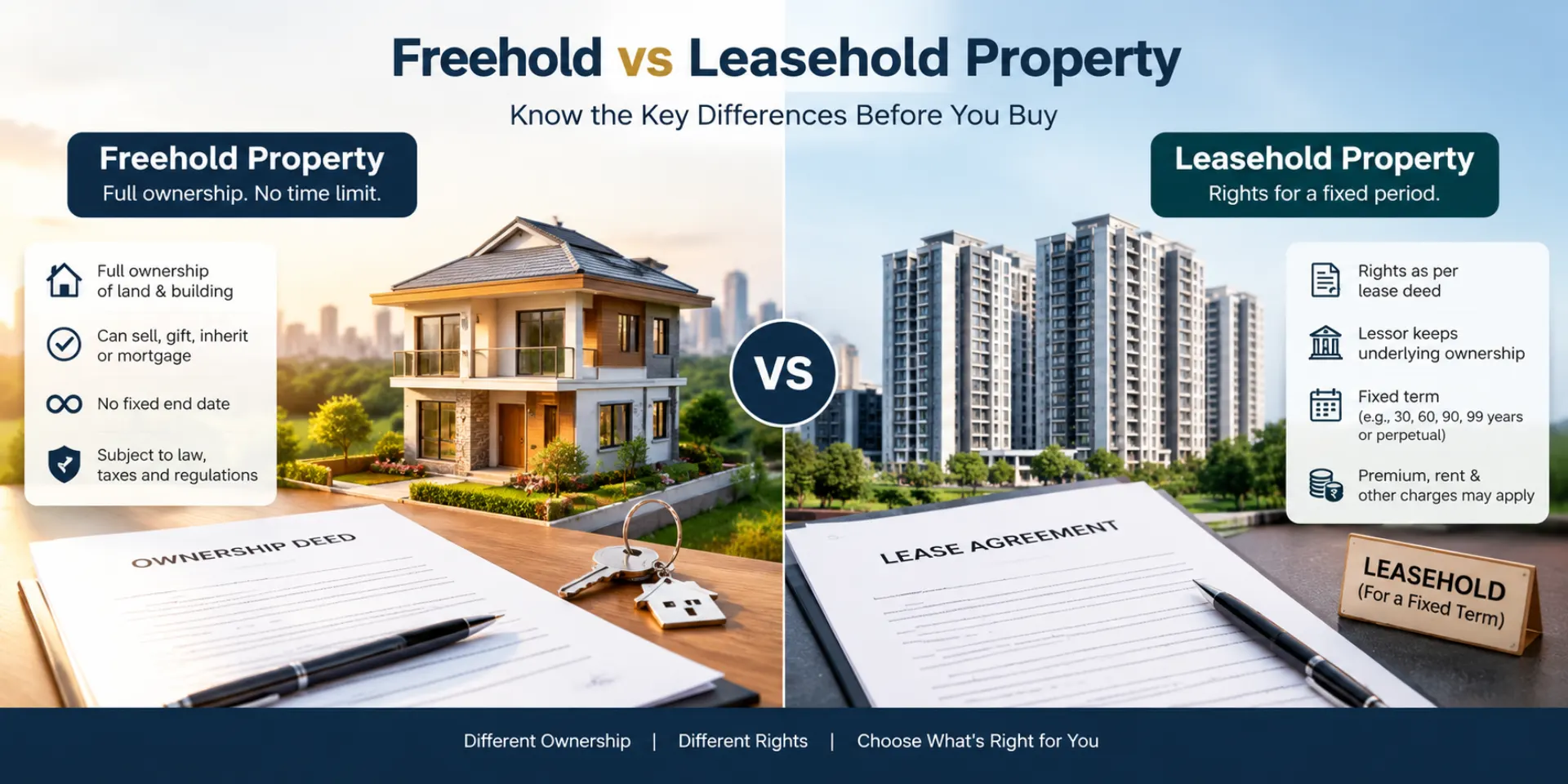
Freehold ownership has no fixed end date. You own the property and can sell it, gift it or leave it to heirs, subject to the law. Leasehold means you hold the property under a lease deed, usually for a fixed number of years. The lessor keeps the underlying ownership or interest in the property, while you, as the lessee, hold the rights granted under the lease deed. The lessor is often a government authority but can also be a private owner. The exact rights depend on the lease terms and applicable rules.
In India, what you can do with a leasehold property (sell, inherit, mortgage or rebuild) depends on the lease deed, the law and the authority's rules. So read the deed, count the years left and check local rules before you pay.
What Is Freehold Property?
Freehold property is property you own outright, with no time limit on your ownership. You hold the land and the building, or in a flat, the flat plus your share of the land.
As an owner you can usually:
- sell or gift the property through a registered deed;
- pass it on by will or by succession law;
- mortgage it to a lender, if your title is clear.
Freehold does not mean "no rules". Your title must be valid. Land-use rules, building regulations, society bylaws and taxes still apply. A freehold property with a weak title is still a risky purchase.
Apartments and the land beneath them. If you buy a flat, you own the flat. The land may be held in one of two common ways. In some states each owner holds an "undivided share" of the land, which means a share of the whole plot, not a marked patch, and the sale deed should mention it. In others, a co-operative society holds the land once the builder signs a conveyance deed in the society's favour. Which model applies depends on state law and your documents, so check what your deed says.
What Is Leasehold Property?
Leasehold property is property you hold under a lease, for a fixed period or in perpetuity, in return for a premium or rent paid to the lessor. Section 105 of the Transfer of Property Act, 1882 defines a lease as the transfer of a right to enjoy immovable property for a certain time, or in perpetuity, for a price paid or promised.
Lessor and lessee. The lessor grants the lease. It may be an authority such as DDA, Noida Authority, YEIDA or CIDCO, a state housing board, or a private landowner. The lessee takes the lease. Their rights and duties come from the lease deed. Where the deed is silent, the default rules in Section 108 of the Act apply.
One of those defaults lets a lessee transfer their interest unless the contract says otherwise. But authority leases often add conditions. YEIDA's lease documents, for example, require written permission before a sale or sub-lease, and its brochures list a fee for permission to mortgage. The safe rule: the deed and the authority's rules come first.
What you may pay. Depending on the lease: an upfront premium or lease rent, periodic ground rent, a transfer charge when you resell, and fees for permissions such as a mortgage. Amounts differ by authority, so ask for current figures in writing.
The 99-year misconception. Not every leasehold runs for 99 years. YEIDA's brochures state 90-year terms. Other sources describe terms of 30, 60, 90, 99 or 999 years. Some leases are perpetual, because the Act itself allows a lease "in perpetuity". Also, 99 years is the original term. What matters to you is the years remaining.
Leasehold is not the same as renting. In daily use, renting means paying for temporary use. A leasehold purchase is long-term, is usually paid for with a premium, and gives you a transferable interest. Legally, even a short tenancy is a kind of lease, so the real differences are length, the price paid and the right to transfer. A leave-and-licence arrangement is weaker still: it gives permission to occupy, not an interest in the property. Read the clauses, not just the document's title.
Is a Perpetual Lease the Same as Freehold Ownership?
No. A perpetual lease has no fixed end date, because Section 105 of the Transfer of Property Act allows a lease to be granted "in perpetuity". But it is still a lease. The lessor keeps its underlying interest, and you hold the rights and follow the conditions set out in the lease deed. Those conditions often cover permitted use, lease rent and the lessor's permission to transfer. A freehold owner has no lessor to answer to on these points.
So do not treat the two as interchangeable, and do not assume a "perpetual" lease gives you freehold rights. Read the deed, and ask the authority whether a conversion scheme exists for your property.
Freehold vs Leasehold Property: Key Differences
| Comparison factor | Freehold property | Leasehold property |
| Ownership rights | Full ownership, subject to law and valid title | Rights set by the lease deed; you hold a leasehold interest, not the lessor's ownership |
| Land ownership | Owner, or shared through an undivided share or society | Lessor keeps the underlying ownership or interest; you hold the rights granted under the lease deed for the lease term. Exact rights depend on the lease terms and applicable rules |
| Ownership duration | No fixed end | Fixed term in the deed, or perpetual in some leases |
| Sale and transfer | Registered sale deed; no lessor permission needed, though other legal steps still apply | Default law allows transfer unless the deed says otherwise; authority leases often need permission and a transfer fee |
| Inheritance | Passes by will or succession law | Usually possible, but heirs get only the remaining term and may need to complete authority formalities. Check the deed |
| Mortgage | Possible with clear title; lender does its own checks | Possible, but may need lessor permission, and lenders look at years left |
| Ground rent | None on the land (property tax and maintenance still apply) | May apply, paid periodically or upfront, depending on the lease |
| Renewal | Not applicable | Depends on the deed and authority policy; perpetual leases need none |
| Lease expiry | None | Lease ends at the end of its term unless renewed or extended under the deed or policy |
| Conversion | Not applicable | Only where the authority runs a scheme; eligibility and dues apply |
| Buyer considerations | Title chain, land use, encumbrances, mutation | All freehold checks, plus lease deed, years left, permissions and dues |
Freehold vs Leasehold: Cost Comparison
The purchase price is only part of the cost. Leasehold can add authority charges that freehold usually does not, and both carry state-specific duties. Amounts vary by state and authority, so ask for current figures in writing.
| Cost factor | Freehold | Leasehold |
| Purchase price | Depends on location, title and market | Depends on location, lease terms and years remaining |
| Stamp duty and registration | State-specific charges on the sale deed | State-specific charges on the transfer document; ask the sub-registrar how your state treats it |
| Ground rent or lease rent | Generally no lease rent on the land (property tax and maintenance still apply) | May apply, paid periodically or upfront for the term |
| Transfer charges | Government charges such as stamp duty may apply; no lessor transfer fee | Authority transfer charges may apply on top of government charges |
| Mortgage permission | Depends on the lender and property documents | Lessor permission may also be required, sometimes with a fee |
| Alteration or construction approvals | Local body approvals and fees | Local approvals, plus lessor permission or fees where the deed requires |
| Conversion charges | Not applicable | May apply if a conversion scheme is open (see the Delhi note below) |
Advantages and Disadvantages of Freehold Property
Advantages
- No expiry date, so you do not track years remaining.
- Resale usually does not need a lessor's permission.
- No ground rent on land.
- Lenders generally find it simpler to assess, though each bank sets its own rules.
Disadvantages and responsibilities
- It often costs more than a comparable leasehold property, but this varies by location.
- You carry the duty to verify the title. Freehold is not a guarantee of clean title.
- Land-use rules, building rules and society or association rules still limit what you can do.
Advantages and Disadvantages of Leasehold Property
Possible advantages
- The entry price may be lower in some locations.
- Many leasehold homes sit in planned, authority-developed areas with set rules.
- A long remaining lease can work much like ownership for everyday use.
- Some authorities run schemes that let eligible owners convert to freehold.
Disadvantages and concerns
- The remaining term shrinks every year, which can affect resale value and loan options.
- Sale, mortgage or alterations may need the lessor's permission and fees.
- Renewal terms and costs may be unclear or undecided.
- Conversion is not a guaranteed right. It depends on policy, and policy can pause.
Can You Rebuild or Make Structural Changes to a Leasehold Property?
Sometimes, but leasehold usually adds one more layer of permission. Freehold and leasehold owners both need local approvals. The lease deed and the authority can add requirements on top.
- Freehold: you still follow building regulations, sanctioned plans, land-use rules and, in an apartment building, society or association rules. No lessor's permission is needed.
- Leasehold: you follow the same local rules. The lease deed or the authority may also restrict alterations, extra floors, change of use or sub-division, or require prior consent and fees. For example, a CAG audit of DDA Nazul-I leases noted that lessees could not sub-divide or sell without DDA's prior consent under those leases.
- Renovation versus redevelopment: repairs and interior work are usually lighter than structural changes. Demolition, rebuilding and redevelopment can need fresh plan approvals, the lessor's consent and, for apartments, the agreement of the society or owners. Check the deed for each.
Unauthorised work can cost you later. DDA and NDMC conversion documents deal with unauthorised construction and non-residential use through separate charges, so illegal changes can add costs and delay a conversion or sale.
Years left matter. Before a costly rebuild on a lease with few years remaining, find out what happens to the new building at expiry (see the expiry section). A building's destruction does not by itself end a lease, according to a Supreme Court ruling (AIR 2014 SC 2895), so a demolished house does not erase your lease or its conditions. Check how this applies to your deed.
Can Leasehold Property Be Converted into Freehold?
Sometimes, but not automatically. Conversion means the authority executes a deed that ends the lease arrangement and gives you freehold title. It exists only where the authority has a scheme. Eligibility, required documents, charges and outstanding dues differ by authority and over time. This is why you should not rely on a generic step list.
Delhi status as of 30 October 2026. DDA's scheme has covered specified categories, including DDA-allotted flats and built-up residential plots above a size threshold, with conditions such as no title dispute, residential land use and no-objection certificates from mortgagees. Conversion is optional, and applicants could pay in one go or in instalments over up to five years. But the government told the Rajya Sabha in August 2026 that pending conversion requests were on hold while the policy is reviewed. On 28 September 2026 the Delhi High Court directed DDA to process all pending applications within two months, under the policy in force on each filing date. It left a new policy for future applications to the Ministry of Housing and Urban Affairs and DDA, with the next hearing listed for 11 December 2026. Check DDA's website and a lawyer for the current position before you plan around conversion.
Update note: this Delhi section is dated 30 October 2026. Re-check it after the 11 December 2026 hearing and after any new DDA or Ministry of Housing and Urban Affairs conversion policy, then change the "last reviewed" date at the top of the article.
Other authorities. Noida, CIDCO, HSVP and other bodies have their own rules. Ask the authority directly whether a scheme is open and what it requires.
What Happens When a Leasehold Lease Expires?
When the term ends, the lease ends in law, and the lessee must hand possession back. That is the default position under Sections 111 and 108 of the Transfer of Property Act. In practice, whether you can renew or extend depends on your lease deed and the authority's policy. Do not assume automatic renewal, and do not assume you lose everything. Read the renewal clause. A perpetual lease has no expiry date.
Worked example (hypothetical, for illustration only). Suppose a lease was granted in 2000 for 99 years, so it ends in 2099. A buyer in 2026 sees 73 years left. In 2060, only 39 years would remain. A lender may ask that the remaining term comfortably exceed the loan tenure, and buyers often pay less as years fall. Each lender and authority sets its own limits, so ask them in writing.
What Happens to the Building or Improvements When a Leasehold Lease Expires?
It depends on the lease deed, the applicable law and the authority's conditions. There is no single rule for every case. Under the default law, the lessee must hand possession back to the lessor when the lease ends (Section 108(q)). Law explainers also note that a lessee may remove fixtures they attached, unless the contract says otherwise (Section 108(h); verify against the Act's text). Many deeds say more. Look for:
- whether the building and improvements pass to the lessor at expiry, and whether any compensation is payable;
- whether you can renew or extend, on what terms and at what cost;
- whether you must restore or clear the land;
- what the authority's current policy says for your type of property.
Do not assume you lose the building, and do not assume you will be paid for it. Ask the lessor or authority for the answer in writing, and have a lawyer read the clause.
Which Is Better: Freehold or Leasehold Property?
Neither is better in every case. Compare these factors for the specific property:
- Rights: what the deed actually allows.
- Remaining lease: years left, and renewal terms.
- Transfer conditions: permissions, fees, timelines.
- Total cost: price, premium, ground rent, transfer and conversion costs.
- Documents: is the chain of registered deeds complete?
- Plans: will you stay 5 years or 30, and will your heirs keep it?
- Resale and loans: how a future buyer or bank will view it.
A freehold property suits buyers who want simple long-term ownership. A leasehold property with many years left, clear permissions and a fair price may suit buyers who accept the conditions and have checked them.
Documents and Questions Before You Buy
Requirements vary by property type, state and authority. Typical checks:
- Registered sale deed or conveyance deed
- Lease deed, and every transfer deed in the chain
- Previous ownership and title documents
- Encumbrance certificate, where applicable
- Mutation and land records
- Authority permissions, such as transfer permission, no-objection certificates and mortgage permission
- Mortgage or charge details on the property
- No-dues proof for ground rent, property tax and maintenance
- Conversion papers, if the property has been converted
Insist on a registered deed. The Supreme Court held in Suraj Lamp & Industries v. State of Haryana (2011) that immovable property can be transferred only by a registered deed of conveyance. Power-of-attorney sales, agreement-to-sell arrangements and wills do not by themselves transfer title.
Ask the seller or authority:
- Who is the lessor, and what is the original term and start date?
- How many years remain, and is the lease renewable? On what terms?
- What permissions and fees apply to resale and mortgage?
- Are any dues pending?
- Does the property qualify for conversion, and is the scheme open now?
- Is the property already mortgaged?
Looking at a new project? If you are comparing projects in Gurugram, Noida or Manesar, ask the developer or its channel partner for the land title documents, the project approvals and, for any plot or flat on leased land, the lease deed, all in writing. You can browse project details on M3M Premium Projects to compare options, but check each project's title, land status and permissions yourself and with a lawyer. The site states that it is an authorised channel partner and not M3M India's official website.
Frequently Asked Questions
What is the main difference between freehold and leasehold property?
Freehold ownership has no fixed end date. Leasehold gives you rights for a set term, or in perpetuity in some leases, under a lease deed.
Is freehold better than leasehold?
Not always. Freehold is simpler, but a leasehold property with a long remaining term, clear documents and a fair price can be sound. Compare the factors above.
Can leasehold property be converted into freehold?
Only where an authority runs a scheme and you qualify. In Delhi, DDA conversion is currently in a policy review, with a court deadline for pending cases (see the dated note above).
What happens after a 99-year lease expires?
The lease ends under the default law unless the deed or policy provides renewal or extension. Check the clause. Not all leases are 99 years, and some are perpetual.
 Sumit Mishra / Property Counselor
You Must Read:
Other