


arrow_backBack to Blog
Other
Rental Yield Explained: Formula, Calculation & Good Yield
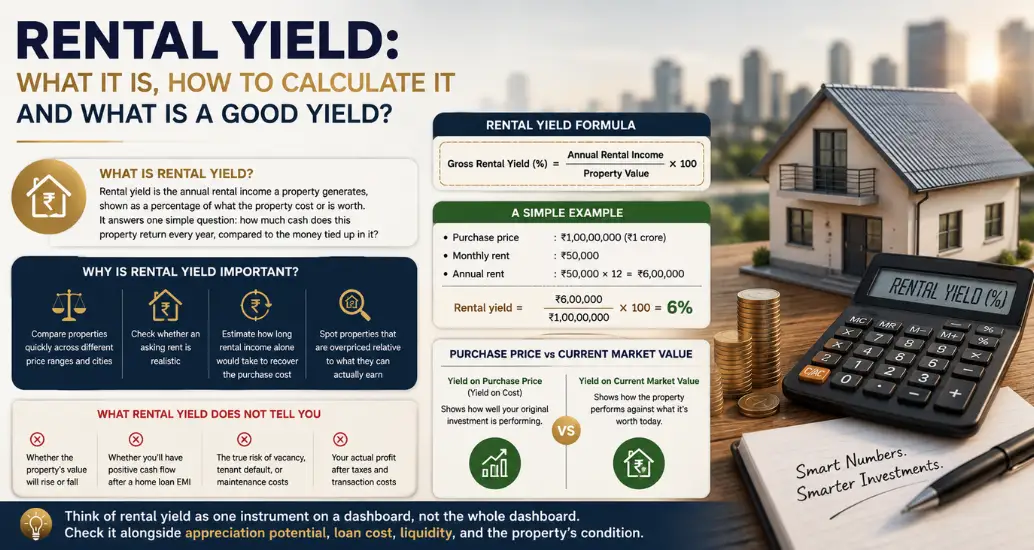
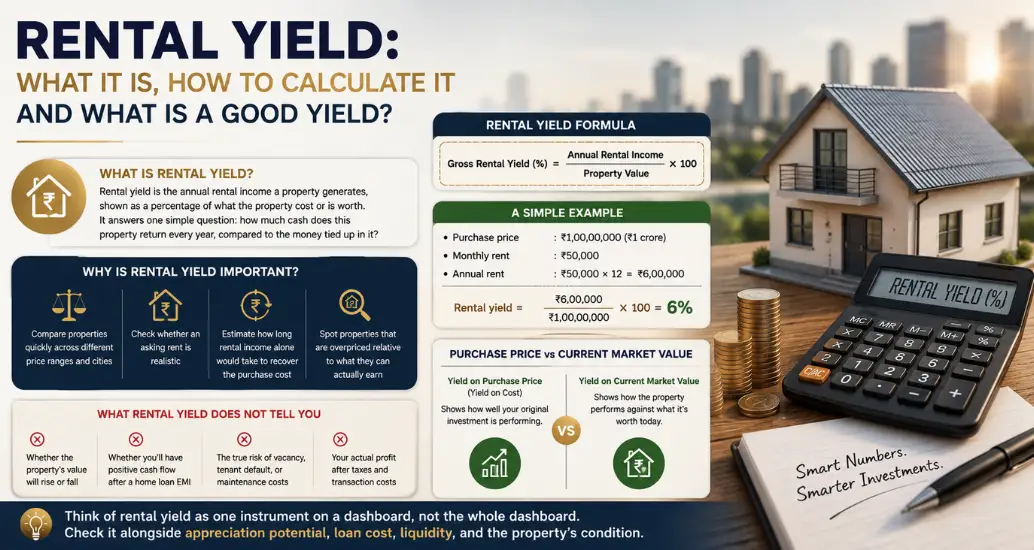
Rental yield is the annual rental income a property generates, shown as a percentage of what the property cost or is worth. It answers one simple question: how much cash does this property return every year, compared to the money tied up in it?
If you put ₹1 crore into a property and it earns ₹6 lakh in rent over a year, the property has a rental yield of 6%. That's it. No complicated math, no guesswork about the future.
Rental yield is not the same as total return. It ignores whether the property's price goes up or down. It only measures income. That makes it one of the most useful numbers in real estate — and also one of the most misunderstood, because people expect it to tell them more than it actually does.
Why Is Rental Yield Important for Property Investors?
Rental yield tells you how hard your money is working right now, through rent alone. A high yield usually means the property is generating strong income relative to its price. A low yield often means you're paying a premium for the property — sometimes because buyers expect the price to rise, sometimes because the location is considered safe and desirable regardless of rental income.
Investors use rental yield to:
- Compare properties quickly, even across different price ranges and cities
- Check whether an asking rent is realistic
- Estimate how long rental income alone would take to recover the purchase cost
- Spot properties that are overpriced relative to what they can actually earn
What rental yield does not tell you:
- Whether the property's value will rise or fall
- Whether you'll have positive cash flow after a home loan EMI
- The true risk of vacancy, tenant default, or maintenance costs
- Your actual profit after taxes and transaction costs
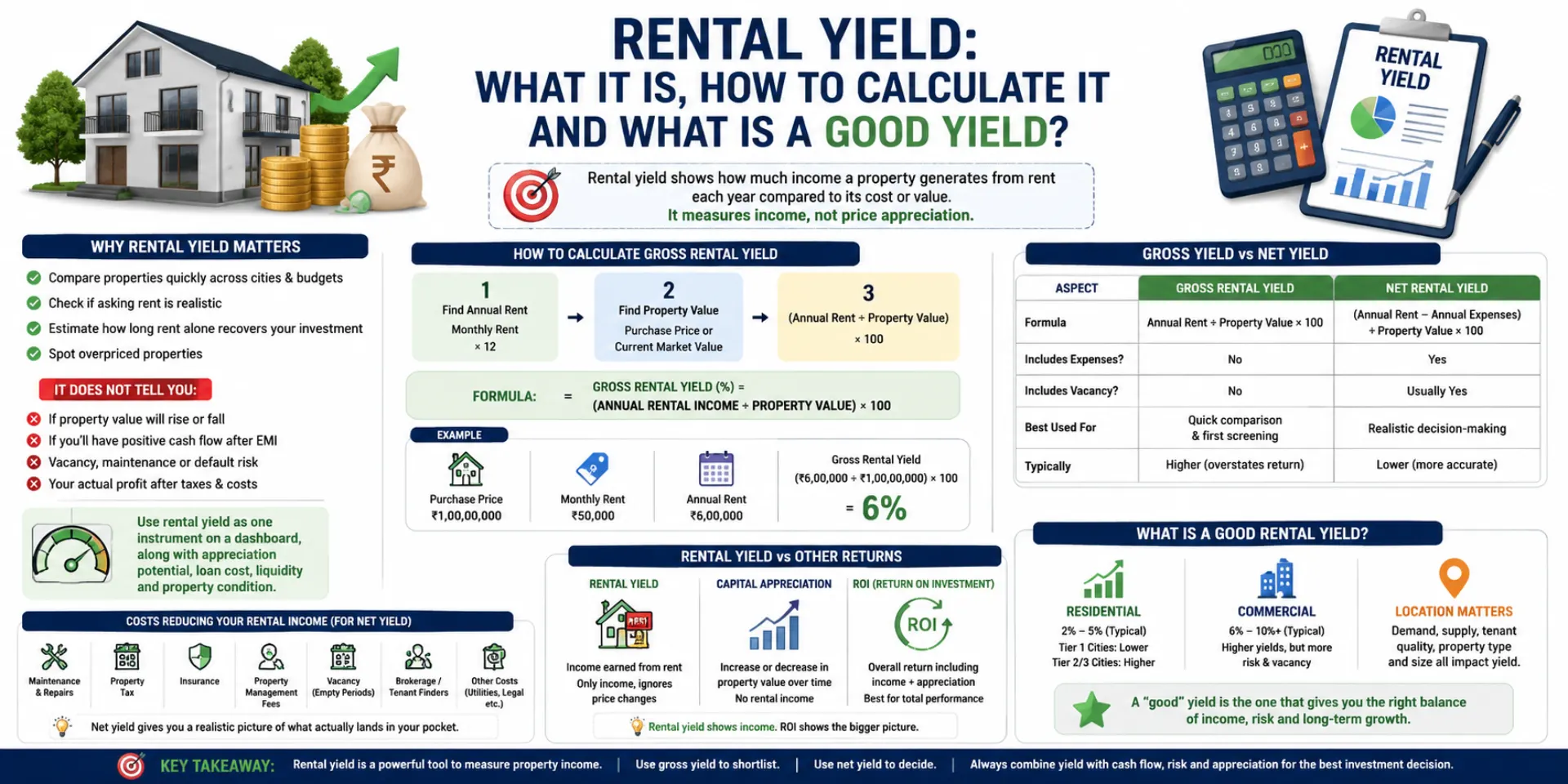
Think of rental yield as one instrument on a dashboard, not the whole dashboard. A serious investor checks it alongside appreciation potential, loan cost, liquidity, and the property's condition.
How to Calculate Rental Yield
The basic calculation has three steps.
Step 1: Find the annual rent. If you have the monthly rent, multiply it by 12.
Step 2: Find the property's value. Use the purchase price, or current market value if you already own the property.
Step 3: Divide annual rent by property value, then multiply by 100.
A Simple Example
Suppose you're evaluating a 3 BHK apartment.
Purchase price: ₹1,00,00,000 (₹1 crore)
Monthly rent: ₹50,000
Annual rent: ₹50,000 × 12 = ₹6,00,000
Rental yield = (₹6,00,000 ÷ ₹1,00,00,000) × 100 = 6%
This is the property's gross rental yield — the raw number before any costs are subtracted. It's the fastest way to screen a property, but it's not the number you should base a final decision on. That comes next.
Rental Yield Formula
The formula, written out plainly:
Gross Rental Yield (%) = (Annual Rental Income ÷ Property Value) × 100
Each part matters:
- Annual Rental Income — the actual rent you receive or expect to receive over 12 months, not an inflated or hoped-for figure
- Property Value — either what you paid (purchase price) or current market value; be consistent about which one you use, especially when comparing properties bought at different times
- × 100 — converts the ratio into a percentage, which is what makes yields comparable across properties of any size
There's also a net version of this formula, which is more useful for actual decision-making. We'll get to that next.
Should You Calculate Rental Yield on Purchase Price or Current Market Value?
This choice changes the answer more than people expect, so it's worth its own section.
Yield on purchase price (also called yield on cost) tells you how well your original investment is performing. It stays useful for years, especially if you bought early or at a good price.
Yield on current market value tells you how the property performs against what it's worth today — which is more relevant if you're deciding whether to hold, sell, or refinance.
Example
Suppose you bought a flat a few years ago.
- Bought at: ₹80,00,000
- Current market value: ₹1,20,00,000
- Current monthly rent: ₹50,000 (₹6,00,000 a year)
Yield on purchase price = (₹6,00,000 ÷ ₹80,00,000) × 100 = 7.5%
Yield on current market value = (₹6,00,000 ÷ ₹1,20,00,000) × 100 = 5%
Both numbers are correct — they just answer different questions. 7.5% tells you the deal has aged well against what you originally paid. 5% tells you that if you bought the same property today, at today's price, that's the return you'd actually get.
When comparing a property you already own against one you're thinking of buying, always use current market value for both. Mixing an old purchase price with today's price on a different property will make the comparison meaningless.
This distinction has a name investors use often: yield on cost vs yield on current market value. Yield on cost tends to rise over time purely because the denominator (your original price) stays fixed while rent grows — it rewards patience and early entry. Yield on current value resets every time the market re-prices the asset, so it's the more honest number if you're deciding whether to keep holding at today's valuation or redeploy the capital elsewhere.
Gross Rental Yield vs Net Rental Yield
Gross rental yield uses rental income only, with no expenses subtracted. It's quick and useful for early screening, but it overstates what you actually earn.
Net rental yield subtracts the recurring costs of owning and renting the property before dividing by property value. It reflects what actually lands in your pocket.
| Aspect | Gross Rental Yield | Net Rental Yield |
| Formula | Annual rent ÷ Property value × 100 | (Annual rent − Annual expenses) ÷ Property value × 100 |
| Includes expenses? | No | Yes |
| Includes vacancy? | No | Usually yes, if calculated properly |
| Best used for | Quick comparison, first screening | Realistic decision-making |
| Typically higher or lower? | Higher (overstates return) | Lower (more accurate) |
How to Calculate Net Rental Yield
Net rental yield subtracts the costs of actually running the property from the rent, before comparing it to property value.
Net Rental Yield (%) = [(Annual Rent − Annual Operating Expenses) ÷ Property Value] × 100
The expenses that genuinely move the needle are:
- Maintenance and society charges — recurring monthly costs for upkeep, security, and common areas
- Property management fees — if you hire someone to manage tenants and repairs
- Property tax — the annual municipal tax on the property
- Insurance — if you insure the property or its contents
- Repairs — routine fixes, repainting, appliance servicing over the year
- Vacancy loss — months the property sits empty between tenants
- Brokerage on tenant turnover — the fee paid to find a new tenant, usually equal to one month's rent
You don't need to track every conceivable cost. Focus on the ones above — they're the ones that consistently affect real numbers.
Worked Example
Take the same ₹1 crore property earning ₹6,00,000 a year in rent.
- Annual maintenance: ₹36,000
- Property tax: ₹8,000
- Repairs (average): ₹15,000
- One month vacancy assumed per year: ₹50,000 lost
- Brokerage for new tenant (once every 2 years, averaged): ₹25,000
Total annual expenses: ₹36,000 + ₹8,000 + ₹15,000 + ₹50,000 + ₹25,000 = ₹1,34,000
Net rent = ₹6,00,000 − ₹1,34,000 = ₹4,66,000
Net rental yield = (₹4,66,000 ÷ ₹1,00,00,000) × 100 = 4.66%
Notice the gap: 6% gross versus 4.66% net. That 1.34% difference is the reality gross yield hides.
What Is a Good Rental Yield?
There's no single number that qualifies as "good" everywhere. A yield that looks excellent in one city can be average in another, and a yield that looks weak on paper can still make sense if the property is likely to appreciate strongly.
What actually determines whether a yield is good for you:
- Location — established, high-demand corridors often carry lower yields because buyers pay a premium for lower risk and better appreciation
- Property type — commercial and warehousing assets typically yield more than residential apartments
- Purchase price relative to rent — properties bought at a discount to market often yield better
- Vacancy risk — a property that's hard to rent out will underperform its projected yield
- Financing cost — a high-yield property can still lose money monthly if the loan EMI is larger than the rent
- Investment objective — someone prioritizing monthly income cares about yield differently than someone prioritizing long-term appreciation
- Liquidity — how easily you could sell the property if you needed to exit
How to Decide Whether a Property Has an Attractive Rental Yield
- Verify the purchase price — is it in line with recent comparable transactions, or is it a premium/discount to the micro-market?
- Verify the achievable rent — not the asking rent, but what similar units have actually leased for recently.
- Calculate net yield, not gross — build in maintenance, tax, insurance, and repairs.
- Add a realistic vacancy assumption — based on how quickly comparable units in that location typically re-let.
- Check tenant demand — is the location driven by steady employment/business hubs, or does demand swing with the market?
- Weigh appreciation potential — a lower-yield property in a high-growth corridor may still deliver a better total return.
- Check liquidity — how easily could you exit if you needed to sell in 12–24 months?
- Run financing and cash flow separately — a yield can look fine and still produce a monthly shortfall once EMI is factored in (see Rental Yield vs Cash Flow below).
- Assess location risk — oversupply, upcoming infrastructure, or regulatory changes that could shift rents or prices.
Rental Yield vs ROI
Rental yield and ROI (Return on Investment) are related but not the same thing, and mixing them up leads to bad decisions.
Rental yield measures only rental income against property value. It ignores appreciation, taxes, financing, and exit costs.
ROI is a broader measure. It typically factors in total gains — rental income plus capital appreciation — against total money invested, including costs like stamp duty, registration, brokerage, and renovation, over the actual holding period.
A property can have a modest 3% rental yield but deliver a strong ROI if its value doubles over five years. Conversely, a property with an 8% yield could have a poor ROI if its value stagnates or falls, or if high vacancy erodes the rent you actually collect.
Rental yield is a snapshot. ROI is the fuller picture, but it needs a defined time horizon and more inputs to calculate.
Rental Yield vs Capital Appreciation
These two are the two separate engines of return in real estate, and they don't always move together.
Rental yield is your income return — money the property generates while you hold it.
Capital appreciation is the increase in the property's market value over time — money you realize only when you sell (or refinance against the higher value).
A property in a mature, high-demand location might have modest rental yield but strong appreciation, because buyers are paying for future price growth, not current income. A property in an oversupplied or slower-growth area might offer a better yield precisely because its price hasn't been bid up as much.
Total return from a property, over a holding period, is broadly the combination of both. Neither number alone tells the full story, and depending too heavily on optimistic appreciation assumptions is a common way investors overestimate what a property will actually deliver.
Rental Yield vs Cash Flow
This is where many first-time landlords get caught off guard: a property can have a perfectly reasonable rental yield and still lose you money every month.
Rental yield is calculated against the property's value. Cash flow is what's left in your bank account each month after rent comes in and every payment — including the home loan EMI — goes out.
Example
- Property value: ₹1 crore
- Net rental yield: 4.66% (net rent of ₹4,66,000 a year, or about ₹38,833 a month)
- Home loan EMI: ₹65,000 a month
Even though the yield looks reasonable on paper, monthly cash flow is negative: ₹38,833 in rent minus ₹65,000 in EMI leaves a shortfall of about ₹26,167 every month, funded out of your own pocket. Over a year, that's roughly ₹3,14,000 paid from your own pocket.
This doesn't necessarily make the investment bad — the EMI is also paying down the loan principal, building equity, and the property may appreciate over time. But it does mean rental yield alone cannot tell you whether an investment is affordable month to month. Always run the cash flow numbers separately, factoring in your actual financing terms.
Rental Yield vs Cap Rate
These two terms are often used interchangeably, but they're built for slightly different purposes, and the distinction matters most for commercial and income-producing property.
Rental yield (as used through most of this article) is typically calculated on the buyer's own purchase price, and is often quoted gross — before expenses.
Cap rate (capitalization rate) is calculated as Net Operating Income ÷ Current Market Value × 100. It's always a net figure, always based on current market value (not what a specific buyer paid), and it deliberately excludes financing — it measures the return the asset itself generates, independent of how any particular investor funds the purchase.
Using the running example (current market value ₹1 crore, NOI ₹4,66,000):
Cap Rate = (₹4,66,000 ÷ ₹1,00,00,000) × 100 = 4.66%
In this case cap rate and net rental yield land on the same number, because purchase price and current market value happen to be equal here. They diverge once the property has appreciated (or depreciated) — cap rate always re-bases to today's value, while yield on cost stays anchored to what you originally paid.
Cap rate is the more common term in commercial real estate and institutional investing, because it lets buyers compare unrelated income-producing assets — office space, retail, warehousing — on a like-for-like, unleveraged basis. Rental yield is the more common term in residential investing, where buyers usually care about their own purchase price rather than a market-wide benchmark.
What Is Net Operating Income (NOI)?
Net Operating Income is the income a property generates from operations, before financing costs (loan interest/EMI), income tax, and depreciation are subtracted.
NOI = Annual Rental Income − Operating Expenses
Operating expenses here mean the running costs of the property — maintenance, property tax, insurance, repairs, vacancy loss, management fees — but not the home loan EMI, income tax, or one-time capital expenditure.
For the running example:
NOI = ₹6,00,000 − ₹1,34,000 = ₹4,66,000
NOI is the number that feeds directly into both net rental yield and cap rate. It's a useful concept to know by name because it's what separates "how the asset performs" from "how you personally financed it" — two things that are easy to blur together, especially when a loan is involved.
Rental Yield vs Cash-on-Cash Return
Rental yield and net yield are calculated against the full property value, regardless of how much of that value is your own money versus borrowed money. Cash-on-cash return answers a more personal question: given the actual cash you put in, what return are you getting?
Cash-on-Cash Return (%) = (Annual Pre-Tax Cash Flow ÷ Actual Cash Invested) × 100
"Actual cash invested" means your down payment plus acquisition costs (stamp duty, registration, brokerage, legal fees) — not the full property price, since the rest came from the loan.
Example (using the running property, purchased with a loan)
- Down payment (20% of ₹1 crore): ₹20,00,000
- Acquisition costs (stamp duty, registration, brokerage, legal): ₹5,00,000
- Total cash invested: ₹25,00,000
- Annual net rent: ₹4,66,000
- Annual EMI: ₹65,000 × 12 = ₹7,80,000
- Annual pre-tax cash flow: ₹4,66,000 − ₹7,80,000 = −₹3,14,000
Cash-on-cash return = (−₹3,14,000 ÷ ₹25,00,000) × 100 = −12.56%
This is a strikingly different picture from the 4.66% net rental yield quoted earlier for the same property. The yield describes the asset. The cash-on-cash return describes what's happening to your actual money once the loan is layered in — and here, the loan is working against the investor, not for them. This gap is exactly why leveraged investors should never rely on rental yield alone to judge whether a deal makes sense.
Leveraged vs Unleveraged Return
Unleveraged return is the return the property generates on its own, ignoring financing — this is essentially your net rental yield (4.66% in the running example). It answers: "how does this asset perform if I paid all cash?"
Leveraged return is the return on your actual equity once a loan is involved — this is your cash-on-cash return (−12.56% in the same example). It answers: "how does this asset perform on the cash I actually put in, once loan costs are factored in?"
Leverage is a multiplier, not a guarantee. It amplifies whatever direction the unleveraged numbers are already pointing:
- When rent comfortably covers the EMI, leverage can push your cash-on-cash return meaningfully above the unleveraged yield — you're using the bank's money to boost your own return.
- When the EMI exceeds what the property earns, as in the example above, leverage pushes your return below the unleveraged yield, sometimes into negative territory, even while the property itself has a perfectly respectable net yield.
The loan interest rate, tenure, and loan-to-value ratio all determine which side of that line you land on — which is why the same property can be a good leveraged investment for one buyer and a poor one for another, depending purely on their financing terms.
Break-Even Occupancy
Break-even occupancy tells you the minimum occupancy level a property needs — as a percentage of the year, or percentage of units in a multi-unit property — for rental income to cover fixed operating costs and debt service. Below that occupancy level, the property runs at a loss regardless of yield.
Break-Even Occupancy (%) = (Fixed Operating Expenses + Annual Debt Service) ÷ Potential Gross Annual Rent × 100
Example (running property, with the loan from the cash-on-cash example)
- Fixed operating expenses (maintenance + property tax + repairs + brokerage): ₹36,000 + ₹8,000 + ₹15,000 + ₹25,000 = ₹84,000
- Annual debt service (EMI × 12): ₹7,80,000
- Total fixed costs: ₹8,64,000
- Potential gross annual rent (100% occupancy): ₹6,00,000
Break-even occupancy = (₹8,64,000 ÷ ₹6,00,000) × 100 = 144%
A break-even occupancy above 100% is a red flag — it means the property can't cover its costs even at full occupancy, let alone with any vacancy. This is the same conclusion the cash flow and cash-on-cash examples pointed to, but break-even occupancy makes it explicit in a single number: this particular financing structure doesn't work on this rent, independent of how good the underlying yield looks.
What Costs Should You Consider When Calculating Rental Yield?
Costs fall into two clear buckets, and mixing them up leads to a distorted yield number.
Acquisition costs — one-time costs when you buy:
- Purchase price
- Stamp duty and registration charges
- Brokerage on purchase
- Furnishing or fit-out costs, if any
- Legal and documentation fees
Recurring costs — ongoing costs while you hold the property:
- Maintenance and society charges
- Repairs
- Property tax
- Insurance
- Vacancy periods
- Management fees, if applicable
- Brokerage on tenant turnover
Total Cost Basis
Some investors calculate yield against purchase price alone (the simplest approach). Others calculate it against total cost basis — purchase price plus every acquisition cost (stamp duty, registration, brokerage, furnishing, legal fees) — which gives a more honest picture of what you actually invested.
Total Cost Basis = Purchase Price + Stamp Duty + Registration + Brokerage on Purchase + Furnishing + Legal Fees
Yield calculated on total cost basis will always be equal to or lower than yield calculated on purchase price alone, since the denominator is larger. Be clear about which denominator you're using, and stay consistent when comparing properties, because switching methods mid-comparison makes the numbers meaningless.
How Vacancy Affects Rental Yield
Every rental yield calculation assumes the property earns rent for a certain number of months. Many quick calculations wrongly assume 12 months of rent, every year, with no gaps. In practice, tenants move out, units sit vacant while you find the next tenant, and turnover itself takes time.
Example
Property earning ₹50,000 a month, fully occupied:
- Annual rent (no vacancy): ₹6,00,000
Same property with one month vacant during tenant transition:
- Annual rent (11 months occupied): ₹5,50,000
- That's a yield reduction from 6% to 5.5% on the same ₹1 crore property, just from a single vacant month
If turnover happens more often — say, tenants change every year instead of every two or three — the vacancy hit and repeated brokerage costs compound, pulling net yield down further. Build a realistic vacancy assumption into your net yield calculation rather than assuming continuous occupancy.
The 5.5% figure above actually has a name: effective rental yield. It's the yield based on rent you actually collect over the year, after vacancy, rather than the rent you'd collect in a perfect world with zero gaps. Gross yield assumes full occupancy. Effective yield doesn't. When someone quotes you a yield number, it's worth asking which one they mean.
As a rough starting point, residential apartments in most Indian cities see somewhere between 15 and 45 days of vacancy a year during normal tenant transitions — more if the unit is priced above market or poorly maintained. Use a vacancy assumption based on what's realistic for the specific property and location, not a best-case guess.
Rent-to-Price Ratio and Gross Rent Multiplier
Two related numbers are worth knowing, mainly because you'll see them used in investor conversations and reports.
Rent-to-price ratio is just another way of expressing gross rental yield — monthly rent divided by property price. A property renting for ₹50,000 a month at ₹1 crore has a rent-to-price ratio of 0.05% per month, which annualizes to the same 6% gross yield.
Gross Rent Multiplier (GRM) flips the yield calculation around. Instead of a percentage, it tells you how many years of gross rent it would take to equal the property price.
GRM = Property Price ÷ Annual Rent
For the ₹1 crore property earning ₹6,00,000 a year: GRM = ₹1,00,00,000 ÷ ₹6,00,000 = 16.7
A lower GRM generally means a better-priced property relative to its rent. GRM is popular with commercial investors because it's a quick way to compare deals without doing a percentage calculation each time — but like gross yield, it ignores expenses, so it's a screening tool, not a final decision-making number.
Yield Compression and Yield Expansion
Yields don't stay fixed — they move as prices and rents move at different speeds, and this movement has its own vocabulary.
Yield compression happens when property prices rise faster than rents, so the yield falls even though nothing about the rental income has changed. This is common in established, high-demand micro-markets where buyers are increasingly paying for expected future appreciation rather than current income — prices get bid up, but rents lag behind.
Yield expansion is the reverse: rents rise faster than prices, or prices fall while rents hold steady, pushing yield up. This tends to happen in markets with heavy new supply putting downward pressure on prices, or in locations where rental demand is strengthening faster than buyer demand.
Neither is inherently good or bad for an investor — it depends on which side of the transaction you're on and what you're optimizing for. A buyer entering during yield compression is paying more for less income today, betting on appreciation. A buyer entering during yield expansion is getting more income for the price, but may be buying into a market with weaker price momentum.
Risk-Adjusted Rental Return
A high yield isn't automatically a good yield — it can simply be compensation for higher risk. Risk-adjusted rental return is less a single formula and more a discipline: judging a yield against the risk it took to get there, not in isolation.
Factors that should discount how attractive a given yield actually is:
- Vacancy volatility — a location with unpredictable, swingy occupancy carries more risk than one with steady demand, even at the same average yield
- Tenant credit risk — a single commercial tenant with weak financials is riskier than a diversified pool of residential tenants
- Market liquidity — a high-yield property that's hard to sell if you need to exit is riskier than a lower-yield property in a liquid market
- Financing risk — a floating-rate loan on a leveraged property adds interest-rate risk on top of rental risk
- Regulatory or location risk — oversupply, zoning changes, or infrastructure delays can affect both yield and exit value
A practical way to apply this: compare the yield against a relevant low-risk benchmark — a fixed deposit rate, a government bond yield, or a REIT distribution yield — and ask whether the extra percentage points genuinely compensate for the extra risk being taken on, or whether they're simply pricing in a problem that hasn't shown up yet.
Residential vs Commercial Rental Yield
| Factor | Residential | Commercial |
| Typical lease duration | Shorter, often 11 months to 3 years | Longer, often 3–9 years with lock-in periods |
| Tenant profile | Individuals, families | Businesses, corporates, retail brands |
| Rent escalation | Less structured, negotiated at renewal | Often built into the lease contract |
| Vacancy risk | Generally lower demand volatility | Can be higher; depends heavily on business cycles |
| Operating costs | Lower, more predictable | Can include common area maintenance, higher management involvement |
| Entry price | Lower ticket size in most markets | Higher ticket size, often needs more capital |
How to Calculate Rental Yield on Commercial Property
The formula is identical to residential; only the inputs change.
Example: Small Retail Unit
- Purchase price: ₹80,00,000
- Monthly rent: ₹60,000
- Annual rent: ₹7,20,000
Gross rental yield = (₹7,20,000 ÷ ₹80,00,000) × 100 = 9%
If common area maintenance charges of ₹6,000 a month and property tax of ₹15,000 a year apply:
- Annual CAM: ₹72,000
- Annual expenses: ₹72,000 + ₹15,000 = ₹87,000
- Net rent: ₹7,20,000 − ₹87,000 = ₹6,33,000
Net rental yield = (₹6,33,000 ÷ ₹80,00,000) × 100 = 7.9%
Commercial yields often look stronger on paper, but always check the lease's lock-in period, tenant financial strength, and how the space would perform if it stayed vacant for several months — commercial vacancies tend to last longer than residential ones. [Explore commercial property investment options in Gurgaon] for retail and SCO formats that fit this profile — for example [M3M CFC], which is built around exactly this kind of commercial-yield use case.
Gurgaon Rental Yield: What Actually Changes the Number?
Gurgaon's rental yield picture is not uniform — it varies by micro-market, property type, and how recently prices in that pocket have run up. Rather than quoting a single citywide figure, it's more useful to walk through the chain of factors that actually determine the number for a specific deal:
Micro-market → Connectivity to NH-8, the Dwarka Expressway, and metro corridors shapes both achievable rent and tenant demand at the neighbourhood level. Areas near Cyber City, Udyog Vihar, and the Golf Course Road corridor draw steady demand from corporate and expat tenants, which supports rent stability but also tends to keep entry prices — and therefore yields — compressed.
→ Property Type → Apartments, builder floors, villas, and commercial/SCO (shop-cum-office) units behave differently within the same micro-market. Commercial and retail formats typically show higher gross yields than residential apartments, but with the trade-offs covered in the residential-vs-commercial section above. A [luxury residential property] in a premium society, such as [M3M St. Andrews] or [M3M Elie Saab], will generally carry a different yield profile than a mid-segment apartment or an SCO unit, even in the same corridor.
→ Purchase Price → Buyers who enter at a premium in an already-appreciated micro-market usually see lower yields than those who buy at more moderate price points, or in emerging corridors like [Manesar] — where projects such as [M3M GIC Manesar] sit — that haven't been bid up as heavily yet.
→ Achievable Rent → What matters is verified, current rent for comparable units — not the asking rent on a listing, and not a rent quoted from memory.
→ Vacancy → Sectors with heavy new residential supply can see softer rent growth relative to capital values, which stretches out vacancy periods and compresses yield further.
→ Expenses → Society maintenance, property tax, and CAM charges (for commercial/SCO units) vary meaningfully by project and need to be checked individually rather than assumed.
→ Net Yield → Only after running the chain above does a meaningful, deal-specific net yield emerge — which is why a single Gurgaon-wide average is rarely useful for an actual purchase decision.
Factors That Can Increase or Reduce Rental Yield
Factors that can raise yield:
- Buying below market price through negotiation
- Choosing locations with strong, consistent rental demand
- Selecting property types with lower vacancy risk
- Minimizing avoidable recurring costs
- Renting in a market experiencing yield expansion — rents rising faster than prices
Factors that can reduce yield:
- Overpaying at purchase relative to achievable rent
- High vacancy due to poor location or condition
- Underestimated maintenance or repair costs
- Frequent tenant turnover and repeated brokerage costs
- Buying in a market undergoing yield compression — prices rising faster than rents
How to Improve Rental Yield
- Select the right property from the start — location and property condition drive rentability more than almost anything else
- Negotiate the purchase price — a lower entry cost directly raises yield, since it lowers the denominator
- Improve usability — modest, sensible upgrades (functional kitchen, working fittings, decent paint) can support a higher achievable rent
- Reduce unnecessary vacancy — list the property early, price rent realistically, and respond quickly to prospective tenants
Use professional tenant management — where it's cost-effective, professional management can reduce vacancy and turnover costs even after fees - Review rent at appropriate intervals — revise rent in line with the market at lease renewal, rather than letting it lag for years
- Control avoidable operating costs — routine maintenance prevents larger, costlier repairs later
Common Rental Yield Calculation Mistakes
- Using monthly rent instead of annual rent in the formula, which understates yield by roughly 12 times
- Ignoring vacancy, assuming the property earns rent every single month of the year
- Ignoring expenses, relying only on gross yield when making a final decision
- Ignoring acquisition costs like stamp duty and registration when they should be part of the denominator
- Confusing rental yield with ROI, treating a yield percentage as if it captures total investment return
- Assuming high yield automatically means a good investment, without checking why the yield is high — sometimes it signals higher risk or a declining area
- Ignoring appreciation potential entirely, which can matter as much as income depending on your goals
- Ignoring location risk, such as oversupply or weak long-term demand fundamentals
- Using outdated rent data, especially in fast-changing micro-markets where rents can shift significantly within a year
- Ignoring financing altogether, quoting an unleveraged yield as if it were the same as the leveraged cash-on-cash return an investor will actually experience
How to Compare Two Properties Using Rental Yield
Property A: ₹90 lakh apartment, rents for ₹42,000/month, in an established, low-vacancy location.
- Annual rent: ₹5,04,000
- Gross yield: 5.6%
Property B: ₹90 lakh apartment, rents for ₹55,000/month, in a newer, less-established location with more competing supply.
- Annual rent: ₹6,60,000
- Gross yield: 7.3%
Property B looks like the better deal on yield alone. But if Property B is in an oversupplied area with higher vacancy risk, or if tenants there turn over more frequently, its net yield after accounting for real vacancy and turnover costs could end up lower than Property A's. Property A's steadier tenant demand and lower vacancy might also mean less stress and more predictable income, even at a lower headline number.
The property with the highest yield on paper is not automatically the best investment. Always check net yield, vacancy risk, tenant profile, and location fundamentals before deciding — not just the gross number.
Rental Yield Calculator
- Purchase price (or current market value)
- Monthly rent (converted to annual rent)
- Annual operating expenses (maintenance, property tax, insurance, repairs)
- Vacancy assumption (number of months typically vacant per year)
- Additional acquisition costs, if you want yield calculated against total cost basis rather than purchase price alone
And, optionally, for leveraged buyers:
- Down payment / loan amount and EMI, to output cash-on-cash return and break-even occupancy alongside gross and net yield
Sample Calculation Table
| Input | Value |
| Purchase price | ₹1,00,00,000 |
| Monthly rent | ₹50,000 |
| Annual rent (12 months) | ₹6,00,000 |
| Annual expenses | ₹1,34,000 |
| Gross rental yield | 6.00% |
| Net rental yield | 4.66% |
Frequently Asked Questions About Rental Yield
What is rental yield?
Rental yield is the annual rental income a property generates, expressed as a percentage of its purchase price or current market value. It measures income return only, not appreciation.
How do you calculate rental yield?
Divide the annual rental income by the property's value, then multiply by 100. For net rental yield, subtract annual operating expenses from the rent before dividing.
What is the rental yield formula?
Gross Rental Yield (%) = (Annual Rental Income ÷ Property Value) × 100. Net Rental Yield (%) = [(Annual Rental Income − Annual Expenses) ÷ Property Value] × 100.
What is a good rental yield?
It depends on the location, property type, price, expenses, and your investment goals. There's no single universal number — compare yields within the same city and property type, and check whether the figure is gross or net.
What is the difference between gross and net rental yield?
Gross rental yield ignores expenses and shows raw rent against property value. Net rental yield subtracts recurring costs like maintenance, property tax, and vacancy, giving a more realistic picture of actual returns.
Is rental yield the same as ROI?
No. Rental yield measures income only. ROI typically includes both rental income and capital appreciation, measured against total money invested over a defined holding period.
Does rental yield include property appreciation?
No. Rental yield is purely an income metric. Capital appreciation is a separate component of total property return and must be assessed independently.
 Sumit Mishra / Property Counselor
You Must Read:
 Other
Other