

arrow_backBack to Blog
Other
Sector 111 Gurgaon: Emerging Luxury Residential Destination
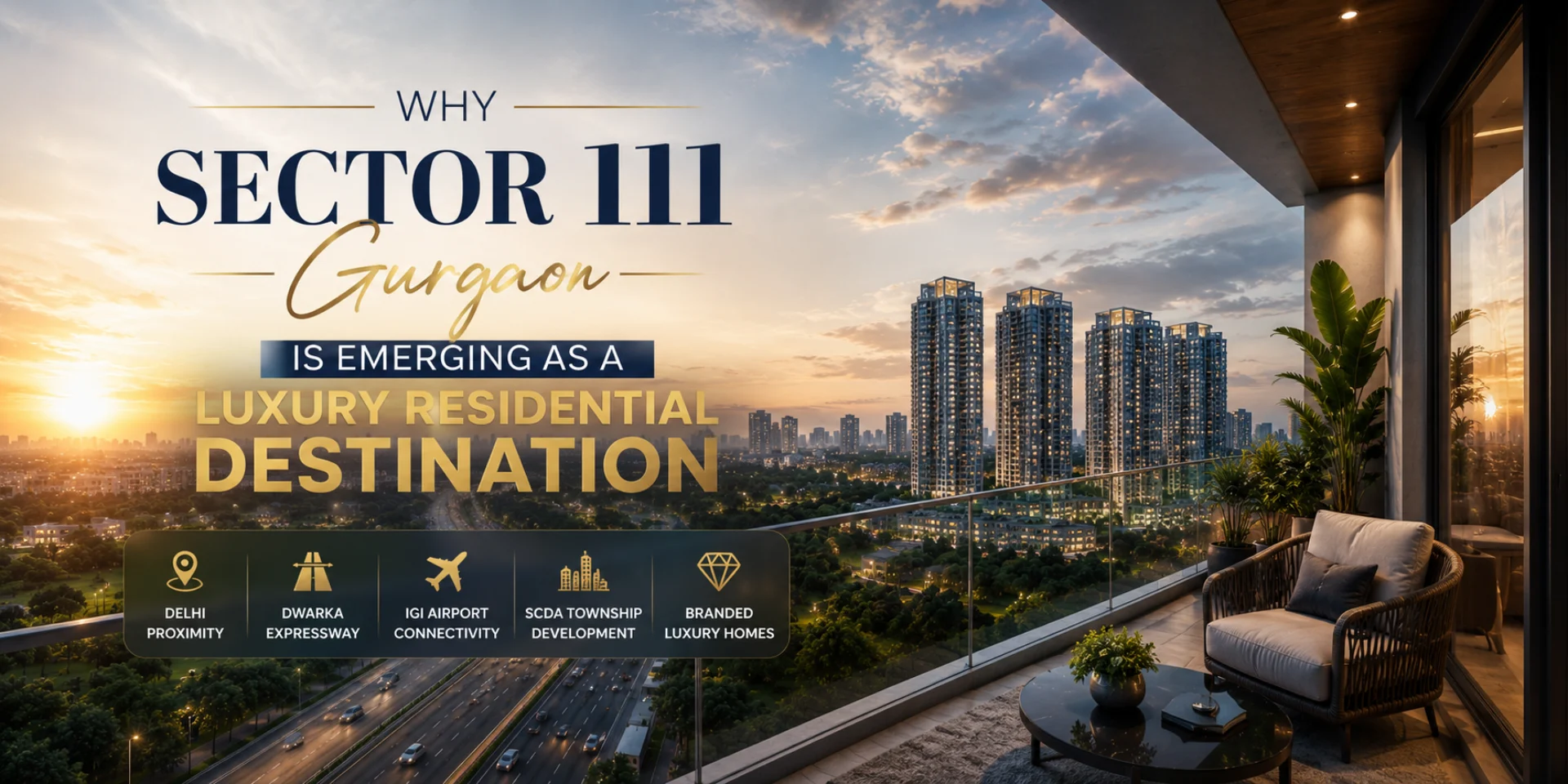
Sector 111 Gurgaon is emerging as a luxury residential destination because of its proximity to the Delhi border, direct Dwarka Expressway connectivity, closeness to IGI Airport, the developing SCDA township, and the arrival of branded residential projects such as M3M Elie Saab and M3M Jacob & Co. Together, these factors are reshaping a location once known mainly for connectivity into a premium residential address.
Sector 111 Gurgaon used to be known mainly as a connectivity point — a sector people passed through on the way to the airport or the Delhi border. That's changing. Over the last couple of years, Sector 111 has started attracting a different kind of buyer: someone looking for a premium home close to Delhi, backed by branded developers, inside a planned township rather than a standalone tower.
This shift didn't happen by accident. It's the result of a few things lining up at once — Dwarka Expressway becoming functional, the Smart City Delhi Airport (SCDA) township taking shape, and a handful of luxury and branded residential projects choosing this specific sector over more established Gurgaon addresses.
Why Is Sector 111 Gurgaon Becoming a Luxury Residential Destination?
- Delhi border proximity — few Gurgaon sectors sit as close to Delhi
- Dwarka Expressway access — direct corridor connectivity to Delhi and NH-48
- IGI Airport connectivity — a short drive for frequent travellers
- SCDA township development — a planned, airport-oriented urban zone
- Branded luxury residences — projects like M3M Elie Saab and M3M Jacob & Co
- Premium residential positioning — a shift away from purely transit-driven interest
- Growing infrastructure — expressway access now functional, more corridors planned
- Business connectivity — links to Delhi's business districts and Gurgaon's commercial belts
- Emerging lifestyle ecosystem — retail and social infrastructure building up around new projects
- Limited ultra-luxury supply — few comparable branded developments elsewhere in Gurgaon
Sector 111 Gurgaon: From Strategic Location to Luxury Residential Destination
For years, Sector 111's biggest selling point was simple: it sits right at the edge of Delhi, on the Dwarka Expressway corridor, close to IGI Airport. That made it useful for connectivity, but not necessarily a destination people associated with premium housing.
That's now shifting. As Dwarka Expressway has opened up and the SCDA township has started taking shape around it, Sector 111 Gurgaon is positioning itself as more than a transit corridor — it's increasingly attracting developers who want to build for a premium and even ultra-luxury audience.
It's worth being precise here: this transformation is still in progress. Several of the projects driving this shift are under construction, and the surrounding social infrastructure — retail, schools, hospitals — is still developing alongside the housing. Sector 111 is emerging as a luxury residential location, not arriving as a fully mature one. That distinction matters for anyone doing real diligence rather than reading marketing copy.
Where Is Sector 111 Gurgaon Located?
Sector 111 Gurgaon sits at the northern edge of Gurugram, right where it meets the Delhi border, along the Dwarka Expressway corridor. It falls within the broader Smart City Delhi Airport (SCDA) zone, a planned township designed around the area's proximity to IGI Airport.
To put this in perspective for a first-time buyer:
- Delhi border — Sector 111 is one of the closer Gurgaon sectors to Delhi, with some parts of the sector sitting almost at the boundary itself
- Dwarka Expressway — the sector has direct frontage or near-direct access to this expressway, which links Dwarka in Delhi to NH-48 in Gurgaon
- IGI Airport — reasonably close by road, making it relevant for frequent flyers and business travellers
- Aerocity — Delhi's business and hospitality hub near the airport, within reasonable driving distance
- UER-II — an upcoming road corridor expected to further connect this part of Gurgaon to south and west Delhi
- NH-48 — accessible via the expressway, linking further into Gurgaon's established business districts
Why Connectivity Is One of Sector 111's Biggest Advantages
Sector 111 Gurgaon is gaining attention largely because of how it connects — to Delhi, to the airport, and to Gurgaon's commercial centres — without requiring residents to travel deep into the city for any of it.
For luxury homebuyers specifically, connectivity isn't just about saving time in traffic. It changes who considers the location in the first place.
A Delhi-based professional who works in south or west Delhi may have historically ruled out Gurgaon because of the commute. Sector 111's position right at the border narrows that gap considerably. For entrepreneurs and business owners who travel frequently, being closer to IGI Airport cuts down on one of the more tedious parts of business travel — the drive to and from the airport itself.
NRIs buying a home in India, often as a second residence or a long-term investment, tend to prioritise ease of access over deep familiarity with local Gurgaon neighbourhoods. An airport-adjacent, Delhi-border location is easier to explain and easier to justify than a sector buried deeper inside the city.
And for high-income buyers generally, the calculation isn't just "how do I get to work" — it's "how do I get to the airport, to Delhi's business districts, and to Gurgaon's established commercial zones, all from one address." Sector 111's road network is what makes that calculation work in its favour.
How Dwarka Expressway Is Influencing Sector 111 Gurgaon
Dwarka Expressway is the single biggest infrastructure factor behind Sector 111's growing residential relevance. Before this road became functional, large parts of this belt were relatively inaccessible compared to established Gurgaon corridors like Golf Course Road.
Once a stretch of expressway like this becomes operational, a few things tend to happen. Accessibility improves in a very literal sense — commute times shorten, and the sector becomes a realistic option for people who work elsewhere in Delhi-NCR. Buyer perception shifts too. A location that once felt remote starts to look like a legitimate residential option, particularly once a few visible projects break ground and sales activity picks up.
Commercial development usually follows residential and infrastructure momentum, not the other way around — retail, F&B, and business space typically arrive once there's enough of a resident base and daily footfall to justify them. In Sector 111's case, that commercial layer is still building up.
It's important not to overstate this. A functional expressway improves access and visibility, but it doesn't automatically translate into property price appreciation. Appreciation depends on a mix of factors — how quickly the surrounding township develops, how many projects actually get delivered on time, and broader real estate market conditions across the NCR. Buyers should treat Dwarka Expressway as one strong factor among several, not as a guarantee.
For the current status of Dwarka Expressway and connected corridors like UER-II, the most reliable references are official updates from NHAI (National Highways Authority of India) and the Haryana government's public works and urban development departments, rather than developer marketing material.
The Role of SCDA in Sector 111 Gurgaon's Growth
SCDA stands for Smart City Delhi Airport — a planned township development in this part of Gurgaon, designed around its proximity to IGI Airport. Sector 111 falls within this broader zone.
In simple terms, SCDA is meant to function as a self-contained, airport-oriented urban environment rather than a collection of unrelated projects. The idea is to bring residential, commercial, and business infrastructure together in a planned way, rather than letting development happen piecemeal.
For Sector 111's residential positioning, SCDA matters in a few ways:
- It gives the sector a coherent identity, rather than being just “another Gurgaon sector”
- It's attracted a cluster of premium and branded residential projects to the same general area, which reinforces the location's luxury positioning
- It's designed with an eye toward business and commercial potential, given the airport proximity — which, over time, could support the retail and lifestyle infrastructure a luxury residential buyer expects
That said, SCDA is a large, multi-phase development, and not all of it is complete or operational today. Specific claims about SCDA's final scale, timelines, or infrastructure commitments should be verified through official project or government sources — including Haryana State Industrial and Infrastructure Development Corporation (HSIIDC) and Gurugram Metropolitan Development Authority (GMDA) publications where applicable — before being treated as settled fact.
Why Luxury Homebuyers Are Looking Towards Sector 111
Luxury buyers rarely make decisions purely on square footage. What they're usually buying is a combination of location, lifestyle, and privacy — and Sector 111 is starting to check those boxes in a way few other emerging Gurgaon sectors currently do.
Location matters because a luxury home needs an address that says something — proximity to Delhi and the airport carries weight for a buyer who travels often or wants to stay closely connected to Delhi's social and business circles.
Privacy and low-density living are recurring priorities for this buyer segment. Several of the newer projects in Sector 111 are being built on relatively large land parcels with a limited number of units, which supports lower density compared to older, more compact developments.
Branded residences — homes developed in collaboration with global fashion or lifestyle brands — have added a new dimension to this. For some buyers, associating a home with a recognised international name adds a layer of exclusivity that a purely developer-branded project doesn't offer.
Premium architecture and international design language matter too. Buyers in this segment are often comparing Indian luxury housing against what's available globally, and they expect design quality, material specification, and finishing that reflect that standard.
Luxury Residential Projects Are Changing the Identity of Sector 111
It's worth separating three categories that often get used interchangeably: traditional premium housing, luxury housing, and branded residences.
Traditional premium housing typically means a good location, decent specifications, and a reputable developer — but without any distinct design identity or brand collaboration.
Luxury housing usually adds larger unit sizes, higher-end materials, more elaborate amenities, and lower density, but is still developed and marketed purely under the builder's own name.
Branded residences go a step further by partnering with a recognised global brand — often from fashion, hospitality, or luxury goods — to shape the design language and market the project's exclusivity.
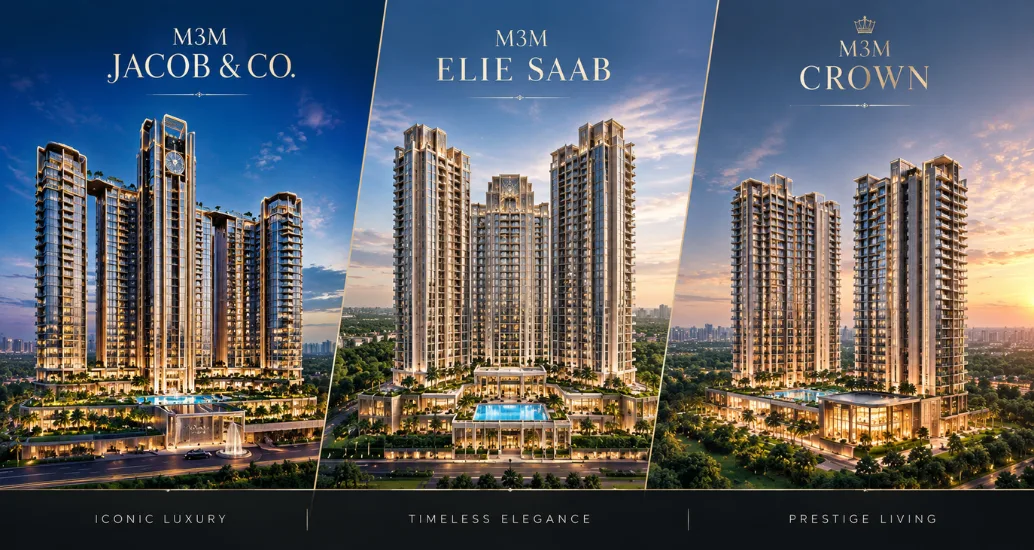
Sector 111 has started attracting the third category specifically, which is a meaningful shift for a sector that, until recently, wasn't associated with luxury housing at all. Two projects illustrate this: M3M Elie Saab and M3M Jacob & Co Gurgaon, both branded residential developments from M3M India, positioned in this part of Sector 111 within the SCDA zone.
M3M Elie Saab Sector 111 Gurgaon – Bringing Branded Luxury to the Location
M3M Elie Saab is a residential project by M3M India, developed in collaboration with Elie Saab, the Lebanese couture designer known internationally for his fashion work. The project is located in Sector 111, within the SCDA zone, along the Dwarka Expressway corridor.
The core idea behind the project is to bring a couture-inspired design sensibility into residential architecture and interiors — think refined finishes, considered material choices, and an aesthetic language drawn from Elie Saab's fashion background rather than a standard developer template.
The project is being marketed around 3 and 4 BHK configurations, positioned toward the upper end of Gurgaon's residential market. Reports around land parcel size, tower count, and total unit numbers vary across sources, which is common at the pre-launch and early construction stage — so these specifics should be confirmed directly from M3M's official documentation rather than taken from promotional listings.
What's more useful to understand is what this project represents for Sector 111 as a location: it's an example of a developer choosing this sector specifically for a branded, design-led luxury product, rather than a standard residential launch. That's a meaningful signal about how the area is being positioned, even though it doesn't guarantee how the broader micro-market will eventually mature.
M3M Jacob & Co Gurgaon and the Rise of Ultra-Luxury Residences in Sector 111
M3M Jacob & Co is another branded residential development by M3M India in Sector 111, this time in collaboration with Jacob & Co, the New York-based luxury brand known for high-end watches and jewellery. The project is positioned within the SCDA zone, along Dwarka Expressway, and is generally described as sitting toward the ultra-luxury end of the market — a step above conventional premium housing.
Branded residence concepts like this tend to work on a similar principle: pairing a recognised global luxury name with high-specification architecture and interiors, aimed at a smaller pool of high-net-worth buyers rather than the broader residential market.
Projects positioned this way can influence how a micro-market like Sector 111 is perceived. When an ultra-luxury, brand-led project chooses a location, it tends to draw attention from other developers and buyers who associate that address with exclusivity — which can, over time, shape the sector's overall market identity.
That influence is a market observation, not a guarantee. A single project — however prestigious — doesn't single-handedly establish a location as an ultra-luxury hub; that requires sustained delivery, multiple successful projects, and genuine resident demand over several years.
Sector 111 Gurgaon vs Other Luxury Residential Locations
| Factor | Sector 111 | Sector 113 | Sector 106 | Golf Course Road | Golf Course Extension Road |
| Delhi proximity | Border-adjacent — among the closest Gurgaon sectors to Delhi | Relatively close, a short drive from the Delhi border | Farther — requires travel through Dwarka Expressway or NH-48 | Farther still — deeper inside Gurgaon | Farthest of the five — furthest from the Delhi border |
| Airport connectivity | Direct via Dwarka Expressway, generally under 20 minutes, traffic dependent | Direct via Dwarka Expressway, similar travel time | Accessible via Dwarka Expressway, slightly longer | Requires travel via NH-48 or Southern Peripheral Road | Requires travel via NH-48, longer than Golf Course Road |
| Dwarka Expressway access | Direct frontage/near-direct access | Direct access | Nearby, not directly on the corridor | No direct access | No direct access |
| Luxury residential development stage | Emerging — recent branded residence launches | Emerging — mixed residential and commercial launches | Developing — fewer branded luxury projects to date | Established — multiple delivered luxury projects with resale history | Established — high density of delivered premium and luxury projects |
| Infrastructure maturity | Developing — expressway operational, some corridors (e.g. UER-II) still under construction | Developing — similar stage to Sector 111 | Developing | Established — mature roads, retail, schools, hospitals | Established — mature social and retail infrastructure |
| Lifestyle ecosystem (retail, F&B, social infra) | Early stage, building up alongside new residential projects | Early stage, similar to Sector 111 | Early stage | Well developed, deep retail and hospitality presence | Well developed, extensive retail and F&B options |
| Business connectivity | Strong to Delhi and airport; developing to Gurgaon's core business districts | Strong, similar profile to Sector 111 | Moderate, more reliant on road links | Very strong — direct proximity to Cyber City and DLF business districts | Strong — connected to Golf Course Road business belt |
Infrastructure and Social Development Around Sector 111
It's important to be clear about what's already functional in and around Sector 111, versus what's still planned or under construction.
Existing infrastructure:
- Dwarka Expressway, largely operational along this stretch
- Basic road connectivity to NH-48 and onward into Gurgaon
- Early-stage retail and F&B outlets in and around newer residential developments
Upcoming or planned infrastructure:
- UER-II, which is expected to further improve connectivity toward south and west Delhi
- Broader SCDA-linked commercial and business infrastructure, still in various stages of planning and construction
- Additional retail, healthcare, and educational institutions expected to follow as residential occupancy in the area increases
This separation matters because a lot of promotional content blurs the line between what exists today and what's proposed for the future. Buyers should ask specifically what's operational right now versus what's planned, and check current status through reliable sources — including government or municipal infrastructure updates — rather than relying solely on developer marketing.
Sector 111 Gurgaon for End Users vs Investors
The reasons to consider Sector 111 differ depending on whether you're buying to live in or buying purely as an investment.
For end users, the appeal typically centres on:
- Reduced commute if you work in Delhi or travel frequently through IGI Airport
- Access to a newer, design-led luxury home rather than an older, more conventional one
- Lower-density living and more privacy compared to established, denser Gurgaon sectors
- A premium environment, provided the surrounding social infrastructure keeps pace with residential delivery
For investors, the considerations are different:
- The location's growth trajectory is tied closely to how quickly SCDA and surrounding infrastructure mature
- Branded residential supply is still limited, which could support demand if delivery and quality hold up
- Future development plans, including UER-II, could improve the area's overall market position over time
- Liquidity is a genuine consideration — resale in a still-developing luxury micro-market tends to take longer than in an established one with a deep pool of buyers
What Could Drive Sector 111 Gurgaon's Luxury Housing Demand?
Delhi proximity remains the most straightforward driver. Very few Gurgaon addresses sit as close to the Delhi border as parts of Sector 111, and that proximity directly widens the pool of potential buyers to include Delhi-based professionals who might otherwise not consider Gurgaon at all.
Dwarka Expressway has changed the practical accessibility of this entire belt. Before the expressway was functional, this part of Gurgaon was harder to justify for daily commuting. That constraint has eased considerably.
IGI Airport proximity matters specifically for a segment of buyers — frequent business travellers, NRIs, and professionals whose work involves regular flying. For this group, minutes saved on airport runs carry real, recurring value.
SCDA's planned development gives the sector a more coherent identity than an unplanned patchwork of individual projects would. A township-style development, even mid-construction, tends to signal longer-term intent from both the government and private developers.
Premium and branded residential projects, including M3M Elie Saab and M3M Jacob & Co, have introduced a level of design ambition to the sector that wasn't there a few years ago. Their presence attracts attention from buyers who might not have otherwise considered this location.
Limited supply of ultra-luxury homes across Gurgaon generally means that when a genuinely differentiated project launches in a new location, it can draw interest simply because comparable options are scarce.
Business connectivity, through both the airport and the expressway network, supports the idea that Sector 111 could eventually function as a residential extension of Delhi-NCR's business ecosystem, not just a bedroom community.
Infrastructure momentum, particularly UER-II once completed, could further strengthen the location's connectivity profile.
Lifestyle development — retail, hospitality, and social infrastructure — is still catching up to residential delivery, but tends to follow once enough residents move in.
What Are the Risks of Buying Luxury Property in Sector 111?
- Project completion timelines — several of the luxury and branded projects here are under construction, and delivery dates in Indian real estate can shift due to approvals, labour availability, or funding cycles.
- Infrastructure maturity — some of the connectivity advantages driving interest in Sector 111, like UER-II, are still being completed. Delays here could affect how quickly the location's full potential is realised.
- High ticket size — luxury and branded residences typically come at a significant price point, which narrows the buyer pool and can affect how quickly a unit sells if you need to exit.
- Resale liquidity — an emerging micro-market generally has a smaller resale market than an established one, which can mean a longer holding period if you need to sell.
- Maintenance costs — luxury developments often carry higher ongoing maintenance charges, given the amenities and specifications involved; these should be factored into the total cost of ownership.
- Rental demand — still developing in this specific sector, and will depend on how quickly the surrounding business and residential ecosystem matures.
- Market cycles — like any real estate segment, luxury housing responds to broader economic conditions, interest rates, and buyer sentiment, all of which can shift.
- Competition from other luxury corridors — established addresses like Golf Course Road and Golf Course Extension Road already have mature infrastructure and a proven resale market, which could draw buyers who prioritise those factors over Sector 111's location advantages.
- Regulatory approvals — buyers should confirm that a project has all necessary approvals and current RERA registration before booking, rather than assuming this based on marketing material.
- Changing property prices — pricing in an emerging corridor can fluctuate as more projects launch and supply increases, which is worth keeping in mind if you're buying with resale value in mind.
Is Sector 111 Gurgaon a Good Place to Buy a Luxury Home?
Sector 111 Gurgaon can be a good option for buyers who specifically value Delhi proximity, airport connectivity, and access to newer branded luxury housing — but it's better suited to those comfortable with an emerging location than those who want a fully mature, established address.
Sector 111 can be considered by buyers who prioritise:
- Proximity to Delhi and reduced dependence on deeper Gurgaon commutes
- Airport connectivity, particularly if you travel frequently
- Premium or branded residential housing with a distinct design identity
- Long-term location potential over immediate, ready-made lifestyle infrastructure
- Lower-density living within a planned township environment
At the same time, buyers should independently verify a number of things before committing:
- Current RERA registration status for the specific project
- All statutory approvals and sanctioned building plans
- The complete payment schedule, not just the headline price
- Actual construction progress and current project status
- Realistic possession timeline, factoring in typical delays
- Final all-inclusive cost, including PLC, GST, stamp duty, and registration
- Ongoing maintenance charges
Sector 111 is not a location to buy into purely because a project carries a well-known international brand name. The brand adds design credibility, but the fundamentals — location, connectivity, developer track record, and documentation — still need to hold up on their own.
Conclusion
Sector 111 Gurgaon is emerging as a luxury residential destination because of a specific combination of factors: its closeness to the Delhi border, direct access to Dwarka Expressway, proximity to IGI Airport, and its place within the planned SCDA township. That combination has drawn branded luxury developments like M3M Elie Saab and M3M Jacob & Co to the sector, introducing a level of design ambition and exclusivity that wasn't associated with this location a few years ago.
At the same time, this is still a developing market. Infrastructure like UER-II is not yet complete, social and lifestyle amenities are still catching up, and resale liquidity in the area hasn't been tested over a full market cycle. The location's appeal is real, but so are the risks that come with any emerging address.
Before buying, compare the project's location, RERA status, total acquisition cost, payment plan, specifications and long-term suitability rather than choosing a property only because it is branded or located in a developing corridor. A well-connected location and a recognised brand name are strong starting points — not substitutes for independent due diligence.
 Sumit Mishra / Property Counselor
You Must Read:
 New Launch