

arrow_backBack to Blog
Ready to move
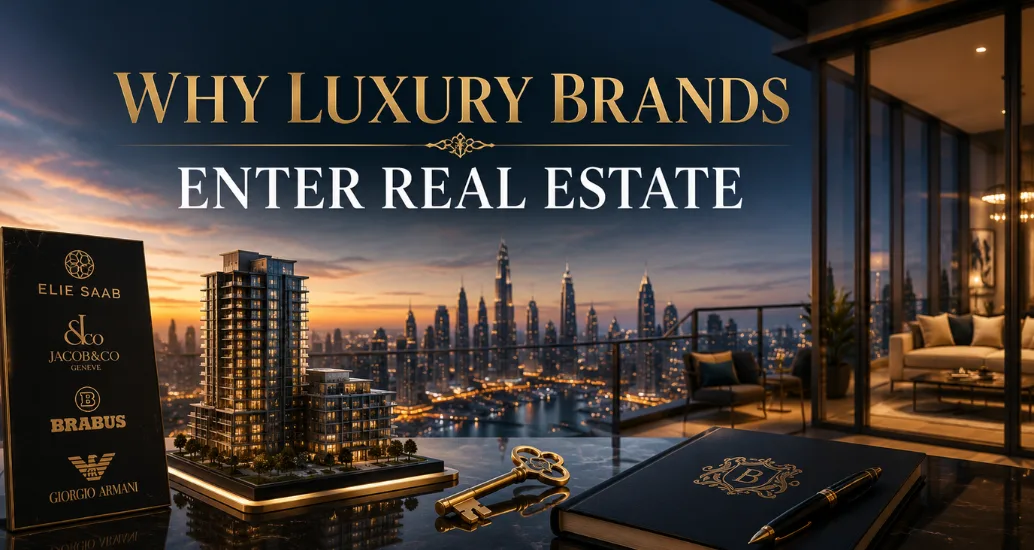
Why Luxury Brands Enter Real Estate: The Branded Residences Guide
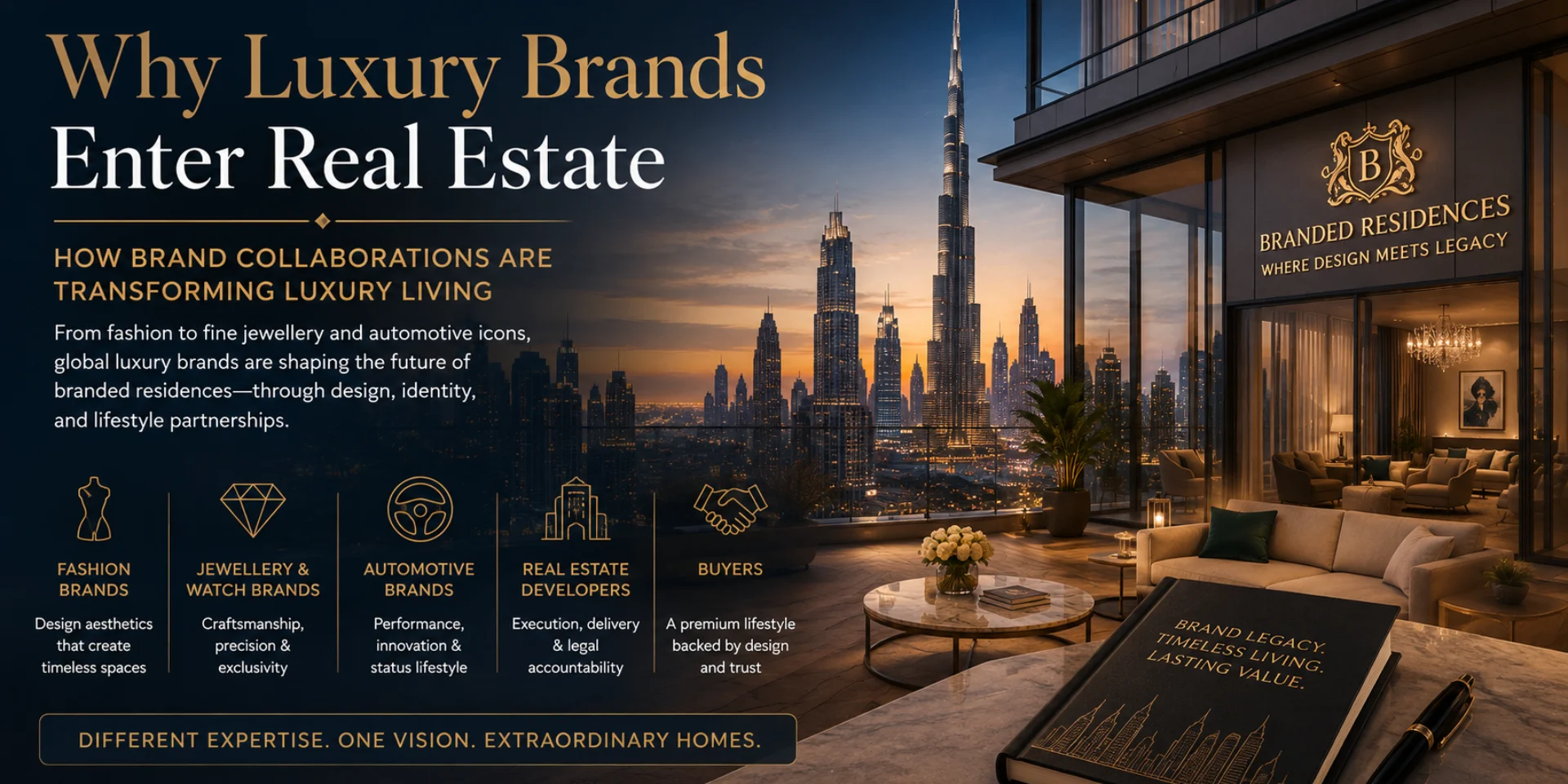
A branded residence is a private home built by a Developer under a formal agreement with a Brand, where the Brand shapes design, identity, or service standards without owning or constructing the property. This is the standard industry definition used by firms like Savills and Knight Frank in their global branded-residence research, and it's worth holding onto because marketing language often blurs it.
Not every project using this term involves the same depth of Brand involvement. Some Brands supply a full design team shaping floor plans, lobbies, and finishes in detail. Others license a name for use on a hoarding with limited creative input beyond that. A buyer's first question for any specific project should be where on that spectrum it actually sits — a question Section 8 answers directly.
One thing worth flagging early, because it rarely gets stated plainly: there's no independent regulator that certifies how "real" a Brand's design involvement is. That verification currently falls entirely on the buyer, through direct questions to the sales team and comparison against the project's actual specification documents.
Why Do Luxury Brands Enter Real Estate?
Luxury Brands enter real estate because a home offers something a boutique or a hotel room cannot: an entire physical environment, occupied daily, that expresses the Brand's design language at full scale. Bernstein luxury analyst Luca Solca has pointed out that fashion houses are drawn to this category primarily for brand elevation rather than direct profit, since real estate royalties typically contribute a modest share of total Brand revenue compared with the reputational value the association carries.
There's a second, more structural driver worth naming explicitly: branded residences are largely capital-light for the Brand. It doesn't buy land, fund construction, or carry inventory risk — the Developer absorbs that exposure. The Brand collects licensing fees tied to sales and, in some structures, ongoing royalties. For a fashion house or watchmaker, that's a rare kind of expansion: new revenue and renewed visibility without balance-sheet risk.
The detail most coverage of this topic skips is the reverse trade-off: because the Brand carries so little downside, it also has limited operational incentive to police quality after the Developer takes over sales. A hospitality Brand that also manages the building has an ongoing reason to protect its name daily. A design-only fashion Brand's incentive to monitor a project largely ends once its design sign-off is complete — which is precisely why the license terms discussed in Section 7 matter more than they're usually given credit for.
A Brief History of Branded Residences
The branded residence isn't a new idea wearing modern marketing language — the concept is nearly a century old, and its age is itself evidence this is a durable model rather than a passing trend. It traces to 1927, when New York's Sherry-Netherland Hotel linked its apartments to the reputation of Sherry's, a well-known restaurant of the era.
The template most of today's industry recognises began in 1985, when Four Seasons opened its first residential project in Boston, pairing private ownership with hotel-grade design and service standards. Aman followed in 1988 with Amanpuri in Phuket, establishing the same idea in Asia. Ritz-Carlton, Mandarin Oriental, and Marriott entered through the 1990s and early 2000s, expanding the category from major cities into resort destinations across the Caribbean, Southeast Asia, and the Middle East.
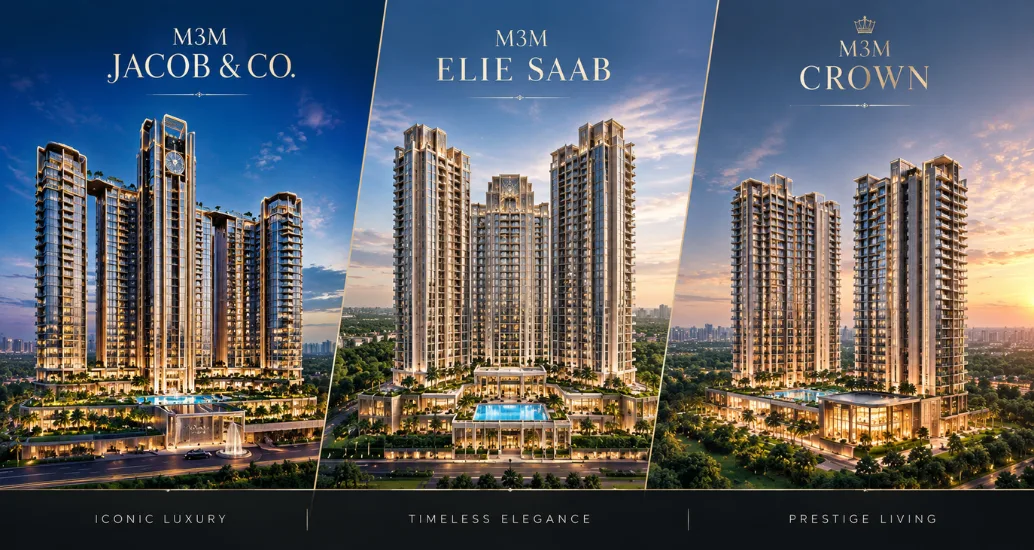
The turning point relevant to this guide came in the early 2000s, when fashion houses began treating real estate as a legitimate business line rather than a hospitality-only game. Armani/Casa launched in 2000, the same year Versace opened Palazzo Versace on Australia's Gold Coast. Bulgari partnered with Marriott in 2001 to build Bulgari Hotels & Resorts, later expanding into residences. That single decade effectively opened the door that Elie Saab, Fendi, Jacob & Co, and dozens of other non-hotel Brands have since walked through.
From Hotel Lobbies to Fashion Runways: How the Category Expanded
Hotel Brands built the branded-residence model, but they no longer dominate its growth the way they dominated its origin — and that shift changes what a buyer should reasonably expect from a new-generation branded project. Hospitality operators still account for the large majority of completed schemes globally, largely because they already run the integrated services — concierge, housekeeping, valet — that early branded residences promised as their core value.
The pipeline tells a different story. Fashion, jewellery, and automotive names are now among the fastest-growing entrants into a category hotels effectively invented, and 2025 alone saw dozens of new non-hotel Brands enter the space globally, according to sector tracking cited in luxury real estate trade press.
This matters practically because a hotel-branded residence usually comes bundled with an operational promise — staffing, service protocols, sometimes access to the group's other global properties. A fashion- or lifestyle-branded residence usually comes with a design promise instead, often without the same ongoing service infrastructure. Knowing which kind of Brand you're buying into should directly change what you expect to receive after handover, not just how the lobby looks on day one.
Hospitality Brands vs Fashion Brands: What's the Real Difference?
Hospitality Brands are built to run buildings; fashion Brands are built to design objects — and that root difference in institutional capability shapes everything else about what each contributes to a residential Project.
| Hospitality Brands (Four Seasons, Ritz-Carlton, Mandarin Oriental) | Fashion & Lifestyle Brands (Armani, Versace, Elie Saab, Jacob & Co) | |
| Core institutional expertise | Running buildings and delivering guest service daily | Designing objects, interiors, and aesthetic identity |
| Typical involvement | Design input plus ongoing operations, staffing, service standards | Design input on architecture, interiors, and common areas |
| Revenue model | Management fees plus a share of ongoing operational revenue | Licensing fees tied to sales, sometimes limited ongoing royalties |
| Post-handover role | Often continues managing the property long-term | Usually design-only; day-to-day operations stay with the Developer |
| What a buyer should verify | Management contract length, service-level agreements | Design-license duration, what happens if the license lapses |
Neither model is inherently superior — they solve different buyer priorities. A hospitality Brand offers service continuity, typically at higher recurring cost. A fashion Brand offers a distinctive design identity, usually at lower ongoing overhead, but with less built-in certainty about long-term service standards unless the Developer contracts those separately.
How Brand Licensing Actually Works
Brand licensing in real estate works the same way it does in fashion or fragrance: the Brand grants the Developer the right to use its name and design direction, in exchange for fees usually structured around unit sales, for a defined period of time. The Brand transfers the right to use its identity — it does not transfer ownership of anything physical.
These agreements typically specify what the Brand's design team must approve — floor plans, material selections, common-area concepts — and set conditions for what happens if standards aren't met during construction. They also define a license term, which is one of the least publicised details in most marketing material and one of the most consequential for a buyer, since branding is rarely granted in perpetuity.
Here's the detail worth understanding that most coverage of licensing skips entirely: because license agreements are private contracts between Brand and Developer, buyers have no independent right to see them. A buyer's only real leverage is to ask the Developer's sales team to put specific brand-standard commitments — not just the Brand's name — directly into the sale agreement or an annexure. A verbal assurance about "brand standards" carries no weight on its own.
Licensing vs Design Collaboration vs Joint Venture
These three structures get used almost interchangeably in marketing copy, but they describe fundamentally different levels of Brand involvement, and the difference should directly influence how much weight a buyer puts on the Brand's name.
| Structure | What It Means | Brand's Financial Risk | Depth of Design Input |
| Pure licensing | Brand name and logo used commercially; minimal creative control | None | Low — largely cosmetic branding |
| Design collaboration | Brand's design or interiors team actively shapes architecture, interiors, and common spaces | Low — fees tied to sales, no capital invested | High — genuine aesthetic influence throughout |
| Joint venture | Brand co-invests capital and shares in profit and risk alongside the Developer | Meaningful — capital exposure | Variable — depends on the specific agreement |
Most fashion- and lifestyle-branded residences globally, including nearly every well-known India example, fall into the middle category: design collaboration. The Brand shapes what the building looks and feels like without putting its own capital at risk. That's a legitimate, well-established model — but it is not the same as the Brand being a co-developer, and a buyer should ask directly which of these three structures actually applies to any specific Project under consideration, rather than assuming from the marketing language used.
Who Signs What: The Buyer's Actual Legal Relationship
In every branded-residence structure common today, the Developer — not the Brand — is the party a Buyer's purchase agreement is signed with, and this single fact resolves most confusion about legal responsibility in this category.
- The Buyer's contract sits with the Developer's registered promoter entity. In India, this means the entity registered under the relevant state's RERA authority — the Buyer's actual legal counterparty for every clause in the agreement.
- Any Brand-specific promise — a material standard, a design compliance commitment, a service layer — has no legal weight unless it's written into that same contract or a signed annexure to it. Marketing material referencing the Brand's design standards is not, by itself, a contractual term.
- If a Project is delayed or under-delivers, a Buyer's recourse runs through the Developer's regulatory registration and the state's real estate regulatory framework — not through the Brand, whose name may appear more prominently than the Developer's throughout the marketing.
This is worth stating plainly because it's the detail most branded-residence marketing pages soften: a Brand's global reputation offers no independent legal guarantee about a specific building's construction quality or delivery timeline. That guarantee, to the extent one exists, comes entirely from the Developer's contract and regulatory compliance.
Fashion Meets Real Estate: What the Case Studies Show
Fashion houses didn't enter real estate by accident — most entered through an existing interiors division that was already designing furniture and living spaces well before the Brand's name appeared on a residential tower. That entry point is itself informative: it's a reasonable way to judge whether a fashion Brand's design involvement in any given Project is likely to be genuine or largely cosmetic.
Armani/Casa is the clearest example of this pattern. Long before Armani-branded residences existed in Miami, Dubai, or elsewhere, Armani/Casa was already an established interior design studio generating a meaningful share of the wider Armani Group's revenue by working directly with developers and private clients — reporting suggests interior design services accounted for roughly 30% of Armani/Casa's total revenue at one point. That pre-existing design infrastructure, not the fashion label's runway fame alone, is what made Armani a credible residential design partner.
Versace followed a comparable path. Palazzo Versace on Australia's Gold Coast, which opened in 2000, was the Brand's first major hospitality venture and set a template later carried into residential projects across Jeddah, Manila, Beirut, and Dubai, with interiors led directly by the house's own design studio under Donatella Versace's direction.
Elie Saab Maison, Explained
Elie Saab's entry into real estate runs through a specific division most buyers have never heard of: Elie Saab Maison, the house's interiors and lifestyle arm. Where the main couture house designs eveningwear and bridal collections, Maison designs furniture, fabric, and home decor in the same visual language. That's the division that typically shapes an Elie Saab-branded residence's interiors and common areas, since it already works in materials and interior proportion rather than only garments.
Elie Saab's best-documented residential project globally is Saab Residences at Dubai's Emaar Beachfront, developed with Emaar Properties — a genuinely useful reference point for what the Brand's design language looks like translated into a finished home, independent of any single new launch's renderings. La Mer by Elie Saab on Al Marjan Island in the UAE is a second, more recent reference point worth checking against for the same reason.
Beyond Fashion: Jewellery, Watches, and Automotive Brands
Real estate branding has expanded well past fashion houses into categories with even less obvious construction connection: jewellers, watchmakers, and car tuning companies. Each entered through the same underlying logic identified in Section 3 — a strong, instantly recognisable design identity a Developer wants to license — but the case studies below show that logic applies even to Brands with zero prior interiors experience.
Jacob & Co, Explained
Jacob & Co is an American luxury jewellery and watchmaking house founded in 1986 by Jacob Arabo, who began as a jewellery designer in New York's Diamond District before expanding into high-complication watchmaking in the early 2000s. The Brand built its reputation on bold, maximalist design — oversized complications, unconventional case shapes, and a client base that grew out of New York's entertainment industry before extending to collectors worldwide. Its move into real estate is recent and highly visible: the Burj Binghatti Jacob & Co Residences in Dubai, developed with Binghatti, is designed to be one of the world's tallest residential towers, translating the Brand's maximalist design ethos directly into architecture.
The instructive point here is that Jacob & Co, unlike Armani or Elie Saab, had no interiors division at all before entering real estate. Its design authority on a residential project rests entirely on its jewellery and watch design language being translated by architects and interior designers working under its direction — a meaningfully different design pathway from a fashion house extending an existing Maison-style interiors arm.
Brabus, Explained
Brabus is a German automotive tuning company founded in 1977 in Bottrop by Bodo Buschmann and Klaus Brackmann, built around transforming Mercedes-Benz, Maybach, and related vehicles into higher-performance, more customised machines. For nearly five decades its identity was purely automotive. Its real estate debut, Brabus Island in Abu Dhabi, developed with Reportage Properties, marks the Brand's first attempt to translate that same performance-driven, customisation-heavy philosophy into architecture and interiors — an unusually direct example of a Brand's core design DNA applied to a category it had never touched before.
Between Jacob & Co and Brabus, the pattern is clear: a Brand doesn't need prior real estate or interiors experience to become a credible design collaborator. What it needs is a design identity distinctive enough that buyers can recognise it applied to a product the Brand has never made before — the same test worth applying to any new Brand-Developer pairing entering the market.
Why Developers Choose Global Luxury Brands
Developers pursue Brand partnerships primarily to solve a differentiation problem that architecture and amenities alone increasingly fail to solve. In a crowded luxury market, a high-end clubhouse, a swimming pool, and a gym are now baseline expectations, not differentiators — a globally recognised Brand name provides an instant, harder-to-copy point of distinction that amenity lists cannot.
A Brand name also compresses the sales cycle in a specific way: buyers researching branded residences already carry a mental picture of a fashion house's or hospitality Brand's design sensibility, which shortens the trust-building work a Developer would otherwise need to do project by project through renderings alone. Branded Projects also tend to draw international media attention independently, giving Developers marketing reach that would otherwise cost considerably more to generate.
The insight worth adding here, because it's rarely stated directly by anyone selling a branded Project: a Brand partnership is also a hedge against a Developer's own market perception. A Developer with a mixed or unproven delivery record can use a strong global Brand to shift buyer attention toward design credibility and away from execution-history questions the Developer might otherwise face directly. That's not necessarily dishonest, but it is a reason Section 18's advice to check the Developer's own RERA record independently of the Brand matters more, not less, when the Brand name is doing heavy lifting in the marketing.
Why Buyers Are Willing to Pay a Brand Premium
Buyers pay a premium for branded residences because the Brand functions as a form of quality assurance in a market where independently verifying construction and design quality is genuinely difficult for most individual purchasers. A recognised name signals a certain design consistency that's harder to evaluate from renderings and brochures alone — whether or not that signal is always accurate for a specific Project.
There's also a status dimension worth naming directly rather than softening. Branded residences let buyers extend a Brand affiliation they already value in fashion, watches, or hospitality into where they live — the same motivation behind a limited-edition handbag or a rare timepiece, applied to real estate. Industry commentary has compared this directly to collectible luxury goods: a scarce, Brand-associated asset that can carry value beyond its pure utility as a home.
Practically, buyers are also often paying for a specific, hard-to-replicate design outcome — materials sourced and specified to a fashion house's standard, furniture and finishes matched to a recognisable aesthetic, common spaces designed with the same discipline the Brand applies to its flagship stores. That's a genuinely different product from a similarly priced unbranded apartment with generically "premium" finishes chosen by an in-house design team.
Does the Premium Hold Up at Resale? What the Data Actually Shows
Branded residences do command a measurable price premium over comparable unbranded projects in most established global markets, though the size of that premium varies significantly by city, Brand, and how deep the actual design collaboration runs. Savills' global branded-residence research puts the average premium at roughly a third above a comparable unbranded unit nearby — a broad industry benchmark, not a guarantee for any specific Project.
Whether that premium holds up specifically at resale, rather than at initial sale, depends heavily on market maturity. In established branded-residence hubs like Dubai, Miami, and London, there's now enough resale transaction history to study how these premiums perform over multiple ownership cycles. In newer markets — India included — that resale history simply doesn't exist yet in meaningful volume, which is a materially different question from whether the initial sale premium exists.
This distinction is the one most marketing material collapses into a single claim, and it's worth separating clearly: an initial-sale premium over comparable unbranded stock is reasonably well documented globally. A guaranteed resale premium years later, in a market without prior transaction history for that specific category, is not the same claim and shouldn't be treated as equally certain.
Global Market Trends and Growth Numbers
The branded-residence sector has moved from a niche hospitality product to one of the fastest-growing categories in global luxury real estate over the past decade. According to Savills' branded residences research, the number of active global schemes grew from 764 at the end of 2024 to an estimated 910 by the end of 2025 — roughly 19% annual growth, and nearly three times the 323 schemes that existed as recently as 2015.
The pipeline suggests durability rather than a short-term spike. Savills counts 837 additional projects already contracted for delivery by 2032, which would take the global total to roughly 1,747 developments spread across more than 90 countries. Asia Pacific — the region that includes India — has grown branded-residence supply by 55% over the past five years, among the fastest of any region tracked in that research.
What's changed most in the past few years isn't only the project count, but the composition of who's behind them. Non-hotel Brands — fashion houses, jewellers, automotive names — represented a meaningful share of new entrants in 2025 alone, alongside dozens of new hotel-brand entries, as the category diversifies well beyond its hospitality-only origins described in Section 4.
The Rise of Branded Residences in India
India's branded-residence market is still young by global standards, but it's growing quickly and concentrating heavily in Delhi-NCR — a pattern distinct enough from the global picture in Section 15 to warrant its own read. Industry coverage citing CBRE's India Residential Market Outlook and Savills' branded residences research consistently identifies Delhi-NCR, alongside Hyderabad and Mumbai, as the country's leading markets for this category, with Gurgaon specifically emerging as the strongest single city for branded-residence supply within India.
That growth tracks a broader structural shift in India's luxury housing market rather than a category-specific bubble. The share of premium homes in total residential sales across India's top cities moved from roughly 11% in 2021 to around 27% by 2025. Rising HNI wealth, a growing base of NRI buyers with direct exposure to established branded-residence markets abroad, and Developer appetite to differentiate in an increasingly crowded luxury segment are the main forces behind it.
Within Gurgaon specifically, the Dwarka Expressway corridor has become a particular focal point, with multiple Developers launching branded Projects with fashion, hospitality, and lifestyle partners within a few kilometres of each other. That density is itself informative for buyers: it signals real demand for the category, but it also means genuine, direct comparison points now exist. Each Project should be evaluated on its own Developer's record and its own license structure — the category's overall growth doesn't transfer automatically to any individual launch within it.
Common Myths About Branded Residences
The Brand co-owns or co-finances the Project. Reality: In the large majority of fashion-, jewellery-, and lifestyle-branded residences, the Brand licenses its name and design direction. The Developer owns the land, funds construction, and carries full financial and legal responsibility, unless a Project is specifically structured as a joint venture — which is uncommon and would typically be disclosed prominently given how much it changes the risk picture.
A branded residence automatically resells at a premium. Reality: As Section 14 details, Brand association tends to support resale value in mature markets with established transaction history. In newer markets, resale performance depends on execution quality, location fundamentals, and demand at the time of sale — the Brand helps, but doesn't guarantee an outcome on its own.
Regulatory registration validates every claim in a Project's marketing material. Reality: A regulator like India's RERA confirms basic project compliance, disclosures, and registration status. It does not independently verify every figure — configuration details, amenity lists, or the depth of Brand-collaboration — published across third-party marketing and broker websites.
All branded residences involve the same level of Brand control. Reality: As Section 8 lays out, the spectrum runs from pure name licensing with minimal creative input, through genuine design collaboration, to full joint ventures with shared capital risk. The specific structure matters far more than the Brand's name alone.
The Brand is legally accountable if the Project is delayed or under-delivers. Reality: As Section 9 establishes, a Buyer's purchase agreement is signed with the Developer's registered promoter entity, not the Brand. Legal recourse for delays or quality issues runs through the Developer, regardless of how prominently the Brand's name appears in marketing.
Risks and What Buyers Should Verify Before Signing
Buying into a branded residence carries the same fundamental risks as any pre-construction luxury purchase, plus a few specific to the branding itself — and the entity relationships mapped in Section 1 point directly to what independent verification looks like in practice.
- Verify the Developer's own delivery record independently of the Brand. Pull the promoter's actual RERA history and compare completion timelines on its last several projects against what was originally promised — this checks the Developer entity, which carries the actual delivery risk.
- Confirm the license structure directly with the sales team. Ask how long the Brand's design license runs, what happens if it lapses, and whether any Brand-standard guarantees are written into the actual buyer agreement rather than appearing only in marketing material.
- Cross-check specification claims against the RERA-filed annexure. Marketing pages often describe interior finishes and materials more precisely — or more generously — than the legally binding project documents do.
- Treat resale-premium figures as market benchmarks, not commitments. Especially in newer markets like India, there isn't yet enough resale data to treat any specific premium figure as guaranteed rather than directional.
- Check regulatory filings directly rather than relying on broker listings. Numbers — RERA registration, promoter entity name, possession date — sometimes vary across third-party sites; the regulator's own portal is the authoritative source for the Developer entity you're actually contracting with.
None of this makes branded residences a poor category to consider. It means the Brand name should sit alongside, not instead of, the diligence any serious luxury property purchase already requires.
Who Should — and Shouldn't — Consider a Branded Residence
A branded residence tends to suit buyers who value a distinctive, Brand-consistent design identity, are comfortable evaluating a Project on the Developer's own delivery record rather than the Brand's reputation alone, and are buying for long-term ownership or end-use rather than a quick resale. It also tends to suit NRI and HNI buyers already familiar with the category from more established markets abroad.
It warrants more caution for buyers who need near-term possession, since most branded launches — like most ultra-luxury pre-construction projects generally — carry multi-year construction timelines. It also warrants caution for first-time luxury buyers not yet comfortable independently evaluating RERA disclosures and construction-linked payment plans, and for anyone assuming a guaranteed resale premium in a market segment still too young to have reliable local data, as Section 14 explains.
What Most Branded-Residence Guides Leave Out
Most published coverage of branded residences — in India and globally — treats the Brand's presence as the headline story and stops there. Two things get consistently underexplained, and both are addressed directly in this guide rather than assumed away.
The first is license duration. Almost no marketing material for any branded residence, in India or abroad, publicly states how long the Brand's design license actually runs or what happens to the Project's branding once that period ends. This is arguably the single most consequential unanswered question in the category, and Section 7 addresses why it matters and what a buyer can realistically do about it — ask directly, and get the answer written into the contract, since it won't appear in a brochure.
The second is the distinction between an initial-sale premium and a resale premium, which Section 14 treats as two separate claims rather than one. Most coverage uses "premium" as a single, undifferentiated number, which flattens a genuinely important difference for anyone evaluating a Project as an investment rather than purely as a home.
Conclusion: An Expert Take
Branded residences are not a passing trend dressed up in marketing language — they're a genuine, fast-growing, and increasingly global category with nearly a century of history behind the underlying idea. What's changed in the last two decades is who's participating: fashion houses, jewellers, and automotive brands have joined hotel operators as credible design partners for developers, and buyers now have real reason to weigh a Brand's design identity as part of a purchase decision.
The category rewards buyers who keep the entity map from Section 1 in view rather than letting a Brand's reputation blur it: the Brand's design contribution is one thing, and the Developer's legal and financial responsibility for actually delivering the home is another, entirely separate thing. Get that distinction right, verify the Developer's own track record independently of the Brand's reputation, ask about license duration before signing anything — and a branded residence can be a genuinely well-informed purchase, not just a well-marketed one.
 Sumit Mishra / Property Counselor
You Must Read:
 Residential