


arrow_backBack to Blog
Residential
M3M St. Andrews Golf-Facing Apartments | Golf View Homes
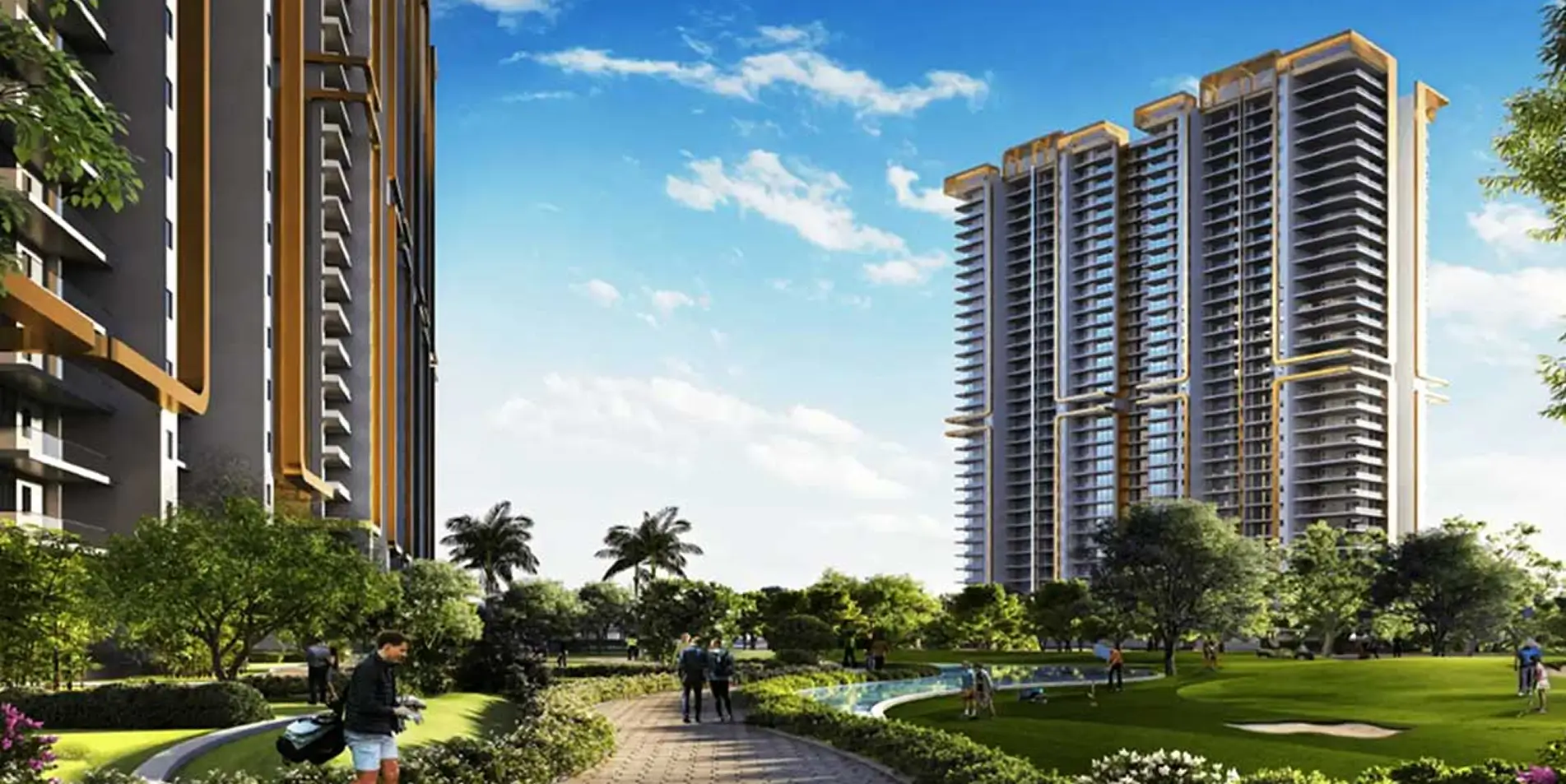
Golf-facing apartments in M3M St. Andrews are residences angled toward the on-site golf course, so the living room, main bedroom, and balcony open onto fairways and greens instead of internal roads or neighbouring blocks.
These are residences within the M3M St. Andrews in Sector 113, part of the larger SCDA township along Dwarka Expressway, deliberately oriented toward the on-site golf course rather than parking courts or adjoining structures. Not every unit gets this outlook — golf-facing apartments are the ones specifically planned for it, with the living room, main bedroom, and balcony all opening toward greens and fairways instead of a service lane or the next wing of the building.
What Makes Golf-Facing Apartments Different?
The difference is structural, not cosmetic — room placement, balcony depth, and spacing from neighbouring blocks are all planned around the outward view.
In a standard-facing apartment, layout prioritises internal flow. In a golf-facing unit, the architect works backward from the view — living areas and the main bedroom face the course, and the balcony becomes a genuine extension of living space rather than an afterthought.
There's also a spacing advantage. Units angled toward an open course sit further from the next block than units facing an internal courtyard, since the course itself acts as a buffer. That distance is where much of the extra privacy and quiet comes from — orientation plus distance, not different fittings or construction quality.
Golf View vs Other View Types
A golf view stays open and consistent across floors, since the course itself protects it from future construction — something park, city, and internal views can't guarantee.
| View Type | Typical Experience |
| Golf View | Open, uninterrupted vista; consistent across most floors; low risk of future obstruction |
| Park / Open Green View | Pleasant but smaller in scale, sometimes bounded by paths or built edges |
| City / Skyline View | Striking at height, but distant and unrelated to daily green-space living |
| Internal / Community View | Faces courtyards or other towers; most exposed to noise and overlooking |
A golf view stands apart because the openness is protected by the course itself — a fairway can't be built over the way a park edge sometimes can.
Apartment Orientation
Orientation affects sunlight and airflow as much as the view — golf-facing units should be evaluated on both compass direction and course-facing angle together.
| Orientation | General Impact |
| North Facing | Soft, consistent daylight; lower heat gain |
| East Facing | Bright morning light; pleasant early balconies |
| South Facing | Longer sun exposure; more heat in peak summer |
| West Facing | Strong evening sun; balconies can feel warm |
| Golf Facing | An outlook layered on top of any compass direction above |
North- and east-facing golf units tend to combine the view with gentler daylight, which is worth checking alongside the golf-facing tag itself.
Key Features
- Open golf course views — unobstructed sightlines from the main living areas, not a partial glimpse.
- Wrap-around, expansive balconies — sized for actual use, not just visibility.
- Floor-to-ceiling windows — maximise both the view and daylight entering the room.
- Low-density placement — golf-facing blocks sit with more open space in front by design.
- Landscape-integrated design — grounds are planned to extend the course's greenery up to the building line.
Each feature ties directly back to the view — none are decorative add-ons.
Golf View vs Standard View
Golf-facing units generally win on privacy, light, and noise; standard units sometimes win on proximity to a specific entrance or amenity.
| Factor | Golf-Facing | Standard-Facing |
| Primary outlook | Golf course, open greens | Roads, parking, adjoining blocks |
| Distance to nearest structure | Greater | Shorter |
| Balcony usage | Extension of living space | Often functional only |
| Natural light | Stronger, fewer obstructions | Can be partially blocked |
| Noise exposure | Lower | Slightly higher |
| Privacy | Higher | Comparatively lower |
Why Golf-Facing Apartments Command a Premium
The premium reflects genuine scarcity and protected open space, not just a nicer-looking view.
- Scarcity of inventory — only a limited number of units can physically face the course, and once sold, that view can't be recreated elsewhere in the project.
- Protected open space — a golf course is functionally permanent, unlike a vacant plot that could later be built on.
- No future obstruction risk — standard-facing units carry more risk of a later construction phase changing the outlook.
- Built-in privacy — the distance created by the course is difficult to replicate through design alone on a standard-facing unit.
Types of Golf Views
"Golf-facing" isn't one uniform category — the amount of course actually visible varies by view type.
- Direct View — faces the course head-on with minimal obstruction; usually the most sought-after.
- Partial View — only part of the course is visible, often from one room or section of the balcony.
- Corner View — a wider angle across two sides, typically on corner units.
- Wide View — a broader, panoramic sweep, usually on higher floors or wrap-around balconies.
- Front View — closest to the course, offering the most immersive outlook.
Always confirm which type a specific unit actually offers, not just the general "golf-facing" tag.
Floor Selection
Golf views tend to open up from mid floors upward; low floors can be partly blocked by boundary landscaping.
- Low Floors — sightline can be interrupted by boundary walls or trees along the course edge.
- Mid Floors — usually the most consistent, clearing ground-level landscaping while staying visually connected to the course.
- High Floors — the widest panorama, often combined with a skyline view, though the course itself can feel visually smaller.
There's no single "correct" floor — it depends on whether a buyer wants immersion or panorama.
Design, Balcony, Natural Light & Privacy
Layouts in golf-facing units typically pull the living room, main bedroom, and balcony toward the same golf-facing side, so the view isn't limited to one corner. Wrap-around balconies extend this further, letting residents take in the view from more than one angle — which is a large part of why the outdoor space actually gets used rather than just admired.
This orientation also drives three practical benefits together. Daylight is stronger since there's no tall structure opposite to block the sun. Ventilation improves because open space in front allows air to move across the unit more freely than between two closely spaced towers. And privacy is higher, since there's no equivalent structure close enough to create a sense of being observed.
The balcony experience also shifts through the day and year — brighter, softer light in the morning; a longer visible horizon in the evening; steadier cross breezes through the temperate months; and the course looking its most vivid just after the monsoon. Compass direction (see Orientation above) still matters for how warm a golf-facing balcony feels in peak summer or winter.
Lifestyle Benefits
Beyond the view itself, golf-facing living tends to mean lower ambient noise, a stronger sense of privacy, and a more sociable, photograph-worthy home.
Everyday living — a view that changes through the day, from morning mist over the greens to a different tone by evening, offers residents (especially those working from home) a visual reset that a fixed view of parking courts can't match.
Wellbeing and noise — sitting away from internal roads and driveways, golf-facing units are generally quieter, and a consistent open outlook is associated with lower everyday stress compared to dense, built-up sightlines.
Social and visual value — a living room or balcony with a fairway backdrop naturally becomes the most-used and most-photographed corner of the home, adding a sense of occasion to routine moments like morning coffee or hosting guests.
Advantages
- Consistently open sightlines across multiple floors, since the course itself is the buffer.
- Higher resale and rental appeal, as the view is a fixed, non-replicable asset.
- Reduced overlooking from neighbouring units.
- Fresher immediate environment, near large landscaped green space.
- A view that doesn't age, unlike trend-dependent interior finishes.
Common Buyer Mistakes
- Mistaking a club- or garden-facing unit for a golf-facing one — always confirm the exact fairway overlooked, not just “greenery.”
- Assuming every unit in a "golf-facing tower" has the same view — corner units, lower floors, or far-end units can differ significantly.
- Not checking future construction plans that could sit between the apartment and the course.
- Booking from brochure renders alone, without a site visit at the actual floor and unit.
- Prioritising balcony width over usable depth, ending up with a view but not a livable outdoor space.
- Ignoring compass orientation, resulting in a great view paired with an uncomfortably warm balcony.
Myths vs Facts
| Myth | Fact |
| Golf-facing always means cooler weather | The view improves outlook and light, not temperature |
| Every unit in a golf-facing tower has an identical view | Views vary by floor, corner, and unit location |
| A green view and a golf view are the same | Landscaped gardens aren't the same as an actual golf sightline |
| Higher floors always mean a better golf view | Mid floors are often the clearest and most immersive |
| The view premium is purely emotional | It reflects real scarcity, protection from obstruction, and privacy |
Expert Perspective
The premium on golf-facing apartments isn't purely about the view. Long-term resident experience points to uninterrupted openness, lower visual congestion, and enhanced privacy as equally significant factors that compound over years of living in the home. Buyers should verify the actual sightline from the specific unit, confirm balcony orientation and depth, and check future development plans before booking — the difference between a genuinely direct golf view and a partially obstructed one can be substantial even within the same tower.
Final Verdict
M3M St. Andrews Golf-Facing Apartments aren't defined by an extra amenity — they're defined by orientation, and everything it makes possible: better daylight, genuine privacy, a balcony that gets used, and a view that doesn't depend on trends to stay relevant.
For buyers who see the view as central to daily life, this configuration is worth prioritising over almost any other decision within the project. For everyone else, it's still worth understanding clearly, since view type, floor, and orientation shape exactly how different one golf-facing unit can be from another.
Frequently Asked Questions
What are M3M St. Andrews Golf-Facing Apartments?
Residences within M3M St. Andrews specifically oriented toward the on-site golf course, with layouts and balconies designed around that view.
What makes them different from other units?
Orientation and distance from neighbouring structures, plus a layout that brings the living room, main bedroom, and balcony toward the same golf-facing side.
What are the advantages of golf-facing apartments?
Consistent open sightlines, stronger privacy, better natural light, and a view that holds its appeal over time.
What's the difference between direct, partial, and wide golf views?
A direct view faces the course head-on, a partial view shows only part of it, and a wide view offers a broader panorama, usually from higher floors.
Do golf-facing apartments have better resale value?
Yes — since the view can't be replicated once construction is complete, they generally hold stronger resale and rental demand.
 Sumit Mishra / Property Counselor
You Must Read:
 Other
Other

 Residential