


arrow_backBack to Blog
Other
Difference Between Carpet Area, Built-up & Super Built-up Area
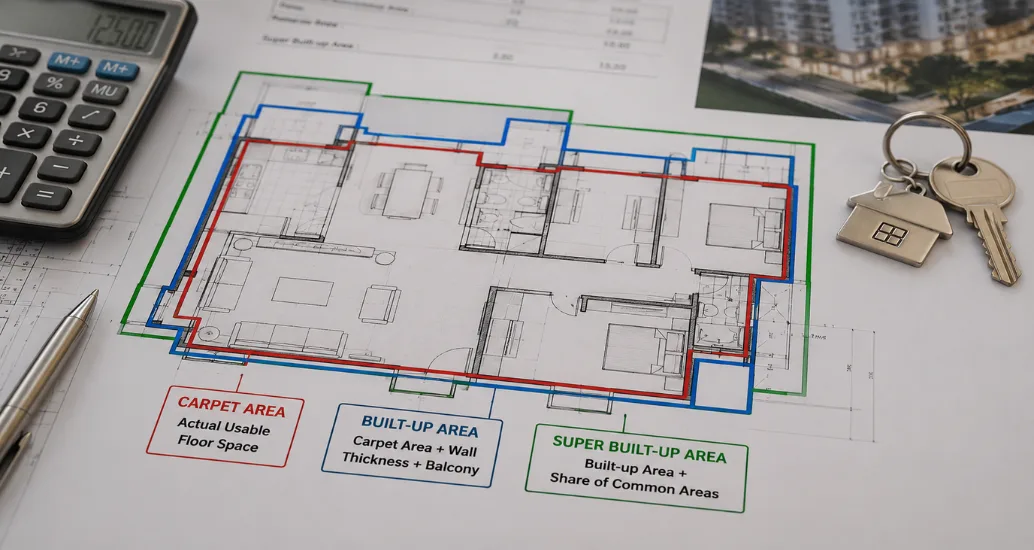
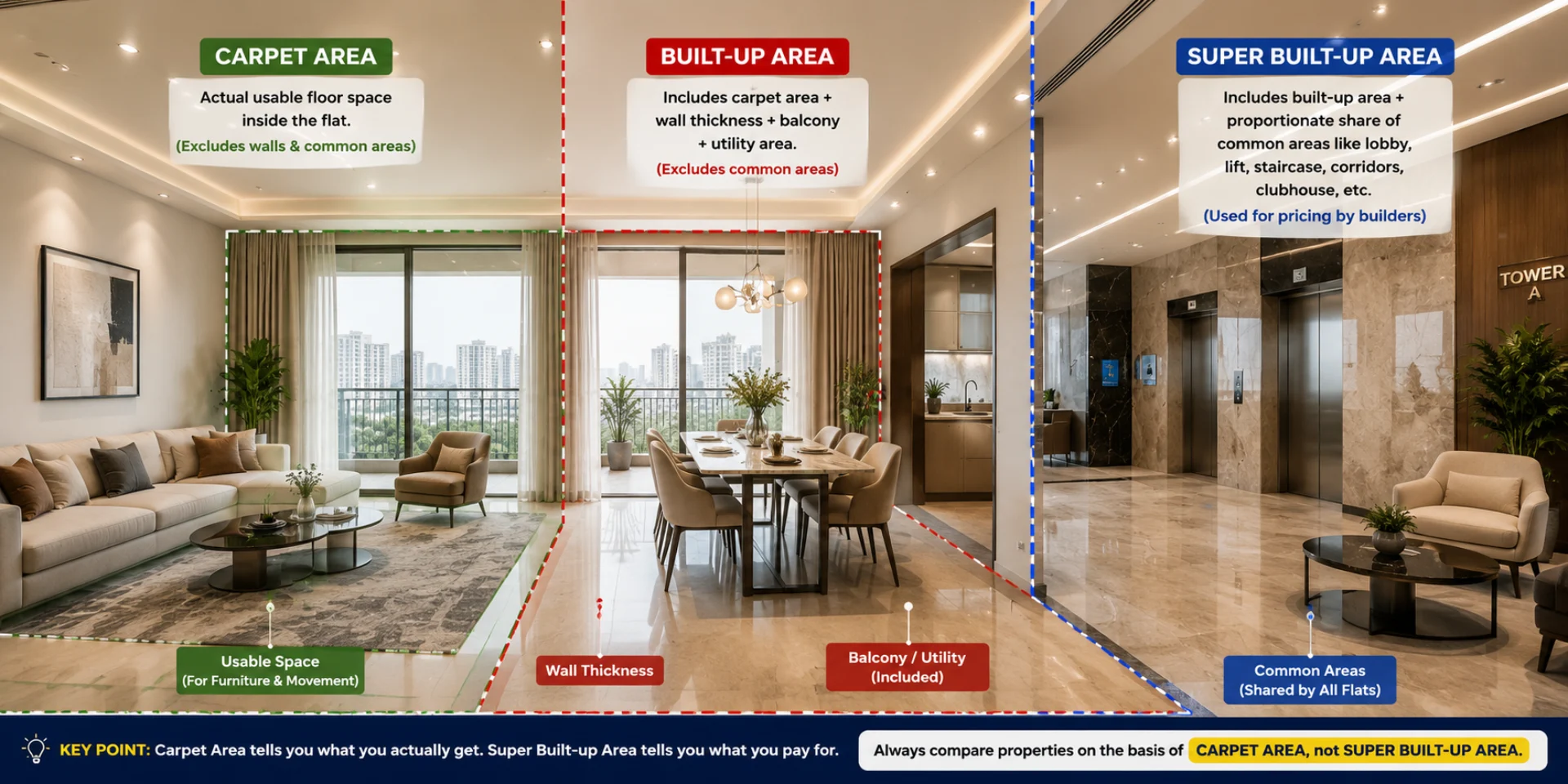
Carpet Area is the actual usable floor space inside your flat. Built-up Area adds wall thickness and balcony to Carpet Area. Super Built-up Area adds a share of common areas like lobby, lift, and staircase. Builders usually quote price based on Super Built-up Area, but RERA requires Carpet Area disclosure too. Always compare Carpet Area to judge real value.
Why Understanding Property Area Matters
Most buyers get confused when they see three different area numbers for one flat. This confusion often leads to overpaying.
A 1200 sq ft flat on paper can feel much smaller once you walk in. Knowing these terms helps you compare properties fairly and calculate the real price per sq ft you are paying.
What is Carpet Area
Carpet Area Meaning: Carpet Area is the net usable floor area inside your flat. It is the space where you can actually place a carpet.
It includes the area inside your internal walls, plus internal partition walls. It excludes external walls and common areas, and open balconies are usually treated separately.
Featured Snippet Definition: Carpet Area is the actual usable floor space within a flat's internal walls, excluding external walls but including internal partition walls. It represents the real area available for furniture and movement, making it the most accurate measure of a home's true size.
Practical Buyer Tip: Always ask the builder for the exact Carpet Area figure in writing. This number tells you what you are really paying for.
What is Built-up Area
Built-up Area Meaning: Built-up Area is Carpet Area plus the area covered by walls. It usually includes your balcony and utility area too.
It is the total covered space of your flat, including wall thickness. Older documents sometimes call this Plinth Area.
Featured Snippet Definition: Built-up Area is the Carpet Area of a flat plus the area occupied by internal and external walls, along with balconies and utility spaces attached to the unit. It is always larger than Carpet Area.
Practical Buyer Tip: If a builder only shows Built-up Area, ask for a breakup into Carpet Area and wall area separately.
What is Super Built-up Area
Super Built-up Area Meaning: Super Built-up Area is Built-up Area plus a proportionate share of common areas in the building.
Common areas include the lobby, lift, staircase, corridors, and sometimes the clubhouse. Every flat owner pays for a share of these shared spaces.
Featured Snippet Definition: Super Built-up Area is the Built-up Area of a flat plus a proportionate share of common amenities like lobby, lift, staircase, and corridors. Builders use this figure, also called Saleable Area, to price residential apartments.
Practical Buyer Tip: Ask what amenities are included in the common area calculation. This varies between residential projects.
Difference Between Carpet Area, Built-up Area and Super Built-up Area
Carpet Area is the smallest number, counting only usable indoor space. Built-up Area is bigger, adding wall thickness and balcony. Super Built-up Area is the biggest, adding a share of building-wide common areas on top.
Carpet Area vs Built-up Area: Built-up Area is always higher than Carpet Area because of wall thickness and balcony space. The gap depends on wall design and balcony size.
Carpet Area vs Super Built-up Area: This comparison shows the biggest gap, since Super Built-up Area includes common areas that Carpet Area does not count at all.
Built-up Area vs Super Built-up Area: These two differ mainly because Super Built-up Area adds a share of shared building spaces to the Built-up Area.
Comparison Table
| Feature | Carpet Area | Built-up Area | Super Built-up Area |
| Also known as | Usable Area | Plinth Area | Saleable Area |
| Includes internal walls | Yes | Yes | Yes |
| Includes external walls | No | Yes | Yes |
| Includes balcony | Usually no (varies) | Yes | Yes |
| Includes common areas | No | No | Yes |
| Size vs others | Smallest | Middle | Largest |
| Used in RERA disclosure | Yes | Sometimes | Rarely primary |
| Used for pricing | Sometimes | Rarely | Most common |
Real Floor Plan Example
Here is how the three areas can look for one sample flat. Actual numbers will differ for every project, so always check your own floor plan.
| Component | Area (sq ft) |
| Carpet Area | 1350 |
| Wall Area | 170 |
| Balcony | 130 |
| Built-up Area | 1650 |
| Common Area Share | 450 |
| Super Built-up Area | 2100 |
Actual Price Calculation Example
This example shows why the area you use for calculation changes your real price per sq ft.
| Detail | Value |
| Flat Price | ₹5 Crore |
| Super Built-up Area | 2500 sq ft |
| Carpet Area | 1750 sq ft |
| Price on Super Built-up Area | ₹20,000/sq ft |
| Price on Carpet Area | ₹28,571/sq ft |
| Difference | ₹8,571/sq ft |
Practical Buyer Tip: The same flat looks cheaper per sq ft on Super Built-up Area. Always recalculate using Carpet Area before comparing two properties.
RERA Rules About Carpet Area
RERA Carpet Area Meaning: RERA, the Real Estate Regulation Act, requires builders to price flats based on Carpet Area, not Super Built-up Area. This rule brings transparency and helps buyers compare projects on equal terms.
Under RERA, Carpet Area excludes external walls but includes internal partition walls. Balcony and terrace treatment can vary, so always check your Builder Buyer Agreement.
| Area Type | Internal Walls | External Walls | Balcony | Common Areas |
| Carpet Area | Included | Excluded | Usually excluded | Excluded |
| Built-up Area | Included | Excluded | Included | Excluded |
| Super Built-up Area | Included | Excluded | Included | Included |
Practical Buyer Tip: Confirm the Carpet Area in your Sale Agreement matches the figure filed with the RERA registration. Check this on your state RERA authority website before booking.
Loading Factor Explained
Loading Factor Definition: Loading Factor is the extra area added to Carpet Area to reach Super Built-up Area, shown as a percentage.
Formula: Loading Factor (%) = [(Super Built-up Area − Carpet Area) / Carpet Area] × 100
A higher loading factor means you pay for more common area relative to usable space. This number varies by builder and project, so always ask for it directly.
Practical Buyer Tip: Compare loading factor across projects in the same location. Lower loading generally means better value.
Saleable Area Explained
Saleable Area is another name for Super Built-up Area, used in the Builder Buyer Agreement and price list. It is the base for your Basic Sale Price, or BSP.
Other charges like PLC (Preferential Location Charges), Floor Rise Charges, GST, and Maintenance Charges are usually added on top.
Practical Buyer Tip: When comparing price per sq ft between projects, always confirm whether the rate is based on Carpet Area or Saleable Area.
Common Builder Tricks
Some builders use area figures in ways that can mislead buyers. Watch out for these practices:
- Advertising only Super Built-up Area in marketing material
- Not mentioning the loading factor upfront
- Giving an approximate, not exact, Carpet Area
- Clubbing common areas differently across projects
- Showing Saleable Area in large font, Carpet Area in small print
Practical Buyer Tip: Ask for Carpet Area and loading factor in writing before you pay any booking amount.
Myth vs Reality
| Myth | Reality |
| Higher Super Built-up Area means a bigger home | Not always. Higher loading factor can mean less usable space |
| Built-up Area and Carpet Area are the same | Built-up Area is always larger, since it adds walls and balcony |
| All builders calculate Super Built-up Area the same way | Calculation methods vary by builder and project |
| RERA Carpet Area and marketing Carpet Area always match | Always verify both figures against the RERA registration |
Which Area Should Buyers Compare
Carpet Area is the most reliable figure for comparing property value, since it reflects actual usable space.
When comparing the Carpet Area of luxury developments such as M3M Jacob & Co Gurgaon or M3M Brabus Residences, buyers should always verify the RERA Carpet Area instead of relying only on the Super Built-up Area. This approach works for any residential project.
Super Built-up Area still helps you understand your share of amenities. But it should never be the only number used to judge value for money.
Common Mistakes Buyers Make
- Judging flat size only by Super Built-up Area
- Assuming loading factor is the same across all projects
- Skipping the RERA-approved floor plan check
- Not confirming balcony treatment for the specific unit
- Ignoring how common area share is calculated
Expert Tips Before Buying
Request the Carpet Area figure in writing before signing anything. Cross-check it against the project's RERA registration on your state RERA website.
Review the Builder Buyer Agreement carefully to see which area is used for pricing. Also check the Occupancy Certificate and Completion Certificate, which confirm the project matches its approved plan.
Factor in stamp duty and property registration charges, which are usually linked to the Carpet Area or Built-up Area value depending on your state's rules. If you are taking a home loan, ask your lender which area figure they use for property valuation.
Home Buyer's Checklist
Before booking a flat, confirm these:
✔ Carpet Area figure in writing ✔ Loading Factor percentage ✔ RERA-approved Floor Plan ✔ RERA Registration number ✔ Builder Buyer Agreement terms ✔ Balcony area treatment ✔ Utility area inclusion ✔ Terrace area treatment ✔ Common Area share calculation ✔ Saleable Area used for final pricing
State-wise Differences
Treatment of balconies, terraces, and area disclosure practices may vary by state and by individual project documentation. Always confirm the exact rules with your local RERA authority and the project's official documents before buying.
Glossary
| Term | Meaning |
| Carpet Area | Usable floor space inside a flat |
| Built-up Area | Carpet Area plus walls and balcony |
| Super Built-up Area | Built-up Area plus common area share |
| Loading Factor | Extra area added over Carpet Area, in percentage |
| Saleable Area | Another name for Super Built-up Area |
| PLC | Preferential Location Charges |
| BSP | Basic Sale Price |
| OC | Occupancy Certificate |
| CC | Completion Certificate |
| IFMS | Interest Free Maintenance Security |
| GST | Goods and Services Tax on property purchase |
Frequently Asked Questions
What is Carpet Area?
Carpet Area is the actual usable floor space inside a flat, within the internal walls. It excludes external walls but includes internal partitions.
What is Built-up Area?
Built-up Area is Carpet Area plus the space taken by walls, balcony, and utility area. It gives the flat's full covered footprint.
What is Super Built-up Area?
Super Built-up Area is Built-up Area plus a share of common areas like lobby, lift, and staircase. It is also called Saleable Area.
What is the difference between Carpet Area and Built-up Area?
Built-up Area is larger because it adds wall thickness and balcony space. Carpet Area only measures usable indoor floor space.
What is the difference between Built-up Area and Super Built-up Area?
Super Built-up Area adds a share of shared building spaces to the Built-up Area, so it is always equal to or larger.
Which area is mentioned in RERA?
RERA requires builders to price and disclose flats based on Carpet Area, not Super Built-up Area.
Which area should buyers compare before purchasing a property?
Buyers should compare Carpet Area, since it reflects real usable space and gives a fair price-per-sq-ft comparison.
Why is Super Built-up Area larger than Carpet Area?
It includes wall thickness, balcony space, and a share of common areas, which Carpet Area does not count.
How do builders calculate Super Built-up Area?
Builders add a proportionate share of common amenities to the Built-up Area. The exact method varies by builder.
Is balcony included in Carpet Area?
This varies by project and state rules. In many cases, open balconies are counted separately from Carpet Area.
Is balcony included in Built-up Area?
Yes, in most cases the balcony is part of Built-up Area, though treatment can differ slightly by builder.
Is common area included in Carpet Area?
No. Common areas like lobby, lift, and staircase are only added when calculating Super Built-up Area.
Is Carpet Area better than Super Built-up Area?
Carpet Area is more useful for judging usable space and true value. Super Built-up Area shows your share of amenities.
What is the loading factor in real estate?
It is the extra percentage of area added to Carpet Area to reach Super Built-up Area.
How much difference is there between Carpet Area and Super Built-up Area?
The difference depends on each project's loading factor, so always ask the builder for the exact figure.
Which area should I use while comparing property prices?
Use Carpet Area to calculate price per sq ft for a fair comparison between properties.
Expert Verdict: Which Area Should You Trust?
Always compare Carpet Area. Never judge a flat by Super Built-up Area alone.
Before you finalise any property, check:
- The RERA registration for the project
- The RERA-approved Floor Plan
- The Builder Buyer Agreement
These three documents, along with your home loan and property registration paperwork, give you the full, verified picture of what you are actually buying.
Conclusion
Understanding Carpet Area vs Built-up Area vs Super Built-up Area helps you make a smarter property decision. Carpet Area shows real usable space, Built-up Area adds wall and balcony space, and Super Built-up Area adds your share of common facilities.
Before buying any flat, verify the Carpet Area through the RERA-approved floor plan and Builder Buyer Agreement. This one step can save you from overpaying and help you choose a home that truly fits your needs.
 Sumit Mishra / Property Counselor
You Must Read:
 New Launch