

arrow_backBack to Blog
Other
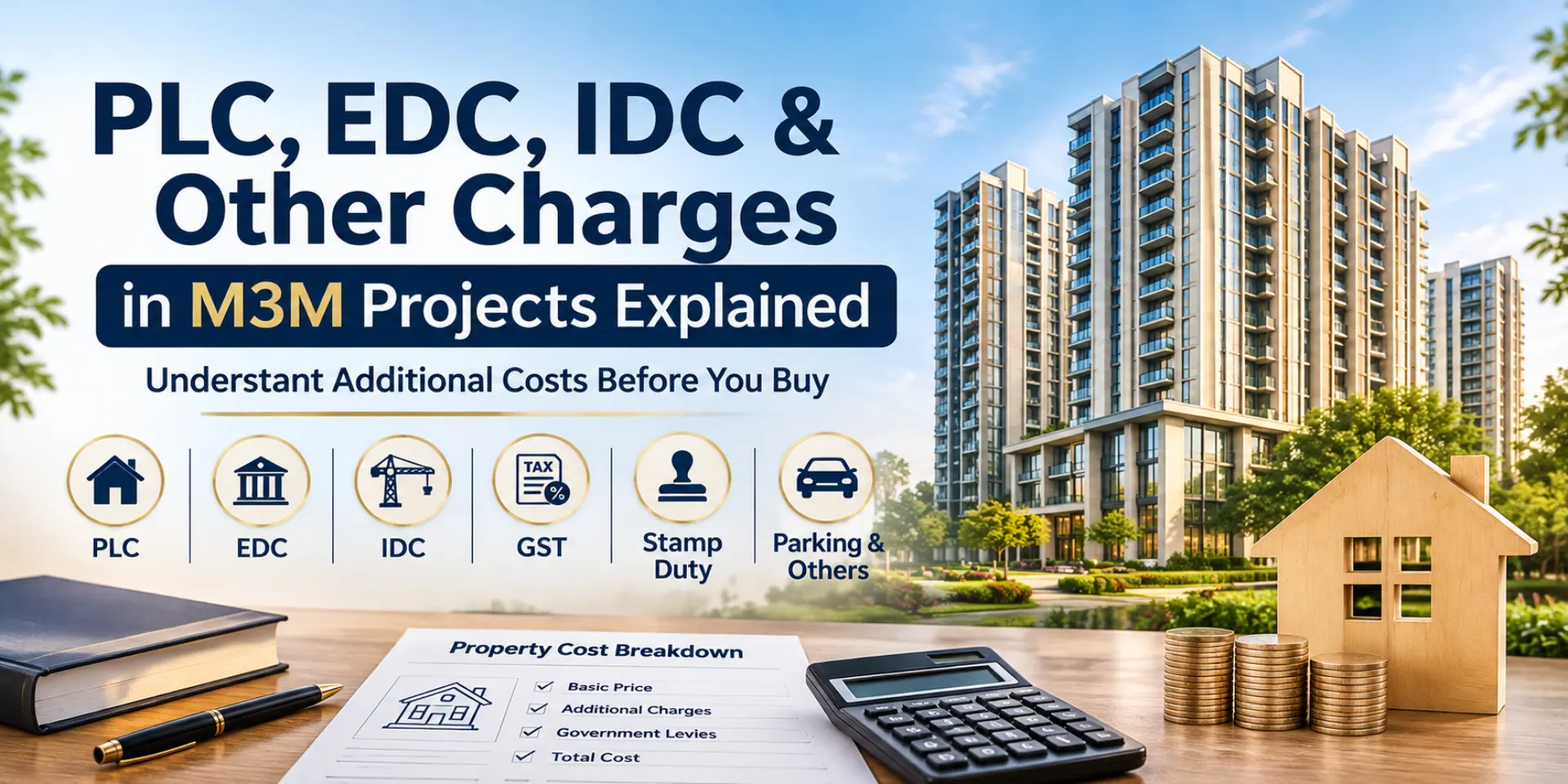
PLC, EDC, IDC & Other Charges in M3M Projects Explained
The basic sale price (BSP) of an M3M home is rarely the amount you finally pay. On top of it you may pay PLC, EDC and IDC (where they are charged separately), floor-rise charges, GST, club and parking charges, a maintenance deposit, and stamp duty and registration. Which ones apply depends on the project, the unit and your agreement.
There is no single M3M price formula. This guide explains each charge in simple words, shows how a total cost is built, and tells you what to check before you pay.
The Short Answer
| Charge | In one line |
| BSP | The base price of the unit, before extras |
| PLC | Extra money for a better-placed unit (corner, view, floor) |
| EDC | External Development Charges: a levy paid to the Haryana Town and Country Planning Department (DTCP) for external services like roads, water, sewer and power |
| IDC | Infrastructure Development Charges: a separate levy on the same licence, paid to DTCP |
| GST | Tax on under-construction homes. Currently 5% without input tax credit for non-affordable homes |
| Stamp duty and registration | Government fees paid when the property is registered in your name |
What Are Additional Charges in an M3M Property?
Additional charges are every payment on top of the BSP. They fall into five groups:
- Government or statutory charges: EDC and IDC (paid by the developer to the state, then often passed to buyers), GST, stamp duty and registration.
- Developer charges: PLC, floor-rise, club membership, parking.
- Deposits: IFMS (Interest-Free Maintenance Security) and similar deposits.
- Recurring costs: monthly or yearly maintenance after possession.
- One-time costs: legal and documentation fees, utility connection fees where they apply.
The same project can show these in different ways. One cost sheet may include EDC and IDC inside the BSP. Another may list them on separate lines. This is why you cannot compare two homes by BSP alone.
Haryana first. This guide uses Haryana (Gurugram and Manesar) as its base, because EDC and IDC are Haryana licence terms. M3M also has projects in Noida, which is in Uttar Pradesh. Noida projects follow a different authority and charge structure, so check those separately. Do not assume a Gurugram cost sheet applies to Noida.
What Is PLC in Real Estate?
PLC means Preferential Location Charge. It is an extra amount a developer adds to the BSP for a unit in a more desirable position.
Why Is PLC Charged?
The developer values some units higher because buyers usually prefer them. A park-facing or corner flat is one example. PLC is a developer's pricing choice. It is not a government tax.
HRERA complaint records show PLC listed as a separate line with labels such as "corner facing PLC" and "floor PLC". This confirms that it is set by the developer and can differ from unit to unit.
What Can Change PLC?
- Floor number
- View (park, garden, road, pool, skyline)
- Corner or end position
- Orientation
- Tower or block
Two buyers in the same tower can pay different PLC. Do not assume every M3M unit carries PLC. Ask whether your unit has one, what it is called, and how it is calculated (per sq. ft. or lump sum).
What Are EDC Charges?
EDC means External Development Charges. In Haryana, a developer needs a licence from DTCP to build a colony or complex. The licence says the developer must pay EDC "as and when demanded" by DTCP, at the rate the department sets.
What Do They Cover?
EDC relates to external infrastructure: services outside the project boundary that connect it to the city network. Licence records mention water supply, sewerage and drainage laid by the state urban development authority (now Haryana Shehari Vikas Pradhikaran, HSVP) or another agency.
Three points matter for a buyer:
- The rate can rise. Haryana licence conditions say that if EDC rates go up, the developer must pay the higher amount. Many agreements pass this increase to the buyer. Read that clause.
- It may be inside the BSP or extra. Agreements differ. Some say the price includes EDC at the rate on the licence date. Others say the price excludes it.
- It is calculated on area. The licence sets it per square metre of land use. A developer then spreads the total across units. Ask how your per-sq-ft figure was worked out.
We do not quote an EDC rate here. Rates differ by licence, land use and date. The licence and DTCP demand notice are the proof.
What Are IDC Charges?
IDC means Infrastructure Development Charges. It is a second levy in Haryana licence conditions, paid by the licence holder to DTCP. Licence records show it as a set amount per square metre of the licensed area, paid in instalments after the licence is granted.
A note on wording: some brokers and a few agreements write IDC as "Internal Development Charges". Haryana licence records and HRERA documents use Infrastructure Development Charges. If your cost sheet says "IDC", ask the sales team to write the full form and say what it covers.
Difference Between EDC and IDC
| EDC | IDC | |
| Full form | External Development Charges | Infrastructure Development Charges |
| Paid by | Developer (licence holder) to DTCP | Developer (licence holder) to DTCP |
| Linked to | External services connecting the colony to the city | A separate infrastructure levy under the licence |
| Rate | Set by the state. Can be revised | Set in the licence |
| Common mistake | Added twice, once in BSP and once as a line | Read as "internal" charges |
They are two different line items. If both appear on your cost sheet, ask for the amount of each and whether either is already inside the BSP.
What about internal development, such as roads and drains inside the colony? Licence records make this the developer's own work. It is part of the project cost, not a government levy. It should not be billed to you as EDC or IDC.
Also know this: a Haryana policy once allowed developers to pay EDC and IDC in instalments, with no completion certificate cleared until dues are paid. Policies change. Ask for proof that the dues for your project are being paid.
Property Price, Location and Tax Charges
| Charge | Full form | Who levies it? | What is it for? | Applies to every unit? | What to verify |
| BSP | Basic Sale Price | Developer | Base price of the unit | Yes | Area basis and rate |
| PLC | Preferential Location Charge | Developer | Better-placed unit | No | Whether your unit has one and how it is calculated |
| EDC | External Development Charges | State (DTCP), collected via developer | External infrastructure | Depends on agreement | Inside BSP or extra, rate and increase clause |
| IDC | Infrastructure Development Charges | State (DTCP), collected via developer | Infrastructure levy under licence | Depends on agreement | Full form, amount and whether it is inside BSP |
| Floor-rise | Floor-rise charge | Developer | Higher floors | No | Rate per floor and starting floor |
| GST | Goods and Services Tax | Central and state government | Tax on under-construction sale | Under-construction homes only | Current rate, taxable base and tax invoice |
Registration, Parking and Maintenance Charges
| Charge | Full form | Who levies it? | What is it for? | Applies to every unit? | What to verify |
| Stamp duty | Stamp duty | State government | Legal registration of the transfer | Yes, at registration | Current rate, base value and buyer category |
| Registration fee | Registration fee | State government | Recording the deed | Yes, at registration | Current slab or rate |
| Club membership | Club membership fee | Developer | Access to club facilities | Depends | Whether it is optional and what it includes |
| Parking | Parking charge | Developer | Allotted parking slot | Depends | Parking type and whether it is already included in the price |
| IFMS | Interest-Free Maintenance Security | Developer or maintenance agency | Deposit for future maintenance | Depends | Amount, who holds it and refund terms |
| Maintenance | Common area maintenance | Maintenance agency | Running the project after possession | Yes, after possession | Monthly rate, advance period and increases |
Other Charges Buyers May Need to Pay
Floor-Rise Charges
Some projects add a per-sq-ft charge as you go higher. It usually starts above a set floor. There is no standard rate. Ask where it starts and how it is applied.
GST
- Under-construction residential homes: the CBIC's real estate FAQ states that projects started on or after 1 April 2019 attract 5% GST without input tax credit. Affordable homes attract 1%. Affordable homes have size and value limits, and luxury homes are above them.
- Completed homes with a completion certificate: generally outside GST.
- Commercial units: a different rate. Check the current notification.
- Base: GST applies to the total consideration the builder charges for the flat. Ask which line items are inside the taxable amount.
GST rates and rules can change. Confirm with the current CBIC notification and the tax invoice for your unit. Many old blogs still quote the earlier 12% rate with credit. That does not apply to new projects.
Stamp Duty and Registration
These are state charges, paid when the sale or conveyance deed is registered. For under-construction homes, this usually happens near possession. Ask whether any stamp duty applies at the agreement stage.
Secondary sources in 2026 commonly report 7% for male buyers and 5% for female buyers within Haryana municipal limits, with different rates for joint names and for areas outside municipal limits. They also say duty is charged on the higher of the agreement value and the circle (collector) rate. These sources disagree on the registration fee: some say 1%, others say a slab with a cap.
Club, Parking and IFMS
- Club membership: HRERA complaint records show builders listing it as a separate charge. One agreement reviewed there made it optional. Ask if yours is.
- Parking: an HRERA order held that open parking cannot be sold or charged separately by a promoter, because it is part of common space. Covered parking is treated differently and appears in agreements. Check what your agreement says.
- IFMS: an HRERA order noted that IFMS is not part of the sale price and is charged in addition. It is a deposit. Ask where it is held, whether it earns interest for the association and how it is refunded or adjusted.
These orders concern specific cases. They do not decide your agreement. They do show why you should question every extra line.
Maintenance and Utilities
Advance maintenance, electricity, water and power backup connection charges may appear at possession. An HRERA order held, in one case, that a promoter could not charge electrification charges at the offer of possession, even though the agreement said it could. Do not accept a charge only because it is in the agreement. Ask what it is for.
How to Calculate the Total Cost of an M3M Property
Basic Sale Price
- PLC (if any)
- Floor-rise (if any)
- EDC/IDC (only if listed separately)
- Club and parking (if applicable)
- GST on the taxable amount
- IFMS and other deposits
- Stamp duty and registration = Estimated total acquisition cost
How to Check Additional Charges in an M3M Cost Sheet
Get the cost sheet in writing, with the unit number and the date. Then check:
- BSP and area basis. Carpet, built-up or super area? What rate per sq. ft.?
- PLC. Is there any? How is it calculated?
- EDC and IDC. Inside BSP or extra? Full form written out? How was the per-sq-ft figure worked out?
- Floor-rise. Rate and starting floor.
- GST. Rate, taxable amount, and how it is shown on each demand.
- Club and parking. Optional or compulsory? Covered or open?
- IFMS and advance maintenance. Amount, holder, refund terms.
- Stamp duty and registration. Estimate and who pays at what stage.
- Payment milestones. Which stage triggers which payment?
- Refundable and non-refundable items. Mark them in two columns.
- Possession-stage charges. What becomes payable only at handover?
- Extra items in the allotment letter or agreement that are not on the cost sheet.
Then compare the cost sheet with the allotment letter, the builder-buyer agreement and the project's RERA page. If any line is unclear, ask for a written explanation. Get a lawyer to read the agreement before you sign.
Buyers evaluating a specific M3M project can also read our M3M Brabus payment plan and full cost guide to understand how project-specific payment terms and additional costs should be reviewed before booking.
Common Mistakes Buyers Should Avoid
- Comparing only the BSP. A lower BSP with more extras can cost more.
- Assuming PLC is already included. Ask.
- Mixing up EDC and IDC. They are two separate levies.
- Adding EDC/IDC twice. Check whether the BSP already holds them.
- Ignoring GST. It is a large amount on under-construction homes.
- Forgetting stamp duty and registration. They are separate from the builder's price.
- Treating deposits as fees. IFMS and similar deposits are different from one-time charges. Ask about refund terms.
- Trusting a verbal quote. If it is not on the cost sheet, it is not a quote.
- Assuming every M3M project is the same. Each project has its own agreement.
What to Confirm Before Booking
- The project's RERA registration and the promoter's name on it
- A dated, itemised cost sheet for your exact unit
- The refund terms for any booking or EOI amount
- The full payment schedule
- Which charges are optional
- The clause on EDC/IDC increases
- The possession clause and delay terms
- Your own legal and tax advice
Conclusion
The price you hear first is the basic sale price. The price you pay is higher, because of PLC where it applies, EDC and IDC where they are separate, GST, club and parking charges, deposits, and state fees. Each has a different purpose and a different source.
Before you book any M3M home, ask for a dated, itemised cost sheet for your exact unit and compare it with your agreement. If you would like help reading one, request a project-specific cost sheet from us and we will explain each line.
 Sumit Mishra / Property Counselor
You Must Read:
Other