


arrow_backBack to Blog
New Launch
M3M Brabus Payment Plan: EOI, 30:40:30 & Full Cost Guide
If you've searched for "M3M Brabus payment plan," you've probably already noticed the problem: every broker website quotes a different price, a different EOI figure, and the same "30:40:30" number repeated so often it starts to sound official. It isn't, at least not yet. M3M Brabus is a pre-launch project, and pre-launch means the payment schedule you see on most listing sites is market chatter dressed up as fact.
This guide separates what's actually confirmed about M3M Brabus from what's being reported, estimated, or simply copy-pasted across broker pages. It walks through the EOI, the widely quoted payment structure, the charges that sit on top of the base price, and the questions worth asking before you send anyone a cheque.
M3M Brabus Payment Plan at a Glance
- Project: M3M Brabus Residences, developed by M3M India in partnership with BRABUS, the German luxury automotive bran
- Location: Sector 58, Golf Course Extension Road, Gurugram
- Configuration: 4 BHK, 5 BHK and penthouse residences, reported sizes roughly 5,000–7,000 sq. ft.
- Current stage: Pre-launch; some broker pages describe it as "under construction," but this is not consistent across sources and should be treated as unverified
- Payment plan status: Not officially published by M3M India as of this writing
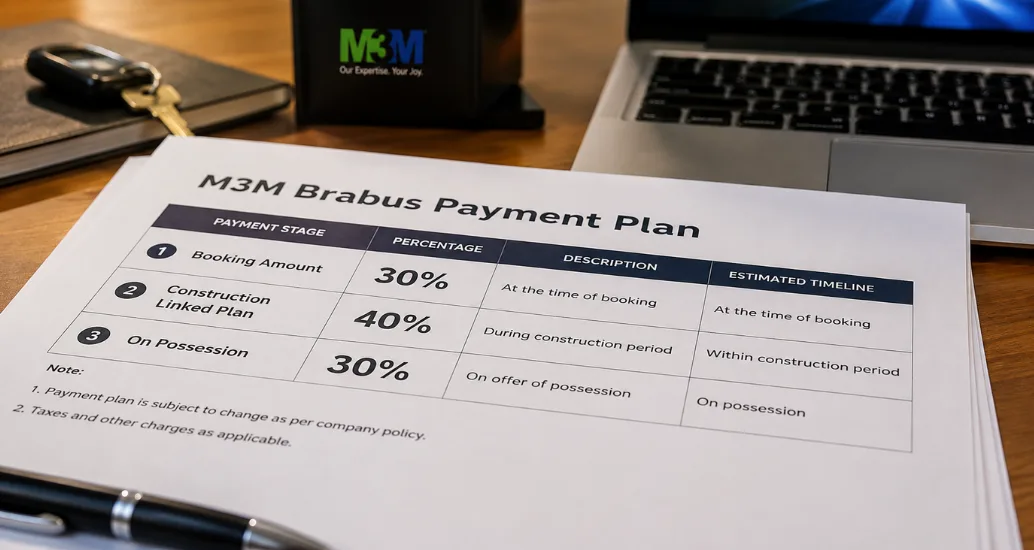
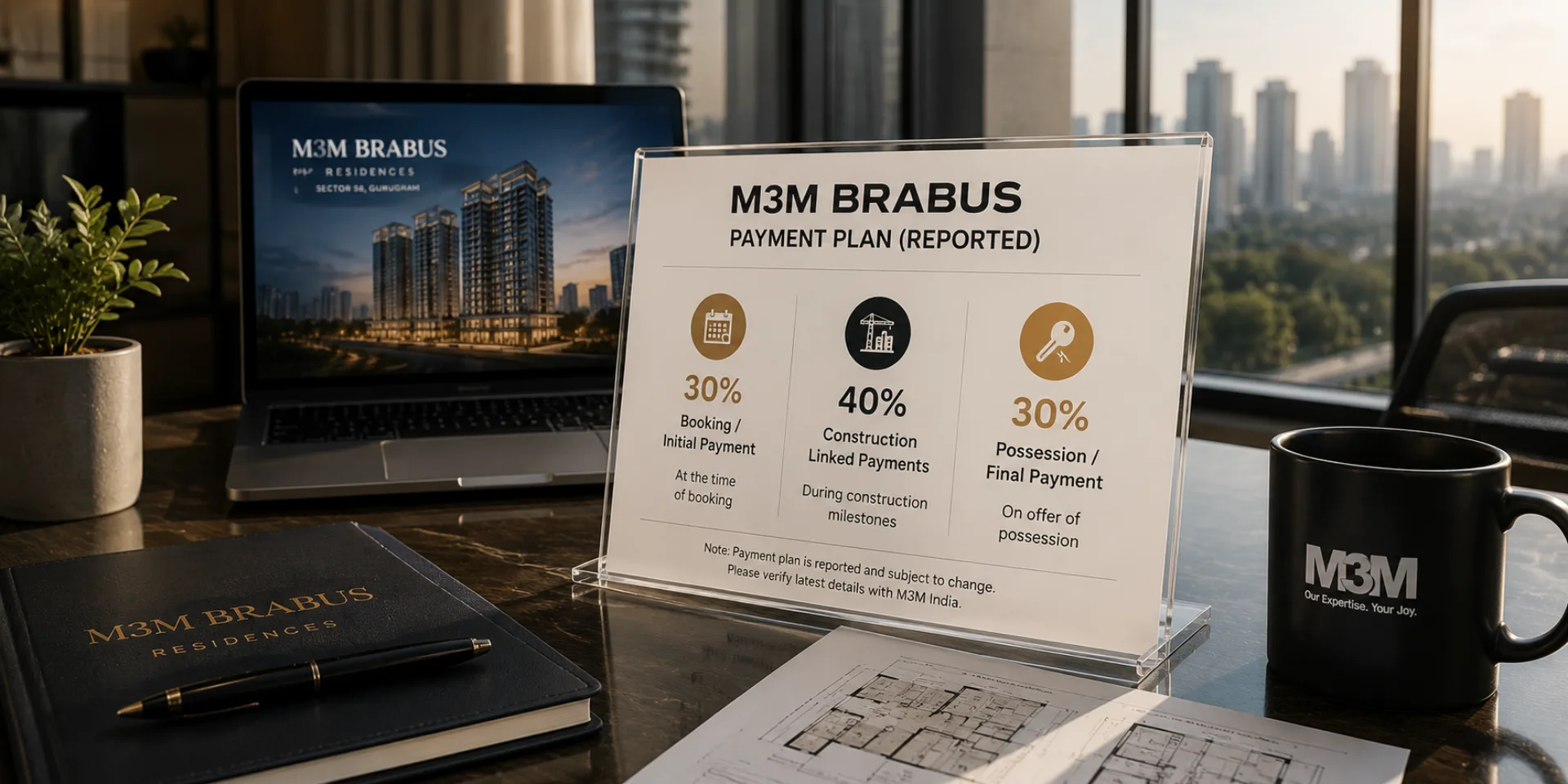
- Reported/indicative structure: A 30:40:30 construction-linked plan is quoted across most broker and listing sites
- EOI: Widely reported at ₹51 lakh (unofficial, subject to change)
- RERA status: Most sources describe registration as "applied," "pending" or "coming soon"; one listing quotes a specific registration number, but it appears alongside a conflicting location detail and should not be relied on
- Price: Reported figures range roughly from ₹20 crore to ₹31.5 crore depending on configuration and source — treat as indicative only
- Possession: Reported timelines range from 2028 to as late as 2033 across sources — unconfirmed
- Caution: Do not pay any amount, including EOI, without checking the current cost sheet and RERA status directly with the developer
What Is the M3M Brabus Payment Plan?
A payment plan is simply the schedule that tells a buyer when to pay what. For a project like M3M Brabus, that usually breaks into three broad stages: an amount at booking, a series of amounts tied to construction progress, and a final amount at possession.
The exact percentages, the milestones that trigger each payment, and the total amount payable all depend on the plan the developer has actually filed and issued. Until M3M India releases that document, any percentage split you see online is a market estimate, not a contractual term.
This is where buyers get into trouble. A sales executive on a call will often describe a plan verbally, and it sounds concrete because it's specific. But a verbal description carries no weight unless it matches the cost sheet and the builder-buyer agreement. Always ask for the plan in writing before treating any number as real.
Is the M3M Brabus Payment Plan Officially Confirmed?
No, not as of this writing. Here's how the information breaks down:
Officially confirmed: The project's location in Sector 58 on Golf Course Extension Road, the developer (M3M India), and the branded-residence partnership with BRABUS.
Reported/market information: A 30:40:30 construction-linked payment plan, an EOI figure around ₹51 lakh, and price ranges spanning ₹20–31.5 crore.
Indicative: Unit sizes, tower count, total number of units (broker pages disagree, citing anywhere from 240 to roughly 800 units), and possession timelines.
Still awaited: A finalised, developer-issued cost sheet; RERA registration number; and an official payment schedule.
Multiple independent broker sites do converge on 30:40:30, which suggests it reflects genuine sales-desk guidance. But convergence among third parties is still not the same as an official document. Treat it as the plan buyers are currently being told about, not the plan that's contractually binding.
M3M Brabus 30:40:30 Payment Plan — Explained
If M3M India does finalise something close to the reported structure, here's how a standard 30:40:30 construction-linked plan typically works in the Gurgaon luxury segment.
30% — Booking / Initial Payment. This covers the EOI or booking amount, followed by the balance due on signing the allotment letter or builder-buyer agreement. It's the largest single upfront commitment most buyers make.
40% — Construction-Linked Payments. This portion is usually split across several milestones — foundation, plinth, each slab, brickwork, and so on. Each milestone triggers a demand notice from the developer, and the buyer pays within a set window.
30% — Possession / Final Stage. The remaining balance, along with possession-linked charges, is typically due close to or at the time the developer offers possession.
Again: this is the standard shape of a 30:40:30 plan in this market, not M3M Brabus's confirmed schedule. Buyers should ask the sales team to show this structure printed on an official cost sheet with M3M India's letterhead before assuming it applies to their unit.
Numerical Payment Example
Here's an illustrative example only, using a round indicative value that sits within the reported price range.
If a unit is valued at ₹20 crore under a 30:40:30 structure:
- 30% at booking = ₹6 crore
- 40% during construction = ₹8 crore
- 30% at possession = ₹6 crore
This is an illustrative example only — not an official M3M Brabus payment schedule. Your actual payable amount will differ based on unit size, floor, PLC (preferential location charge), GST, EDC/IDC, and other charges layered on top of the base price. Two buyers on the same floor plan can end up with different total costs depending on tower, floor and view.
EOI and the Payment Plan
What is EOI? An Expression of Interest is a token amount collected before a project formally launches, to gauge and register buyer demand.
Why do developers collect it? It helps them size demand, plan inventory release, and build a priority list before prices and floor plans are finalised.
What does EOI mean for a buyer? It signals intent, not ownership. It generally does not lock in a price, a specific unit, or a floor.
Is EOI the same as booking? No. Booking usually follows project launch, involves a larger amount, and is tied to a specific unit and an allotment letter. EOI comes earlier and is more preliminary.
Is EOI refundable? This must be confirmed in writing from the developer. Refund terms vary by project and are not something to assume based on a verbal promise.
What should the EOI document state? The exact amount paid, whether it's adjustable against the final price, refund conditions, and what happens if the launch terms differ from what was discussed when the EOI was collected.
Does EOI guarantee a unit, floor, or price? Generally, no — unless the document explicitly says so. Treat any verbal assurance about a "locked" price or floor with caution until it's in writing.
Booking Amount vs EOI vs Actual Payment
These terms get used loosely, but they mean different things:
- EOI: A small token amount paid pre-launch to register interest.
- Booking Amount: A larger sum paid after launch, tied to a specific unit, usually accompanied by an allotment letter.
- Agreement-Linked Payment: Amount due on execution of the builder-buyer agreement.
- Construction-Linked Payment: Amounts due as construction hits defined milestones.
- Possession Payment: The final balance, paid closer to handover, often alongside possession-related charges.
Construction-Linked Plan vs Down Payment Plan
Construction Linked Plan (CLP): Payments are spread across construction milestones. This reduces upfront cash burden and links your payment to visible progress, but it also means your total exposure grows only as the project advances — useful if you want to track delivery before committing more capital. The risk is that if construction stalls, so does clarity on when you'll pay next, and financing costs can add up over a longer payment window.
Down Payment Plan (DP): A larger share is paid upfront, often in exchange for a price discount. This can reduce the total acquisition cost and simplify the payment timeline, but it also means committing more capital early, with less linkage to actual construction progress — a bigger bet on the developer's execution.
Neither is universally better. The right choice depends on your liquidity, whether you're financing the purchase, how far along construction actually is, the size of any discount on offer, your risk tolerance, and your exit plan for the asset.
M3M Brabus Payment Plan and Cash Flow
Initial cash requirement: EOI plus the booking-stage payment, often the single largest lump sum in the entire schedule.
Construction-period requirement: A series of milestone payments spread over the build timeline — irregular in timing, so plan for demand notices to arrive at variable intervals.
Final payment requirement: The possession-linked balance, plus charges that typically only become due at handover (stamp duty, registration, some society/maintenance deposits).
Additional charges: These sit outside the base price and can meaningfully change your total cash outlay — covered in detail below.
The mistake many buyers make is calculating affordability only against the base selling price (BSP). The real number to plan around is total cash exposure across the entire timeline, including everything below.
Additional / Hidden Charges
- GST: Applicable on under-construction property as per current government rates
- PLC (Preferential Location Charge): May apply for specific floors, corner units, or park/view-facing units
- EDC/IDC (External and Internal Development Charges): Government-linked development charges that may apply
- Floor-rise charges: May apply on higher floors
- Club charges: One-time membership fee for clubhouse/amenities, where applicable
- IFMS (Interest-Free Maintenance Security): A deposit collected toward future maintenance
- Parking charges: Often charged separately per parking slot
- Stamp duty and registration: Government charges payable at the time of registration
- Legal/documentation charges: May apply for agreement drafting and processing
By timing, these generally fall into:
- One-time: Club charges, PLC, floor rise
- Construction-linked: GST, spread across milestone payments
- Government-related: Stamp duty, registration, EDC/IDC
- Possession-related: IFMS, parking, possession-linked maintenance deposits
- Recurring: Ongoing maintenance once you take possession
Total Cost Calculation
The base price you see quoted is not your final acquisition cost. A simple framework:
Base property value + applicable PLC + applicable floor-rise charges + applicable EDC/IDC + GST + government charges (stamp duty, registration) + other applicable charges (club, IFMS, parking) = Estimated total acquisition cost
Do not fabricate or assume exact figures for any of these — request an itemised cost sheet from the developer or authorised channel partner and run the calculation against real numbers before committing.
Payment Plan for Investors
- How much capital gets locked in, and for how long, given uncertain possession timelines currently ranging across sources from 2028 to 2033
- Construction risk — a pre-launch project carries more execution uncertainty than a nearly-complete one
- Market-cycle risk over a multi-year holding period
- Opportunity cost of capital tied up versus other investment options
- Resale considerations, including how easily a pre-possession unit can be transferred and what charges apply
Payment Plan for End Users
- Family buyers need to plan the multi-year payment schedule against school terms, job stability and other long-term commitments.
- HNI buyers may have more flexibility but should still verify whether a down-payment discount makes sense against opportunity cost.
- Buyers upgrading from an existing property need to sequence the sale of their current home against the payment demands of this one — a mismatch here is one of the most common cash-flow problems in Gurgaon's luxury segment.
- Buyers using financing should confirm loan disbursement timing matches milestone demands before signing anything.
Pre-Launch Payment Risks
- RERA status: Under Haryana's RERA rules, a project generally cannot be marketed or legally accept booking amounts until it is registered. Most current sources describe M3M Brabus's RERA status as applied, pending, or "coming soon" — confirm the live status before paying anything beyond an EOI, and even then, ask what legal basis the EOI itself is being collected under.
- Changing price and payment plan: Figures quoted at pre-launch stage can shift once the project formally launches.
- Changing unit allocation: A unit informally "held" against your EOI is not the same as a confirmed allotment.
- Refund clauses: Don't assume EOI or booking amounts are refundable without seeing it in writing.
- Documentation risk: Broker pages sometimes contain inconsistent details — for example, mismatched sector numbers or unit counts across different pages for the same project — which is a sign the source may be reusing template content rather than verified project data.
- Broker-created urgency: Phrases like "early-bird pricing closes once the project formally launches" or "limited inventory" are sales tactics. They may or may not reflect real scarcity — there's no way to verify this from outside the sales office.
Who Should Consider It?
- End users who want a long-term home and can absorb a multi-year construction timeline and cash-flow schedule.
- Long-term investors comfortable with pre-launch execution risk in exchange for potential early-stage pricing, and who aren't relying on a fixed exit date.
- High-liquidity buyers who can meet a large upfront percentage without financing.
- Buyers using financing should proceed only once RERA status and documentation are clear enough for a lender to disburse against milestones.
- Short-term investors looking for a quick flip should weigh pre-launch uncertainty carefully — resale before possession on an unregistered or newly registered project can carry its own documentation complications.
FAQ Section
What is the M3M Brabus payment plan?
It's the staged schedule buyers pay against — typically booking, construction-linked instalments, and a possession payment. M3M India has not officially published a final schedule yet; most figures online are reported or indicative, not confirmed.
Is the M3M Brabus 30:40:30 payment plan official?
Not officially confirmed by the developer as of this writing. It's widely reported across broker and listing sites, which suggests it reflects current sales-desk guidance, but buyers should get it in writing before relying on it.
What is the M3M Brabus EOI amount?
Multiple independent sources report an EOI of around ₹51 lakh. This is unofficial and should be reconfirmed directly with the developer or an authorised channel partner before payment.
What is the difference between CLP and DP?
CLP spreads payments across construction progress; a Down Payment (DP) plan front-loads a larger share upfront, often for a price discount. Suitability depends on liquidity and risk tolerance.
When is possession expected?
Reported timelines vary widely across sources, from around 2028 to as late as 2033. Treat any possession date as unconfirmed until it appears on a RERA certificate.
 Sumit Mishra / Property Counselor
You Must Read:
 Residential