


arrow_backBack to Blog
Finance
Residential vs Commercial Property for Rental Income
Ask ten property owners whether residential or commercial real estate gives better rental income, and you'll get ten different answers — because the honest answer depends on the specific property, not the category. This article breaks down how rental income actually works for both, how to calculate what you'll really earn (not just the advertised rent), and how to compare two very different properties on equal footing.
Residential vs Commercial Property for Rental Income: What Is the Difference?
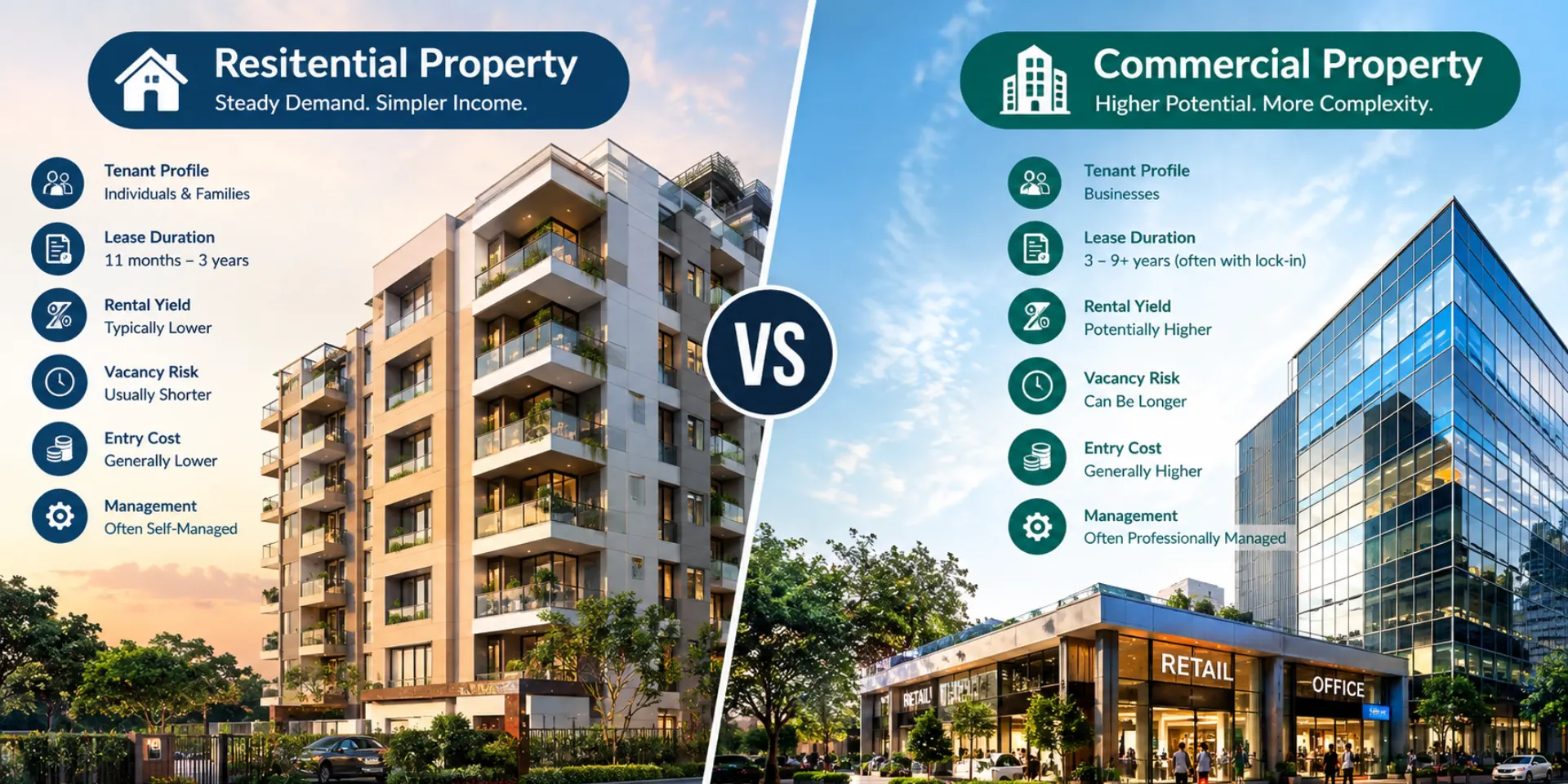
Residential property usually means lower entry cost, broader tenant demand, and simpler month-to-month economics — but often a lower gross yield. Commercial property usually means a higher potential yield and longer, more structured leases — but with fewer prospective tenants, longer vacancy stretches when a lease ends, and income concentrated in one tenant's business health. These are tendencies, not rules — plenty of residential units outperform commercial ones, and vice versa, depending on location and pricing.
How Does Residential Property Generate Rental Income?
A residential property earns income from one source: monthly rent paid by an individual or family occupying the unit.
- Tenant pool: Families, working professionals, students — a large and fairly liquid pool in most cities.
- Lease length: Typically 11 months to 3 years, renewed periodically.
- Rent revision: Usually negotiated at renewal rather than fixed in advance.
- Vacancy: Generally shorter, since demand is broad.
- Costs: Maintenance, society charges, occasional repairs — usually predictable and modest.
- Management: Most owners handle this themselves without hiring a property manager.
How Does Commercial Property Generate Rental Income?
A commercial property — office, retail, or showroom space — earns income by leasing to a business.
- Tenant pool: Businesses, not individuals — smaller pool, but often more formal tenancies.
- Lease length: Often 3–9 years, frequently with a lock-in period where neither side can exit early without penalty.
- Rent revision: Commonly written into the lease upfront as a fixed escalation (e.g., a set percentage increase every few years).
- Security deposit: Usually higher than residential.
- Vacancy: Can stretch longer, since finding the right business tenant takes more time than finding a residential one.
- Costs: CAM (common area maintenance) charges and operating costs are often part of the lease structure.
- Management: More commonly professionally managed, given the complexity of commercial leases.
Residential vs Commercial Rental Income — Key Differences
| Factor | Residential | Commercial |
| Rental structure | Simple monthly rent | Structured lease with escalation clauses |
| Tenant profile | Individuals/families | Businesses |
| Lease duration | Short-medium (11 months–3 years) | Long (3–9+ years), often with lock-in |
| Rental demand | Broad | Narrower, tied to business activity |
| Vacancy risk | Usually shorter | Can be longer |
| Rent escalation | Negotiated at renewal | Often contractual |
| Security deposit | Lower | Higher |
| Operating costs | Lower, predictable | Can include CAM, higher |
| Rental yield | Often moderate | Can be higher, not guaranteed |
| Income stability | Broader tenant base cushions risk | Concentrated in one tenant |
| Management need | Often self-managed | Often professionally managed |
| Entry cost | Generally lower | Generally higher |
| Liquidity | Usually easier to re-let/sell | Can be slower |
Rental Yield vs Total Return — Not the Same Thing
This distinction matters because people often use "return" and "yield" interchangeably, and they're not.
Rental yield only measures the annual rent as a percentage of what you paid for the property. It says nothing about whether the property is gaining or losing value.
Total return adds property appreciation (or depreciation) and subtracts costs — it's the full picture of what an investment actually earned you over a holding period.
A property with a modest 3% rental yield but strong price appreciation could still deliver a solid total return. Conversely, a property with a 7% yield in a stagnant or declining market may underperform on total return. This article is focused specifically on rental income and yield — appreciation is a separate, larger topic — but it's worth knowing that yield alone doesn't tell you whether a property was a good investment overall.
Should Rental Yield Be Calculated on Purchase Price or Total Acquisition Cost?
The formula most people use — rent divided by purchase price — understates the real cost of buying, which inflates the yield on paper.
Total acquisition cost typically includes:
- Base property price
- Stamp duty and registration charges
- Brokerage
- Initial furnishing or interiors (for residential)
- Fit-out costs, where the owner bears them (for commercial)
- Any other one-time costs of acquiring the property
Headline yield (using only the base price) will always look better than effective yield (using total acquisition cost). For a fair comparison — especially between two different properties — calculate yield both ways, but treat the effective yield as the more honest number.
How to Calculate Rental Yield
Gross Rental Yield = (Annual Rental Income ÷ Purchase Price) × 100
Net Rental Yield = [(Annual Rental Income − Annual Operating Costs) ÷ Purchase Price] × 100
To calculate this for an actual property:
- Confirm the purchase price (and, ideally, total acquisition cost).
- Get realistic monthly rent from current, comparable listings in the same micro-market — not an assumed or aspirational figure.
- Annualize the rent (monthly × 12).
- Calculate gross yield.
- List recurring costs — maintenance, management fees, applicable charges.
- Build in a realistic vacancy assumption based on how that property type typically performs in that location.
- Subtract costs and vacancy loss from gross income to get net income.
- Calculate net yield using that net income.
Skipping steps 5–7 is the most common mistake — it's what makes a property look far more profitable than it actually is.
Comparing Properties of Different Sizes and Prices: Rent per Sq Ft
Comparing a ₹1.5 crore residential unit against a ₹2.5 crore commercial unit by rent amount alone isn't a fair comparison — the two properties differ in size, so rent needs to be normalized.
Monthly Rent per Sq Ft = Monthly Rent ÷ Rentable/Leasable Area
This lets you compare properties of different sizes on the same basis, and it's especially useful in commercial real estate, where rent is usually quoted per square foot to begin with. Treat this only as a calculation method — actual per-sq-ft rent figures vary widely by location and should come from current listings, not generic benchmarks.
What Costs Reduce Rental Income?
Monthly rent on paper is not the same as the income you actually receive. Common deductions include:
Gross Rental Income
minus
- Vacancy periods
- Maintenance and repairs
- Property management fees
- Applicable ownership costs (society charges, CAM, insurance)
equals
Net Rental Income
For commercial property, CAM and shared operating costs often matter more than in residential, depending on how the lease splits these charges between landlord and tenant. This article doesn't cover tax treatment — rules vary and change, so check with a tax professional for current guidance.
Vacancy, Rent-Free Periods, and Fit-Out: Why Advertised Rent ≠ First-Year Income
This is where a lot of rental-income estimates go wrong, particularly for commercial property.
Advertised annual rent assumes the unit is occupied and paying rent for all 12 months. In practice, a property can sit vacant between tenants, and even once a new tenant is signed, commercial leases often include a rent-free period or fit-out period — time the tenant needs to set up the space before opening for business, during which little or no rent is collected.
So the real formula looks more like:
Effective First-Year Rental Income = Advertised Annual Rent − (Vacancy Period + Rent-Free/Fit-Out Period, converted to lost rent)
For residential property, this gap is usually smaller — tenants move in and start paying almost immediately. For commercial property, a 1–3 month rent-free period isn't unusual, and this alone can shift the real first-year yield meaningfully lower than the headline number suggests.
How Tenant Default Affects Rental Income
Beyond vacancy, there's the separate risk of a tenant simply not paying on time, or at all.
Rent collection: Residential tenants typically pay smaller amounts, so a missed payment has a smaller absolute impact, but can still disrupt cash flow.
Delayed payment or default: Commercial tenants pay larger sums, so a default has a bigger financial impact — and if the tenant's business fails, income can stop entirely mid-lease.
Security deposit: Acts as a partial cushion in both cases, though it rarely covers a full lease term of lost rent.
Lease enforcement: Recovering a defaulting tenant's dues, or evicting them, can be a slow legal process regardless of property type — this is a genuine income risk, not just a theoretical one.
How Lease Terms and Rent Escalation Affect Income
Residential: Rent is usually revised at renewal, informally, based on what the market is paying at that time. Security deposits are lower and fairly standardized.
Commercial: Escalation is often written into the lease from day one — for example, a fixed percentage increase every 2–3 years — giving more predictable long-term income, but less flexibility to adjust rent if the market moves faster than the escalation clause.
Both structures vary by individual agreement — always check the actual lease terms rather than assuming a standard structure.
What Factors Determine Rental Income?
Every factor here ties back to one question: does it change what rent you can charge, or how reliably you collect it?
- Location: Proximity to employment hubs (residential) or business districts and footfall (commercial) drives achievable rent.
- Micro-market demand: Local supply-demand balance affects both rent and vacancy.
- Tenant profile: Affects reliability and turnover.
- Property size and layout: Affects rent per sq ft and the pool of interested tenants.
- Connectivity and parking: Tenant convenience factors that support higher rent.
- Building quality: Better-maintained buildings typically command higher rent and lower vacancy.
- Amenities: Relevant only where they influence tenant demand or retention (security, power backup, lifts) — not as a general feature list.
- Purchase price: Determines yield for any given rent level.
- Lease structure and operating costs: Directly shape net income, as covered above.
Residential vs Commercial Property: Rental Income Risks
Residential: Tenant turnover, short vacancy gaps, ongoing maintenance, and rent-collection friction with informal agreements.
Commercial: Tenant concentration (one tenant is often 100% of your income), business-cycle exposure, longer vacancy after a lease ends, and dependency on a single lease's terms for years at a stretch.
Neither is inherently "safer" — a well-let commercial property with a stable, long-term tenant can be more predictable than a residential unit with high tenant churn.
Liquidity and Exit Considerations
If you plan to sell or re-let eventually, these factors matter:
- A stable, creditworthy tenant on a long lease can make a commercial property more attractive to a future buyer — or less, if that buyer wants to occupy it themselves.
- A vacant property is harder to value quickly and may narrow your buyer pool.
- Broad-demand residential units are generally easier to re-let or sell than a niche commercial space.
- An overpriced property, regardless of type, will always face a slower exit.
Illustrative Scenario: Comparing Two Properties Side by Side
| Residential | Commercial | |
| Purchase price | ₹1,00,00,000 | ₹2,00,00,000 |
| Monthly rent | ₹35,000 | ₹1,25,000 |
| Annual gross rent | ₹4,20,000 | ₹15,00,000 |
| Gross yield | 4.2% | 7.5% |
| Assumed annual vacancy | 1 month | 2 months (incl. fit-out) |
| Effective annual rent collected | ₹3,85,000 | ₹12,50,000 |
| Annual operating costs | ₹60,000 | ₹1,50,000 |
| Net rental income | ₹3,25,000 | ₹11,00,000 |
| Net yield | 3.25% | 5.5% |
Even here, where the commercial unit shows a higher net yield, notice how much ground is lost between the gross yield (7.5%) and the net yield (5.5%) once vacancy and costs are factored in — a bigger drop than the residential example. This is the core point: a higher headline rent or yield doesn't automatically mean a proportionally higher net return. Always run both numbers before comparing two properties.
How Should Buyers Compare the Two?
Compare actual properties against each other using:
- Purchase price (and total acquisition cost)
- Realistic rent, based on verified comparable listings
- Gross and net rental yield
- Realistic vacancy assumptions, including rent-free/fit-out periods
- Operating costs
- Lease structure — duration, escalation, lock-in
- Tenant demand for that specific property type and location
- Liquidity and exit ease
- Your intended holding period
- Comfort with tenant-concentration risk
- Willingness to manage the property yourself vs. hire management
Who May Prefer Each Option
Residential often suits buyers who want broader tenant demand, simpler lease management, and a lower entry price point.
Commercial often suits buyers comfortable with a higher entry cost and longer vacancy risk, in exchange for potentially higher yield and longer, more structured leases.
These are tendencies based on how each category typically behaves — not guarantees for any specific property.
Conclusion
Residential and commercial properties generate rental income through fundamentally different mechanics — different tenants, lease structures, vacancy patterns, and cost profiles. Neither is the universally better choice. What actually determines your return is the specific property's purchase price, realistic achievable rent, true vacancy experience (including any rent-free periods), operating costs, and lease terms.
The most reliable way to choose isn't to pick a category first — it's to run the same calculation on specific properties in both categories: effective net yield, based on verified current rent and actual costs, not advertised numbers. That comparison is what tells you which property actually makes financial sense for you.
Frequently Asked Questions
Is commercial property better for rental income?
Not universally. It can offer higher yields in some markets, but with higher entry costs, longer vacancy risk, and tenant concentration.
Is residential property good for rental income?
Yes, for many buyers — particularly those who value broader tenant demand and simpler management, even if yields are often more moderate.
How is rental yield calculated?
Gross yield = (Annual Rent ÷ Purchase Price) × 100. Net yield subtracts costs and vacancy before applying the same formula.
What is the difference between rental yield and total property return?
Yield measures only rental income against price. Total return adds appreciation and subtracts all costs — a fuller picture of investment performance.
How does tenant default affect rental income?
It disrupts cash flow and, in commercial leases, can mean a larger absolute loss since commercial rents are typically higher per tenant.
 Sumit Mishra / Property Counselor
You Must Read:
 New Launch