

arrow_backBack to Blog
Other
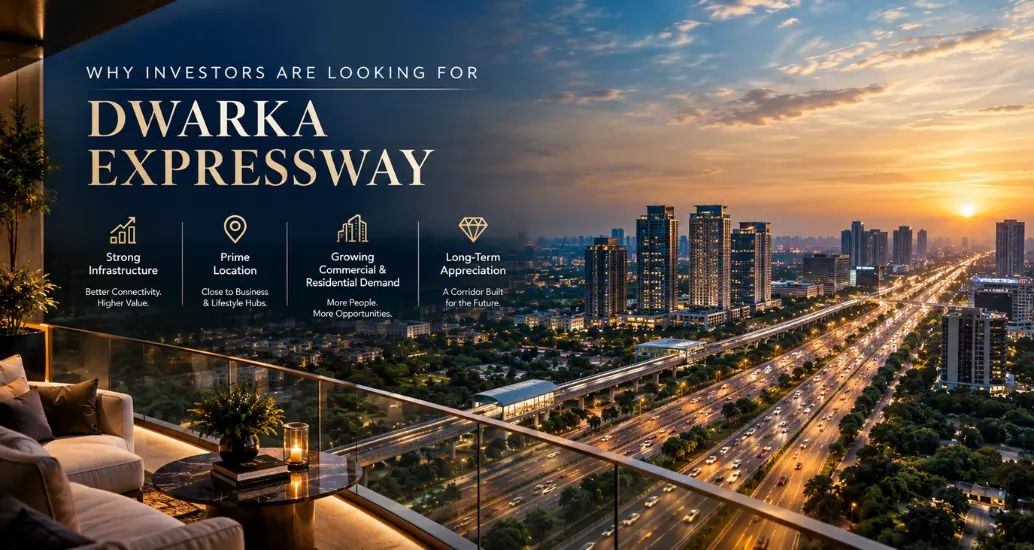
Why Investors Are Looking at Dwarka Expressway
Investors are watching Dwarka Expressway because the corridor has stopped being a promise and started being a place people actually live and work in. The Haryana stretch of the expressway opened in March 2024, after being stuck in planning and land disputes since 2006. That single change unlocked a wave of residential launches, pulled established developers into the area, and gave the Haryana government's Global City project a real timeline instead of just a map. But prices here have also climbed sharply over the last few years, so the real question for anyone looking at this market in September 2026 isn't just "why is everyone talking about it" — it's whether the good news is already baked into current asking prices, and what still needs to be checked before writing a cheque.
What Changed on Dwarka Expressway
For close to two decades, Dwarka Expressway was the project everyone in Gurugram real estate mentioned with a slight shrug — always coming, never quite here. That changed on March 11, 2024, when Prime Minister Narendra Modi inaugurated the 19-km Haryana section of the road. The Delhi-side section took a bit longer, and travel between the two states along this stretch has only become fully smooth over the following year or so.
The road itself is not a small project. It's an eight-lane expressway, built with sections running on a single pier to save land, and it includes India's first four-level interchange along with an eight-lane tunnel section. The Ministry of Road Transport and Highways has publicly defended its higher-than-usual per-kilometre cost, pointing out that projects with this much tunnelling, bridge work and elevated construction simply cost more than a flat highway.
None of this guarantees anything about future property prices. What it does mean is that a lot of the "if this road ever gets built" uncertainty that kept this corridor cheap for years is gone. That's the actual shift, and it's worth being precise about it instead of just saying connectivity has "improved."
Why Investors Are Looking at This Now
A few different things lined up close together, and it's the combination that matters more than any one factor on its own.
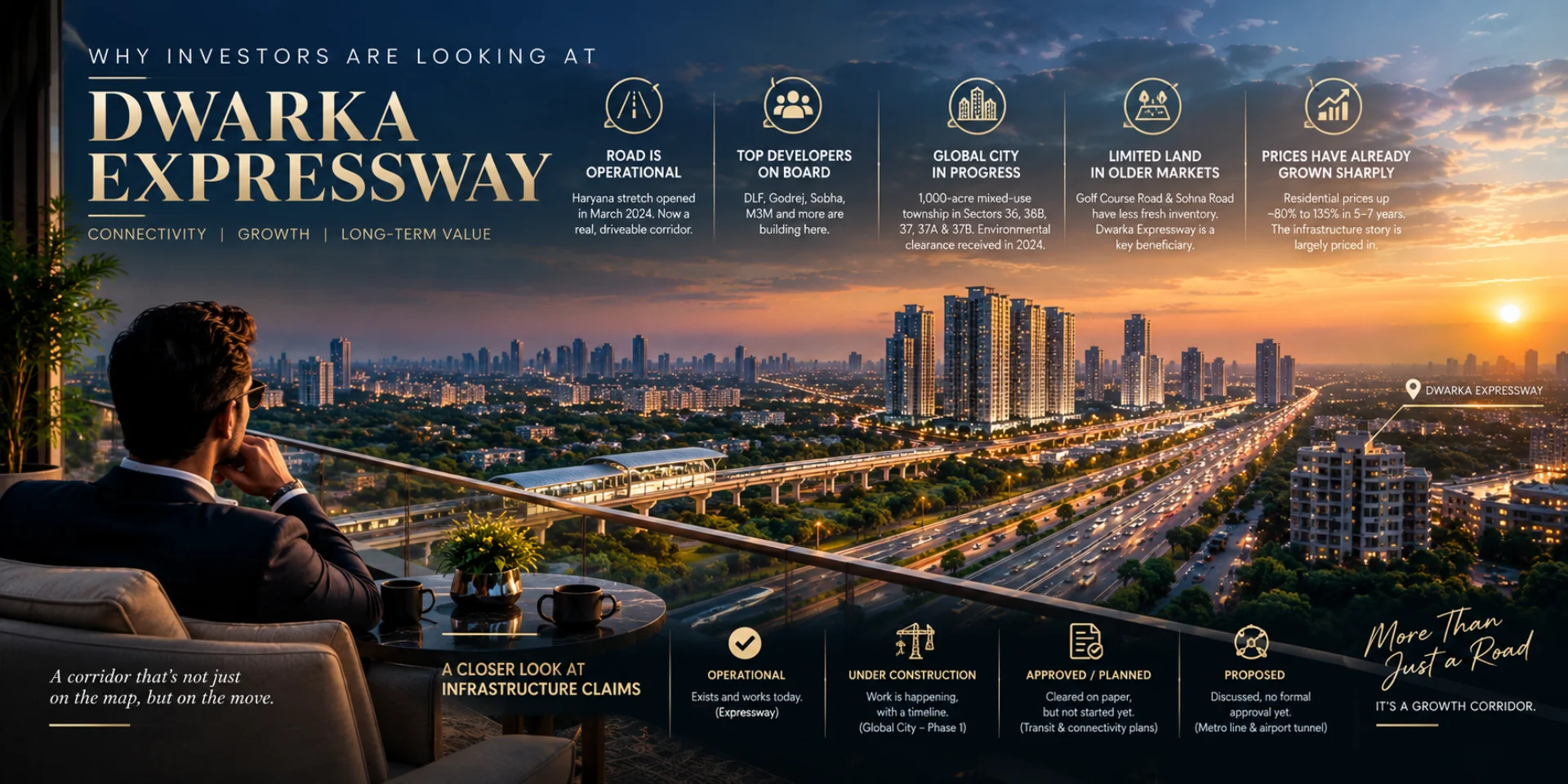
The road is operational, not proposed. Buyers can drive it today. That's a very different pitch than "connectivity is coming in a few years."
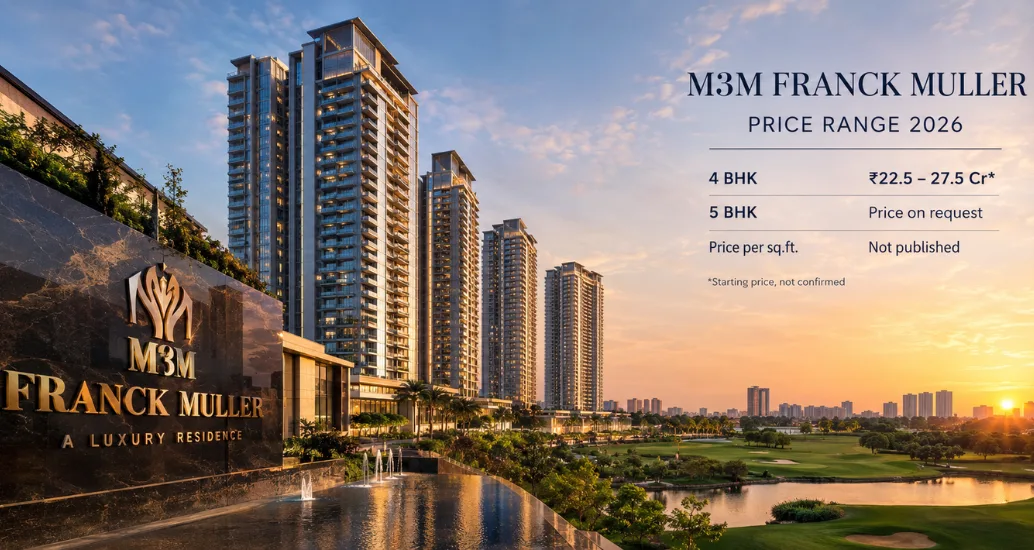
Established developers moved in. Names like DLF, Godrej Properties, Sobha and M3M, among others, now have projects along this stretch. A few years ago, this corridor was mostly smaller, lesser-known builders. That shift changes how seriously institutional and HNI buyers treat the location.
Global City is under construction, not just announced. The Haryana government's mixed-use township project — spread across roughly 1,000 acres in sectors 36, 36B, 37, 37A and 37B — received environmental clearance in mid-2024, and its first phase has moved well past the drawing-board stage.
Older Gurugram markets are running out of land. Golf Course Road and Sohna Road have limited fresh inventory left. New large-format launches are increasingly happening further out, and Dwarka Expressway is one of the main beneficiaries of that shift.
And here's the part that gets skipped in a lot of write-ups: prices have already moved a great deal. Depending on which market tracker you look at, residential prices along this corridor have gone up anywhere between roughly 80% and 135% over the past five to seven years, with a noticeably sharp jump in late 2024 into 2025. That's not a small number. It means an investor buying today is not getting in at the same risk-reward as someone who bought in 2019 or even 2021. The infrastructure story that used to be the main reason to buy here is now largely known and, to a real extent, already reflected in what sellers are asking.
That doesn't mean the opportunity is gone. It means the basis for buying has to shift — from "this area will eventually get infrastructure" to "is this specific project, at this specific price, a sound decision on its own terms."
A Simple Way to Judge Any Infrastructure Claim Here
One habit worth building before looking at any project brochure: sort every infrastructure claim into one of four buckets.
Operational — it exists and works today. The Haryana section of the expressway itself falls here.
Under construction — work is visibly happening, with a stated timeline. Global City's first phase sits here as of the latest available updates.
Approved or planned — cleared on paper, but construction hasn't meaningfully started. Several transit and connectivity proposals for the wider corridor fall into this category.
Proposed — discussed, sometimes even mapped, but with no formal approval yet. A metro line along the expressway has been suggested by Delhi Metro Rail Corporation but is still awaiting approval from the Haryana Government, and a planned tunnel connecting to Terminal 3 at IGI Airport also falls in this bucket.
Marketing material tends to blur these four categories into one confident sentence. A careful buyer doesn't let it.
Proximity to IGI Airport — What It Actually Means
Distance to the airport genuinely matters to a specific slice of buyers — people who fly often for work, senior corporate hires, and a fair number of NRI buyers who value quick airport access when they're in town for short visits. The Delhi end of the expressway sits reasonably close to Mahipalpur and the airport's approach roads.
A direct tunnel link to Terminal 3 has been discussed as part of the project's later packages. It's a good story, and it may well add value eventually. But as of today, it belongs in the "planned" bucket, not the "operational" one, and it shouldn't be priced into a purchase decision as if it already exists.
Residential Development Along the Corridor
Sector numbers you'll come across most often include 83, 84, 88, and the long stretch from 99 through 113, along with the newer 36-37 series tied to Global City. These aren't interchangeable. Some sectors sit closer to functioning road access points today; others, particularly around Global City, will depend heavily on how quickly that township actually gets built out.
A large share of Gurugram's total new housing supply over the past few years has come from this corridor — at one point accounting for well over a third of all new launches in the city in a single year. That's a lot of new stock entering the market at roughly the same time, which is worth remembering when you hear that a particular project is in high demand. High demand and high supply can exist in the same sector at once, and the second one tends not to get mentioned in sales pitches.
Rental demand has picked up too, driven mostly by professionals working in Gurugram's expanding office belt rather than by tourists or short-term renters. Rents for a standard 2 BHK apartment in the area have risen noticeably over the past few years, though rental growth and capital appreciation don't always move at the same pace — a unit can appreciate well in resale value while offering a fairly ordinary rental yield relative to its purchase price.
Who Is Actually Buying Here
The buyer mix on this corridor isn't one type of person. End users are relocating here for newer construction and more space than older parts of Gurugram or Delhi can offer. Mid-term investors are buying under-construction units, betting that the completion story keeps playing out. Rental-focused buyers are targeting sectors where occupancy is already established rather than sectors that are still mostly cranes and scaffolding. HNI and NRI buyers tend to lean toward larger configurations in branded projects, partly for lifestyle reasons and partly because bigger units from known developers usually resell faster later.
Knowing which of these you are changes almost every decision that follows — which sector, which developer, whether possession timeline matters more than entry price, and how much weight to put on rental numbers versus resale potential.
What Property Actually Costs Here Right Now
There isn't one single number for "the price of property on Dwarka Expressway," and any article that gives you one flat figure is oversimplifying. Portal listing prices, developer launch prices, resale asking prices and registered transaction values are four different things, and they don't move in lockstep.
What's fair to say, based on how multiple independent market trackers have reported this corridor: average residential prices have roughly doubled to more than doubled over the past five to seven years, with the steepest single jump happening around late 2024 into early 2025. Current asking prices for new launches and resale apartments vary widely — often by several thousand rupees per square foot — depending on the sector, the developer's brand, and how far along construction actually is.
The practical takeaway is not the headline percentage. It's that entry price now matters more than it did five years ago, because the easy, early-mover advantage has largely already played out. Two projects a few sectors apart can carry very different price tags for reasons that have nothing to do with the underlying road, and paying a premium for brand or finish should be a deliberate choice, not something you back into by assuming every project "on Dwarka Expressway" is priced the same way.
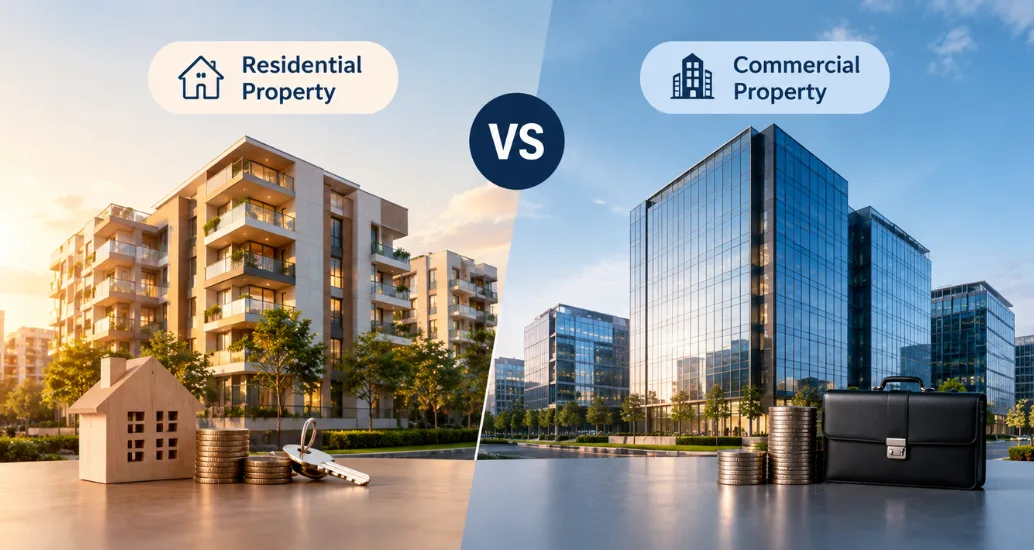
Residential vs Commercial — Different Games Entirely
Residential property here rises and falls with end-user demand, actual occupancy once a project is delivered, rental interest from the local job market, and how easily a unit resells — which tends to be stronger for projects from developers with a real delivery track record.
Commercial property depends on a different set of things: whether tenants are actually leasing space (not just whether a building looks impressive), how tight the catchment area is, current vacancy in comparable buildings nearby, and how well a developer handles ongoing maintenance once the building is occupied. Much of the large-scale commercial space planned for this corridor, particularly through Global City, is still being built. There's a real difference between "commercial development is planned nearby" and "commercial tenants are already active nearby," and that gap should factor directly into how a commercial buyer prices risk.
A Basic Framework for Evaluating Any Project Here
Rather than judging a project by how close it is to the expressway alone, it helps to run it through a short list:
- Location — actual distance and access, not marketing distance.
- Connectivity available today — not what's planned for later.
- RERA registration — confirmed directly with Haryana RERA, not just claimed in a brochure.
- Developer execution history — how their past two or three projects were actually delivered.
- Construction stage — verified progress, not artist impressions.
- Entry price — compared against at least two or three similar projects nearby.
- Rental demand — based on currently occupied inventory in the sector, not future projections.
- Supply pipeline — how many similar projects are launching in the same sector around the same time.
- Exit and liquidity — how actively comparable units have resold recently.
Risks Worth Keeping in Mind
Rising prices don't remove risk — they mostly just change what kind of risk you're taking on.
- Entry prices are higher than they were a few years ago, so the margin for error is smaller.
- A well-located project from a poorly managed developer can still underperform, regardless of the road outside it.
- This corridor has a long history of infrastructure timelines slipping, and individual project timelines can slip the same way.
- Several sectors have seen a large number of units launched close together, which can pressure both rental yields and resale prices if demand doesn't keep pace.
- Capital appreciation and rental yield don't always move together — don't assume one guarantees the other.
- Ready, RERA-compliant projects from established developers typically resell faster than early-stage or lesser-known ones.
- Real estate moves in cycles. A corridor that's appreciated strongly for several years can also slow down, and past performance here is not a promise of future performance.
Is This the Right Market for You?
That depends entirely on what you're trying to do.
A long-term investor who's comfortable holding through construction delays can reasonably track this corridor's progress over several years. An end user gets real, tangible benefits today — newer construction, more space, working road access — regardless of what happens to prices later. A rental-focused buyer should stick to sectors with existing occupied inventory rather than sectors that are still mostly under construction. A luxury or HNI buyer will care more about brand, unit size and amenities than about squeezing out the lowest entry price, but should still check developer execution history regardless of budget. A commercial investor needs to separate planned supply from tenanted supply before assuming any leasing numbers. And an NRI buyer faces the same fundamentals as anyone else, plus the practical work of managing paperwork, power of attorney and repatriation rules from a distance.
The Bottom Line
The case for this corridor is built on things that actually happened — a highway that finally opened, a township project that moved from paperwork to construction, and serious developers choosing to build here instead of smaller names. That's real. What's also real is that prices have already absorbed a good chunk of that story, so the decision now sits more at the level of the individual project than at the level of the corridor as a whole. RERA status, construction progress, developer history, and a fair comparison against nearby alternatives will tell you far more than the fact that a listing mentions Dwarka Expressway in its name.
Frequently Asked Questions
Is Dwarka Expressway a good location for property investment right now?
It depends on the specific project and what you're trying to achieve. The road and surrounding infrastructure are real, but prices have already risen a lot, so the case for buying now rests more on project-level checks than on the location alone.
How does the expressway connect Delhi and Gurugram?
It runs from Shiv Murti near Mahipalpur in Delhi to Kherki Daula in Gurugram, mostly as an elevated, access-controlled road with an eight-lane section and India's first four-level interchange.
Is residential or commercial property the better choice here?
Residential tends to suit end users and buyers who want steadier resale liquidity. Commercial can offer stronger rental yields but depends heavily on actual tenant demand, and a lot of the planned commercial supply in this corridor is still being built.
What is Global City and why does it matter here?
It's a large mixed-use township being developed by the Haryana government across sectors 36, 36B, 37, 37A and 37B, meant to bring residential, commercial and institutional space together in one area. It received environmental clearance in 2024, and its first phase has moved into active construction.
 Sumit Mishra / Property Counselor
You Must Read:
 New Launch